| Author |
 Replies: 54 / Views: 7,132 Replies: 54 / Views: 7,132 |
|
|
|
Pillar Of The Community
Israel
4904 Posts |
|
|
GB issued this stamp in 1999 dedicated to Darwin theory. It combines a Galápagos finch with the fossil of Archaeopteryx. The finch represents Darwin's studies of adaptation and natural selection, while Archaeopteryx, the earliest known bird fossil, symbolizes transitional forms in evolution. By placing the living finch atop the ancient fossil, the design visually links Darwin's observations of species variation with the deep evolutionary history that supports his theory of common descent. 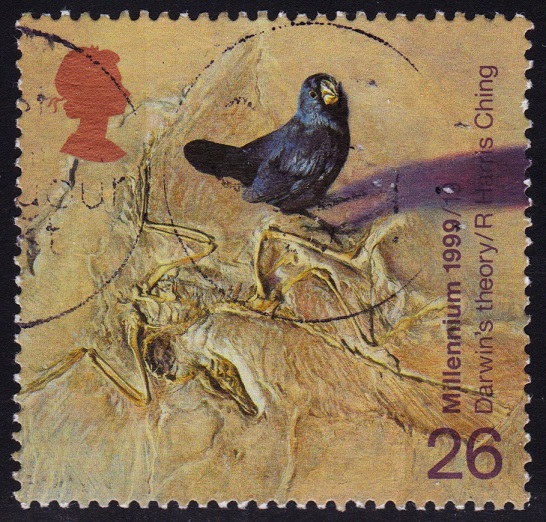 |
Send note to Staff 
|
| Edited by LaoPhil - 09/17/2025 09:25 am |
|
|
Pillar Of The Community
Israel
4904 Posts |
|
|
"The Millennium of Exploration - Charles Darwin", a set contains 17 stamps show the life and the scientific work of Darwin, including species he discovered and researched, Mongolia, 2000. - Darwin portrait - Mollusk – Darwin studied mollusk fossils and living species to support his ideas on gradual evolution and variation. - HMS Beagle - Peacock – Darwin used the peacock's extravagant tail as an example of sexual selection, a mechanism he proposed alongside natural selection. 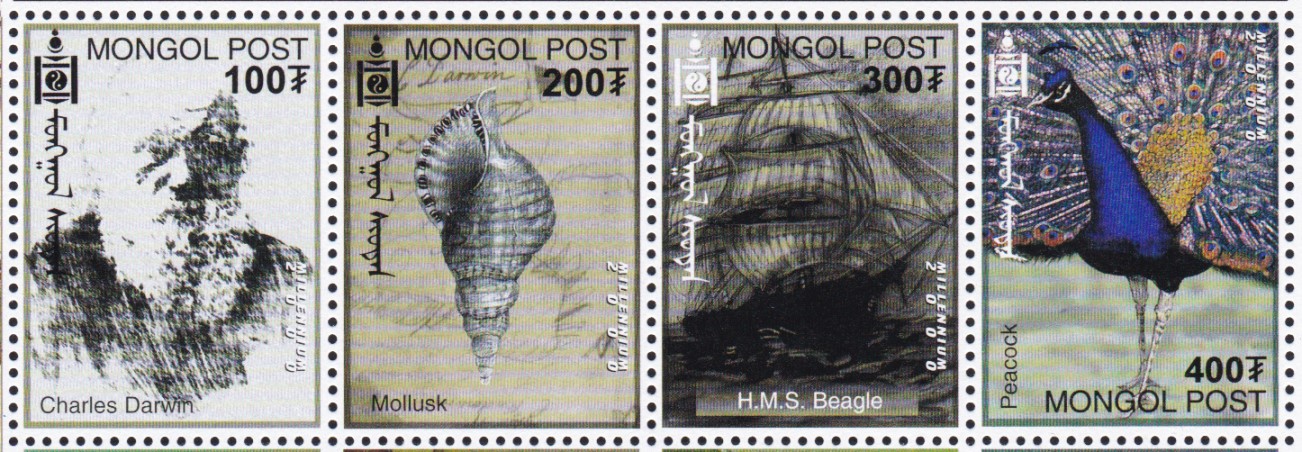 - Dinosaur – Darwin corresponded with palaeontologists and cited fossil evidence like dinosaurs to illustrate the deep history of life. - Clematis – In his plant studies, Darwin examined climbing plants such as Clematis to explore adaptations in movement and growth. - Orchid – Darwin wrote a book on orchids showing how their intricate flowers evolved to ensure pollination by specific insects. - Giant Tortoise – On the Galápagos, Darwin observed giant tortoises whose variations across islands helped inspire his theory of natural selection. 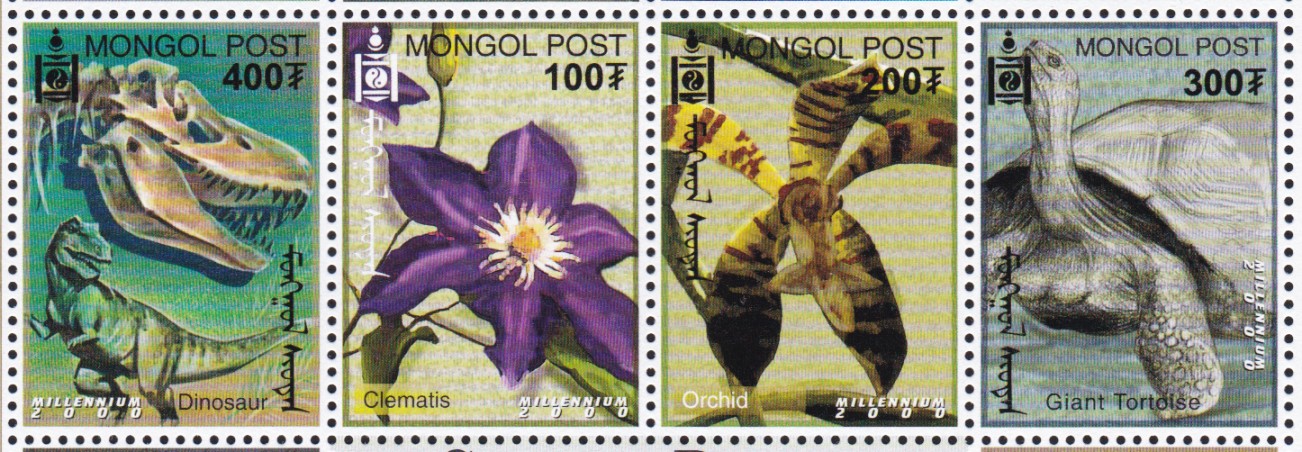 - Reduviid Bug – Darwin described being bitten by a reduviid bug (Triatoma infestans) in South America during the Beagle voyage. - Darwin working room at Down House (Label) - Down House – Darwin's longtime home, Down House, was where he conducted experiments, wrote his major works, and raised his family. 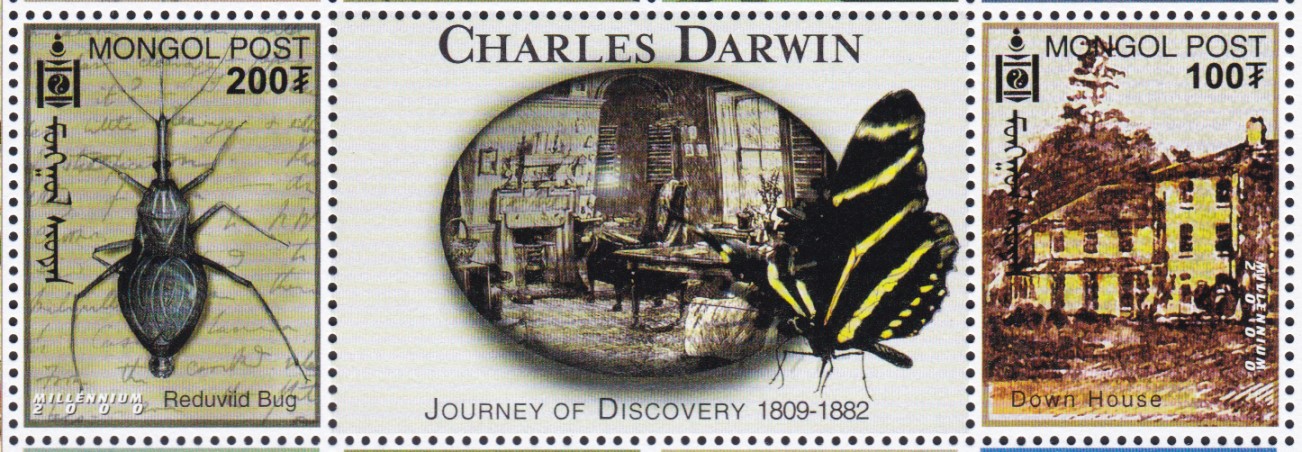 - Relict Gull (Ichthyaetus relictus) – Darwin did not study this specific species, but he often used gulls and other waterfowl as examples in his discussions of variation and distribution. - "The origin of Species" cover - Chimpanzee – Darwin pointed to chimpanzees and other primates to argue for the shared ancestry of humans and animals. - Turkey (Otis tarda) – Darwin mentioned the great bustard (Otis tarda) when discussing sexual selection and plumage in birds. 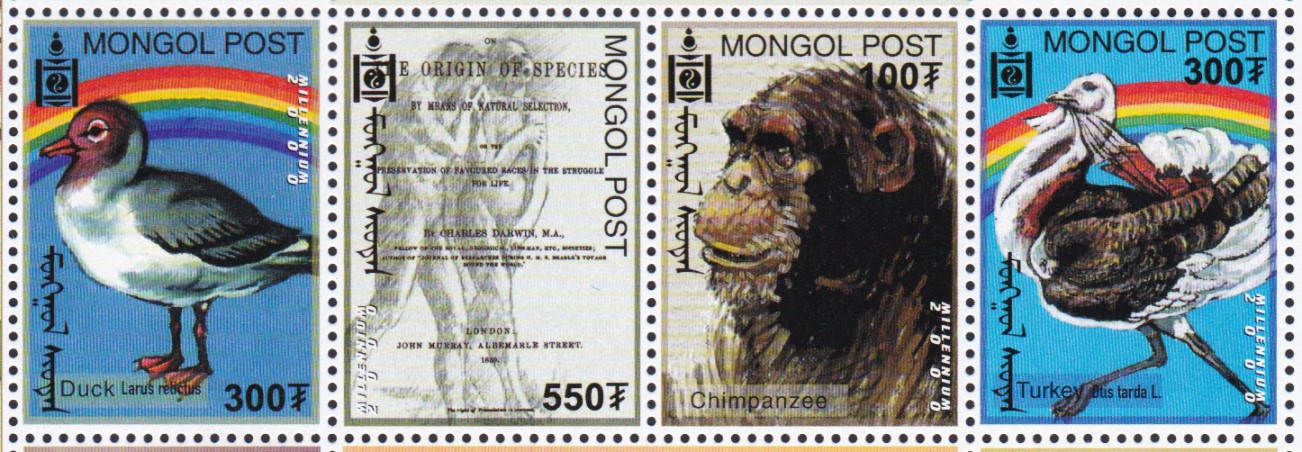 - Horse (Equus hemionus) – Darwin examined wild horses and their relatives like the Asiatic wild ass (Equus hemionus) in relation to domestication and variation. - Ram (Ovis ammon) – Darwin referred to the argali (Ovis ammon) as an example of wild sheep related to domestic breeds. - Vormela peregusna – Darwin mentioned the marbled polecat (Vormela peregusna) among examples of mammalian diversity in his writings. 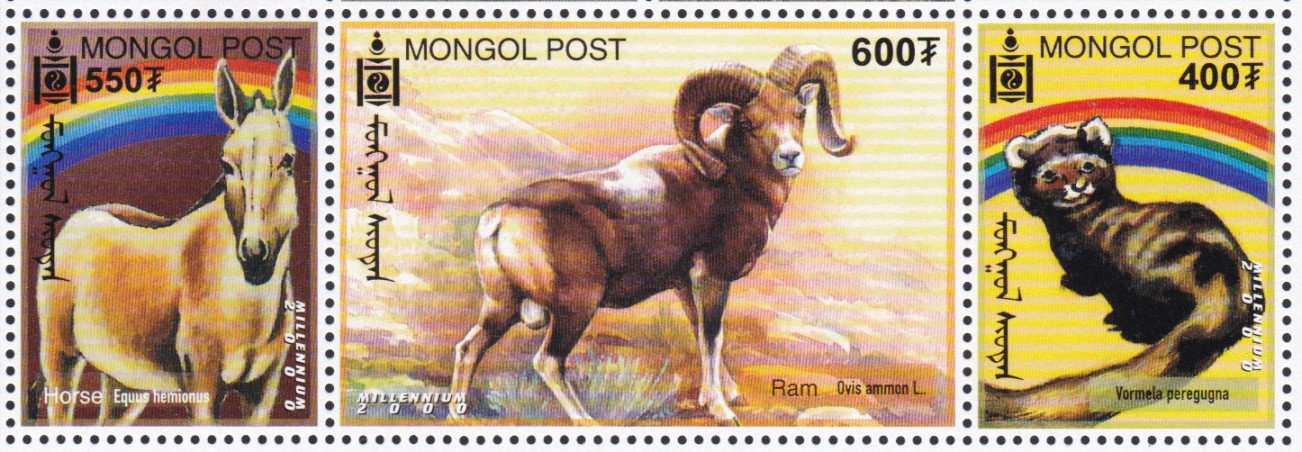 |
|
Send note to Staff
|
|
|
Pillar Of The Community
Israel
4904 Posts |
|
|
The above Mongolian stamps were issued in a sheet. 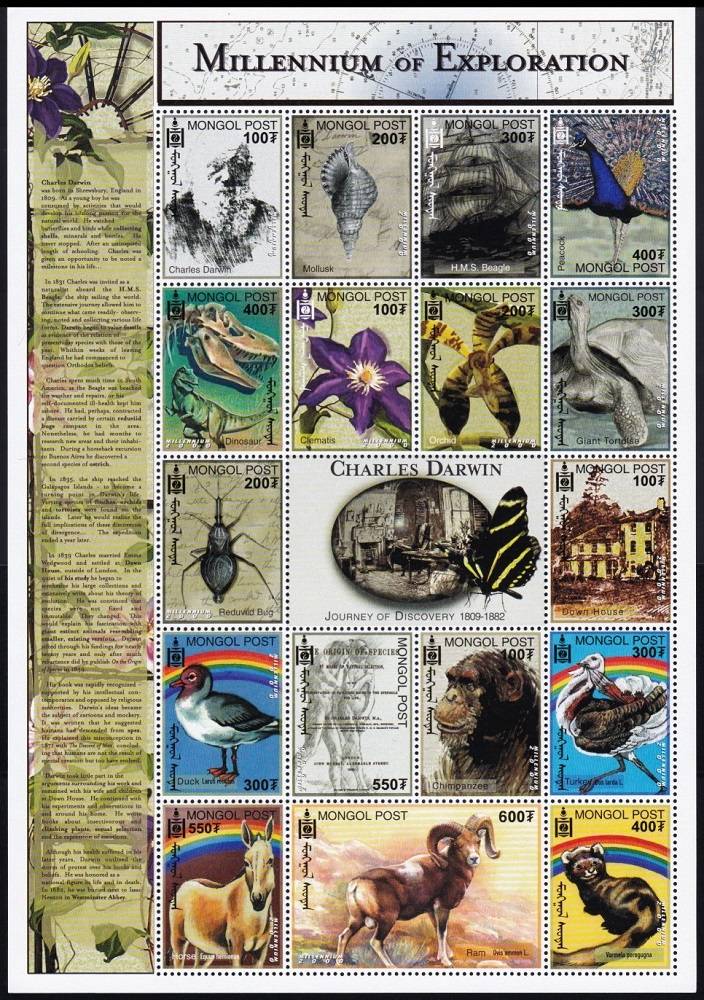 Here is the high-resolution scan of the side description. If the image appears reduced in size, please download it to your PC and open the original file. 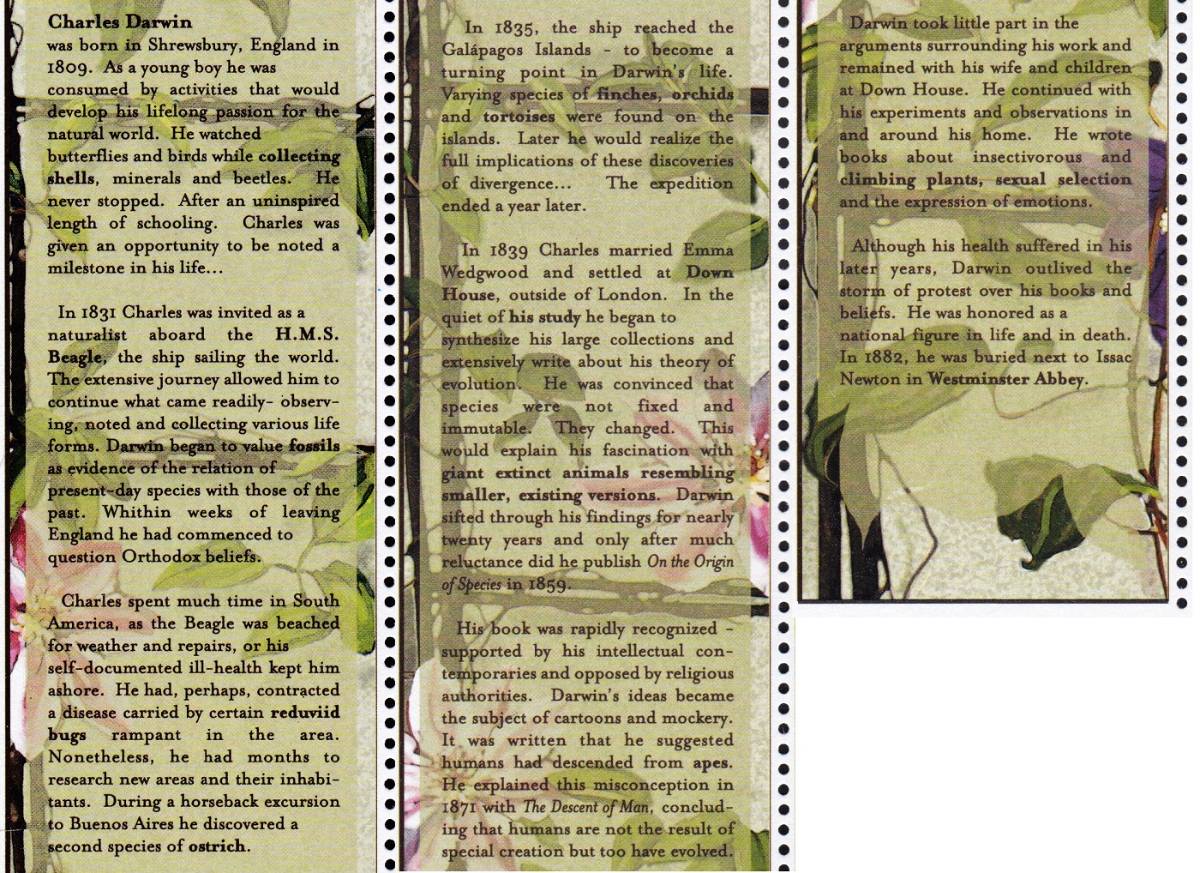 |
|
Send note to Staff
|
|
|
Pillar Of The Community
France
2942 Posts |
|
|
Pillar Of The Community
Israel
4904 Posts |
|
|
Georges-Louis Leclerc, Comte de Buffon (1707–1788), was a leading French naturalist who challenged the belief in fixed, unchanging species. He proposed that climate and geography could influence organisms, causing them to adapt and even diverge from common ancestors. Though he later softened his conclusions to avoid conflict with the Church, Buffon's ideas were among the first to suggest a dynamic, changing natural world. Darwin, who read Buffon's works, acknowledged him as an important precursor whose insights helped pave the way for the theory of evolution by natural selection. Buffon, designed and engraved by Gabriel Antoine Barlangue, France, 1949. 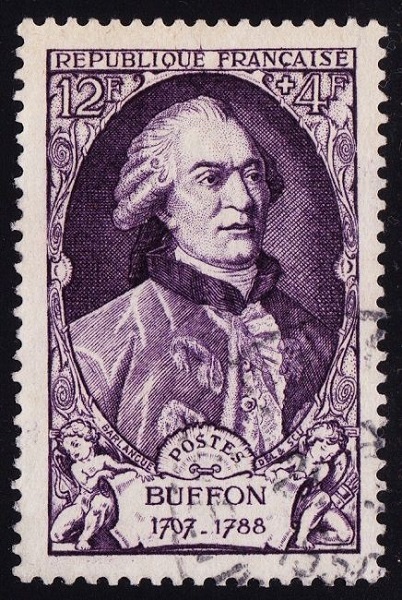 Illustrations from Buffon's "Natural History" encyclopedia, designed by Roger Druet, engraved by Claude Haley, France, 1988. Illustrations show Eurasian otter, Red deer, Red fox and European badger. 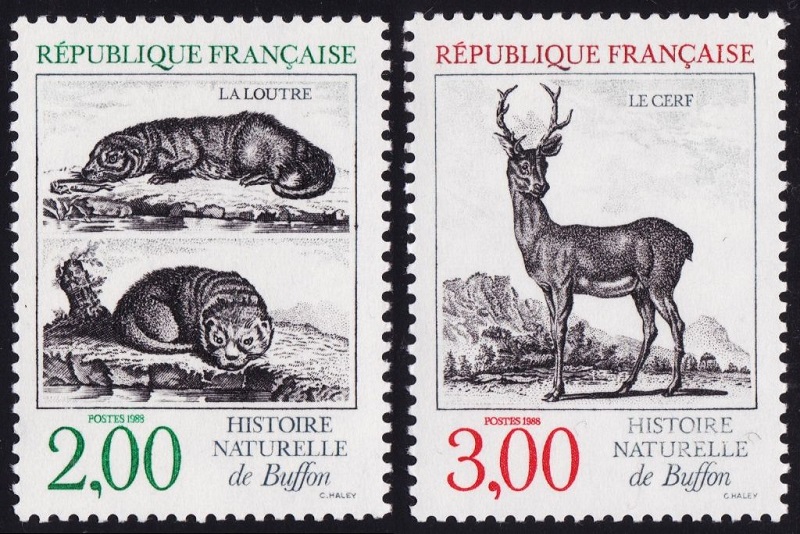 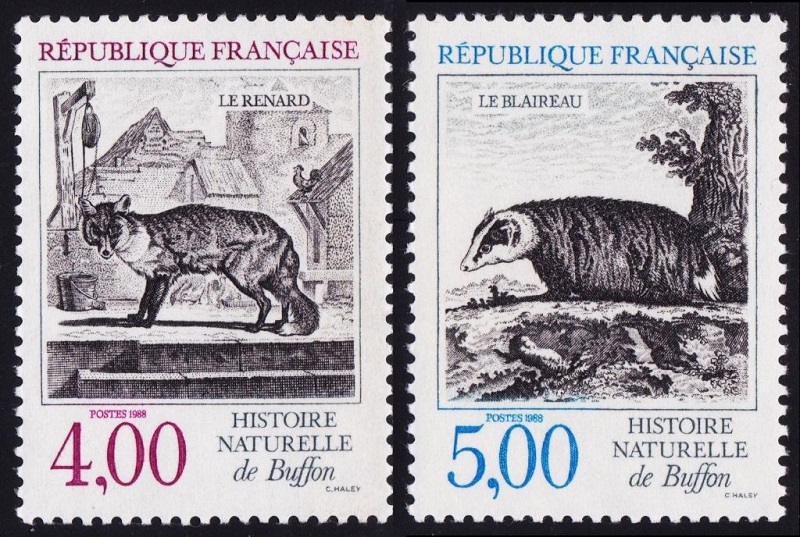 |
|
Send note to Staff
|
|
|
Pillar Of The Community
France
2942 Posts |
|
|
Pillar Of The Community
Israel
4904 Posts |
|
|
Pillar Of The Community
Israel
4904 Posts |
|
|
Pillar Of The Community
Israel
4904 Posts |
|
|
175th Anniversary of the birth of Charles Darwin (1809-1882), issued by Turks and Caicos, 1984. Stamps show Clown Fish, Monitor Lizard, Rainbow Lorikeet and Koala Bear. Although Darwin did not study all of these species in detail, each illustrates themes central to his evolutionary thinking. Clownfish, living in symbiosis with sea anemones, reflect the ecological relationships Darwin emphasized in his coral reef studies. Monitor lizards, like the iguanas he observed in the Galápagos, exemplify reptilian adaptation to diverse habitats. The rainbow lorikeet, with its specialized nectar-feeding adaptations, highlights the co-evolution of birds and plants that Darwin later explored in his botanical works. Finally, the koala, which Darwin encountered in Australia, demonstrated the uniqueness of marsupial fauna on isolated continents and strengthened his arguments about biogeography and species divergence. 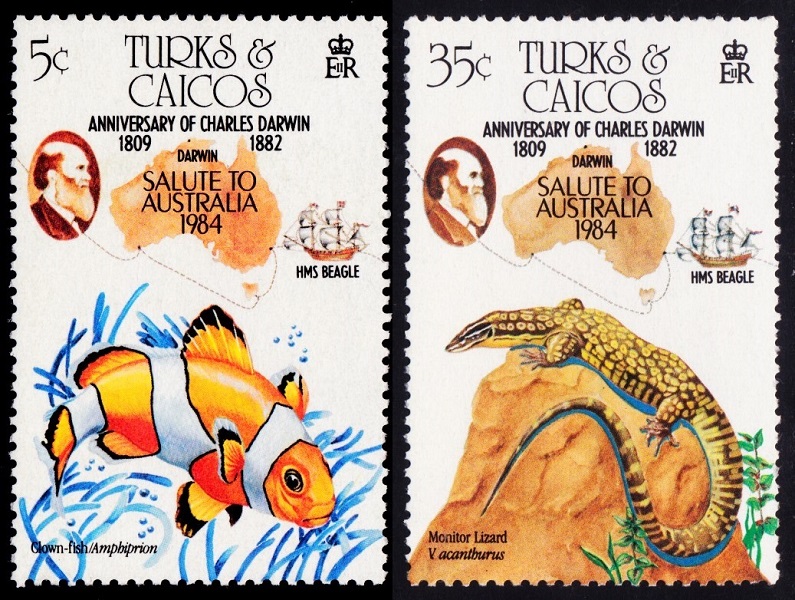 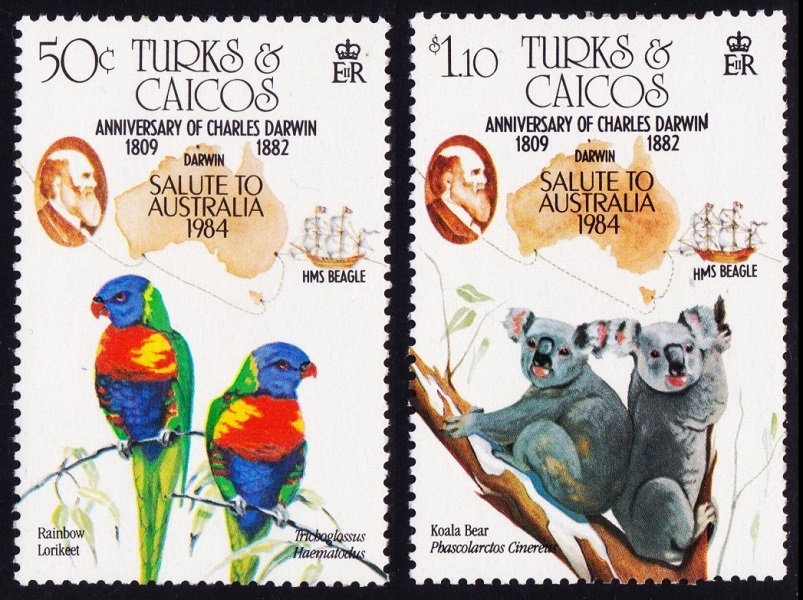 |
|
Send note to Staff
|
|
|
Pillar Of The Community
Israel
4904 Posts |
|
|
Pillar Of The Community
Israel
4904 Posts |
|
|
Alexander von Humboldt (1769–1859) was a German naturalist, explorer, and geographer whose extensive voyages reshaped the study of nature. Between 1799 and 1804 he traveled through Latin America, from Venezuela and the Andes to Mexico and Cuba, collecting vast data on plants, animals, and climates. Later, in 1829, he undertook a major expedition across Russia and Central Asia. Humboldt's writings, such as his Personal Narrative and Cosmos, presented nature as an interconnected system shaped by geography, climate, and biological relationships. The 250th anniversary birth of Alexander von Humboldt, Germany 2019. 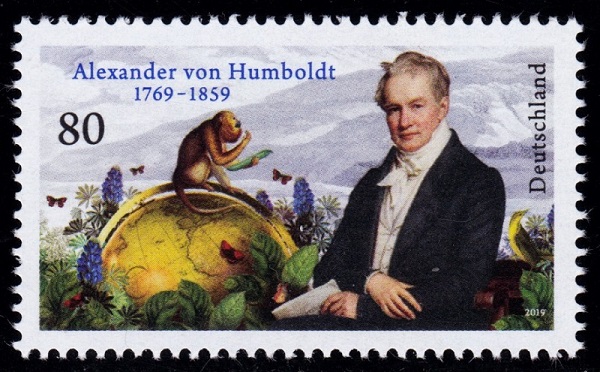 Charles Darwin regarded Humboldt as one of his greatest inspirations. Reading Humboldt's Personal Narrative as a young man ignited Darwin's passion for scientific exploration, and he carried Humboldt's works aboard HMS Beagle. Humboldt's holistic vision of nature as a web of interconnected forces strongly influenced Darwin's way of observing species and environments. Darwin later expanded this framework by adding the mechanism of natural selection, transforming Humboldt's vision into a coherent evolutionary theory. Humboldt, DDR, 1959 and 1969. 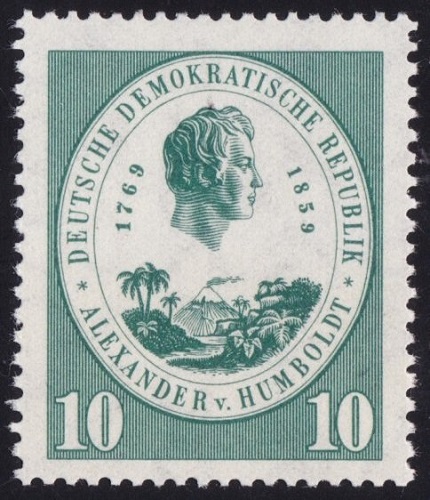 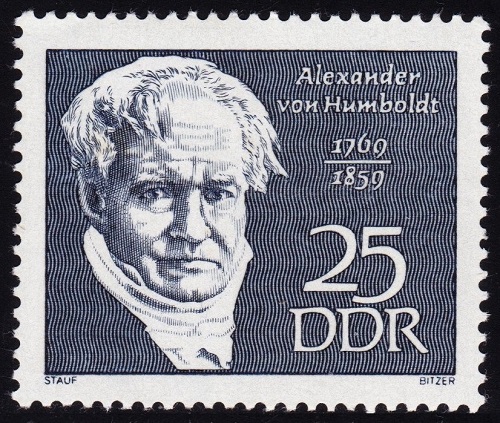 Humboldt is considered to be the "second discoverer of Cuba" due to the scientific and social research he conducted on this Spanish colony. Here is a set features Humboldt, issued by Cuba in 1959. Each stamp features the cover of the book "The Island of Cuba" by Humboldt. 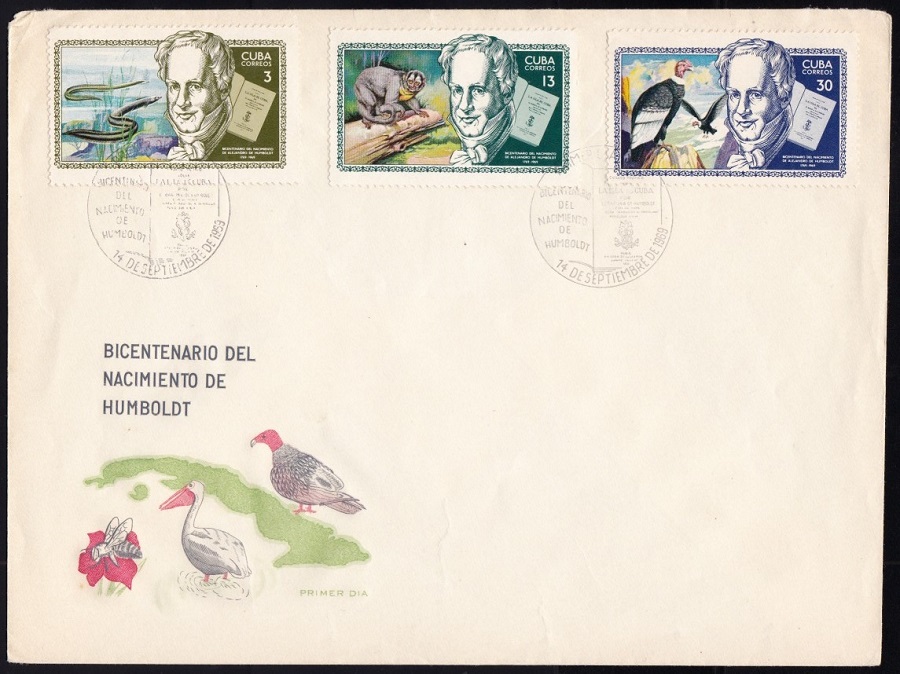 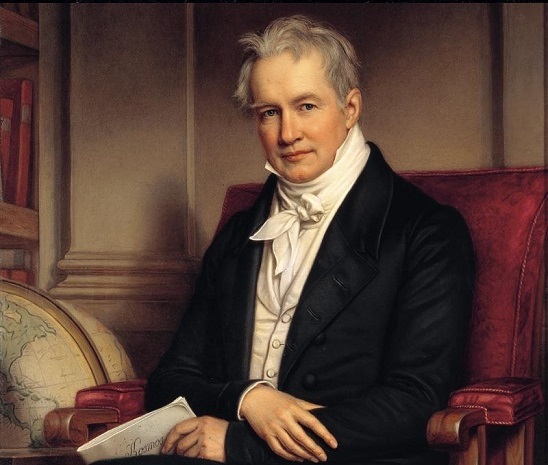 |
|
Send note to Staff
|
|
|
Pillar Of The Community
Israel
4904 Posts |
|
|
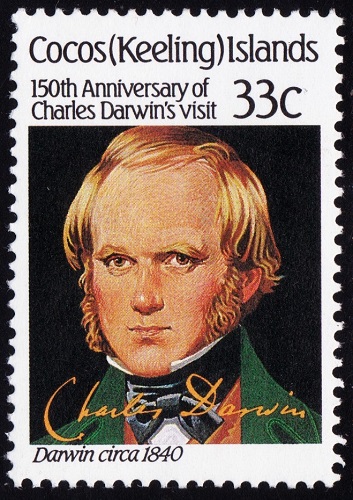
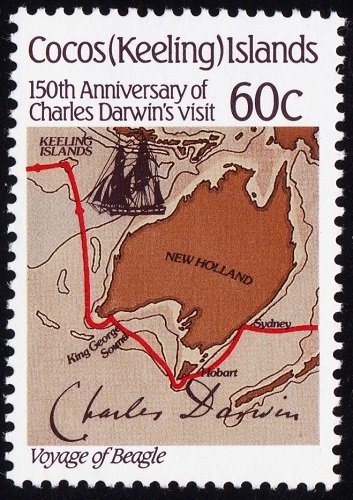
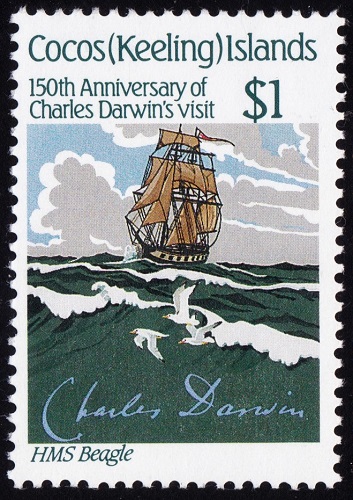
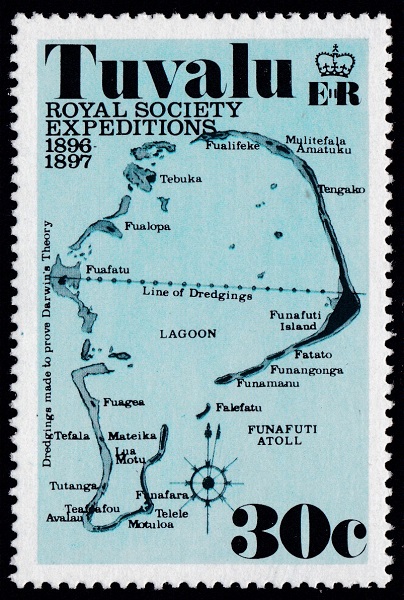
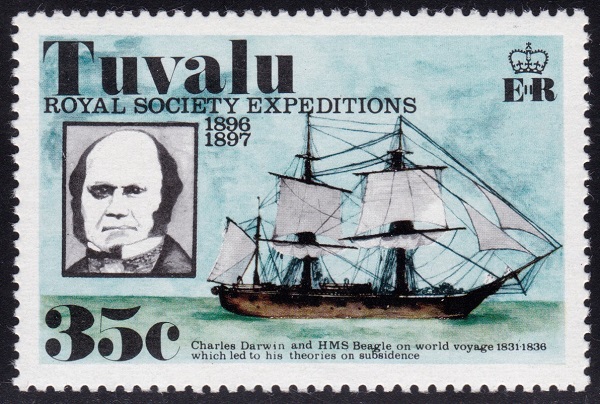
Darwin's theory of atoll formation, proposed after his observations in the Cocos (Keeling) Islands, explained that coral reefs develop as volcanic islands slowly subside. Fringing reefs first form along the shore; as the land sinks, these expand into barrier reefs, and with continued subsidence, only a central lagoon remains, creating an atoll. This idea, published in The Structure and Distribution of Coral Reefs (1842), was later confirmed by geological evidence and remains a cornerstone in understanding reef formation. Cocos (Keeling) Islands, 1981. 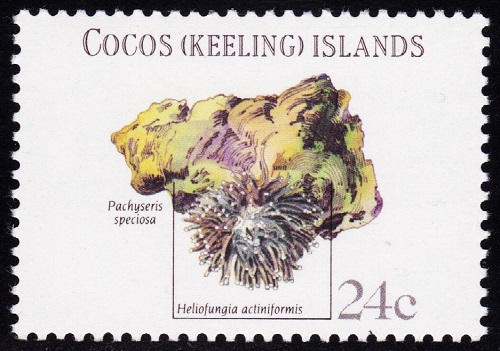 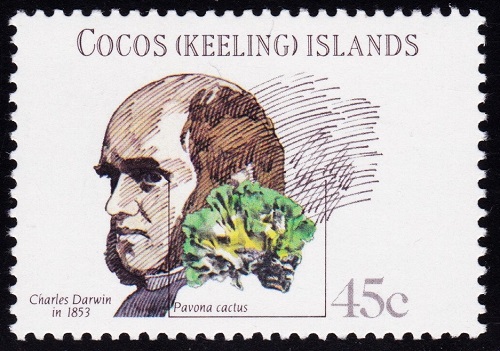 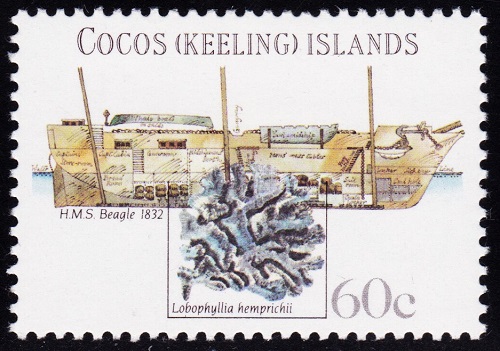 On leaving the Cocos Islands on 12th April 1836 Charles Darwin wrote – "I am glad we had visited these islands, such formations surely rank high amongst the wonderful objects of this world. We feel surprise when travellers tell us of the vast dimensions of the Pyramids and other great ruins, but how utterly insignificant are the greatest of these when compared to these mountains of stone accumulated by the agency of various minute and tender animals! This is a wonder which does not at first strike the eye of the body, but after reflection, the eye of reason." 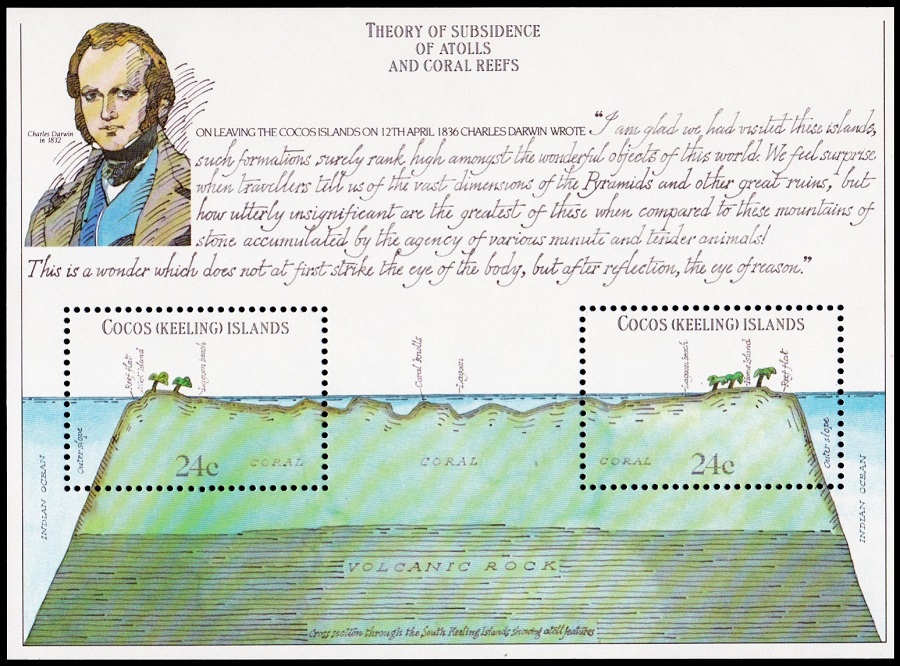 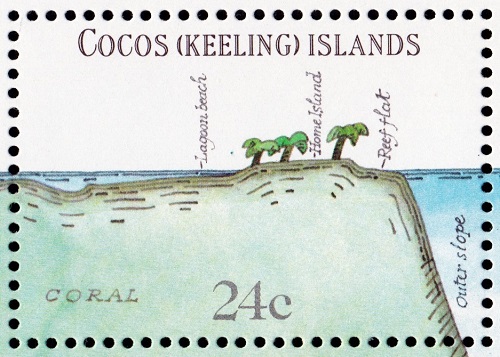 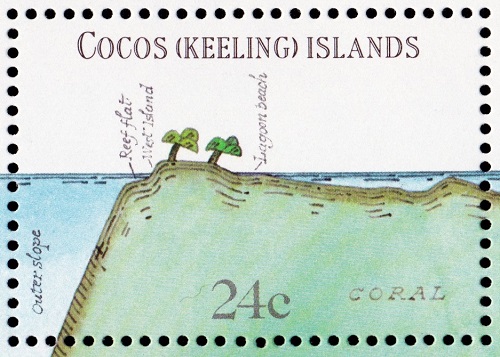 |
|
Send note to Staff
|
| Edited by LaoPhil - 09/23/2025 04:54 am |
|
|
Pillar Of The Community
Israel
4904 Posts |
|
|
Pillar Of The Community
Israel
4904 Posts |
|
|
Pillar Of The Community
Israel
4904 Posts |
|
|
Replies: 54 / Views: 7,132 |
|




 Posted 09/17/2025 09:22 am