| Author |
 Replies: 22 / Views: 1,668 Replies: 22 / Views: 1,668 |
|
Valued Member
United States
65 Posts |
|
|
|
Hello all! Sorry if this is a repeat topic. I haven't used these boards much lately, and do not quite know if this topic has been covered yet.
Basically, I'm looking to place a couple of orders on Hip Stamp, for MNH topical stamp sets, nothing too pricey. The two dealers I'd like to purchase from are out of the country. I am in the US.
Believe it or not, I have never purchased stamps out of the US before!
So, can anyone please give me a rundown on what to expect? Do I pay customs, or even my local mailman anything? Any other expected charges?
Things have been confusing lately, and I'm lost, to put it bluntly!
Thanks in advance for any help! Happy Thanksgiving!
Greg
|
|
Send note to Staff
|
|
|
|
|
Pillar Of The Community
Netherlands
6641 Posts |
|
|
You wrote it. It is confusing. There has been a whole discussion with people pointing at 0% tariffs for stamps. However, the tariffs that have been causing confusion were announced as additional tariffs. I have yet to see any evidence that the additional tariffs do not apply to stamps. Some postal authorities will add charges to packets being sent to the US and others just do not accept them. If they do, the seller, likely, will charge for it. At the same time, anecdotal evidence suggests stamps, at least when sent in non-commercial envelopes, do not attract additional charges. The charges, however, were intended to be paid by the foreign senders. So whether the lack of evidence that the additional charges apply are due to: 1. not being applicable to stamps, 2. US customs being as confused as the rest of the world, 3. anecdotal evidence being limited to the cases where no tariffs have been collected in the US (including cases where it had been collected abroad), remains a question. Here is what the Dutch PostNL states: https://www.postnl.nl/campagnes/onl...rankeren-vs/Only personal presents under USD 100 are exempted. You must describe the content, its value, the country where it was produced, and use the correct HS-code. Clearly, any stamps you buy will not be personal gifts. Other countries' postal services may have other regulations. If the sender ignores the regulations and sends it as a letter, or marks it as a personal gift below USD 100, that is the sender's problem, and against regulations. Regulations are clear that they must be declared and tariffs will be levied. PostNL services this and the sender has to pay. As long as a platform or the seller, automatically, adds the charges, it is irrelevant whether or not they should apply or not. It is not the problem of the rest of the world that the US government is incapable of clearly communicating what it wants. You may be charged those charges anyway. So, read the conditions of sale not only for the platform, but also for the listing. Edit: If no (additional) US tariffs have been collected abroad, it was announced US customs would charge a hefty sum. So, in case the seller does not comply with regulations and additional tariffs do apply, the consequences could be dire. At the same time, there could be no consequences. |
Send note to Staff 
|
| Edited by NSK - 11/27/2025 02:01 am |
|
|
Valued Member
United States
65 Posts |
|
|
Interesting. It is unfortunate that any of this is even a problem with shipping. Thanks for the explanation, as it was very helpful! |
|
Send note to Staff
|
|
|
Valued Member
Netherlands
79 Posts |
|
|
I have an ebay shop and ship 30 to 40 items per week to the USA. These are all items in the price range of $1 to $30. Shipment is done by regular mail. I have not received messages from my customers that they had to pay extra for these shipments since the tariffs situation started. Problems for me will start when I have to ship more expensive items to the USA (say above $100) because then I want to use registered mail with a customs declaration. As far as I know, the Dutch post will not accept that at this moment because who has to pay what is unclear. |
|
Send note to Staff
|
|
|
Valued Member
United States
65 Posts |
|
|
Sorry to hear that. As a buyer, I can see it hurts both sides of the sale. Things seem very confusing. Who gets what, and how much? Its absurd. |
|
Send note to Staff
|
|
|
Pillar Of The Community
United States
775 Posts |
|
|
I have recently (last 3 months) made several purchases from a Canadian stamp company and a couple from other countries; I am in the USA. Each package has a Customs form attached to the front indicating it contains "stamps for collectors". There are no customs fees, tariffs, etc. Which is basically unchanged from the last few decades. That's my experience. |
|
Send note to Staff
|
|
|
Bedrock Of The Community
12750 Posts |
|
|
Quote:
The new letter is silent on the issue of whether stamps are informational materials or not, qualifying for the Berman Amendment's exemption for informational materials.The last paragraph refers to Chapter 99 but does not appear to provide guidance on this matter.
Informal guidance from CBP supervisors continues to refer collectors to the CBP FAQ which notes that HTS heading 9704 items may be considered informational materials. The suggestion then is that philatelic material can enter the US under one of four exemption codes for informational material as follows:
Mexican origin material : 9903.01.03
Canadian origin material : 9903.01.12
Chinese origin material : 9903.01.22
All other origin material : 9903.01.31
Collectors who have instructed their overseas vendors to include the HTS code 9903.01.31 in addition to the traditional 9704.00.0000 code are reportedly now successfully receiving their purchases without the assessment of tariffs. Based on all available evidence, this approach should work. This information above comes directly from the American Philatelic Society. Further discussion and a CBP letter specific to the tariff matter: https://goscf.com/t/90508There are a LOT of firsthand accounts of this approach working. If you choose to not see it that is a conscious decision. Is there still confusion? Yes, there is. Tariffs are complex. Many would rather maintain the status quo wherein the US continues getting the short end of the stick.  |
|
Send note to Staff
|
|
|
Pillar Of The Community
Netherlands
6641 Posts |
|
|
Clearly, a number of foreign postal authorities disagree, and the APS does not determine what those postal authorities do.
Other than that, anyone is free to go for it. |
|
Send note to Staff
|
|
|
Pillar Of The Community
1366 Posts |
|
|
It's very confusing and the whole tariff issue has upset many sellers and buyers.
But you, the consumer, do not have to do anything. You just buy the product, and if it's price has gone up to pay for the tariff, then it's will cost you more. You most likely won't even know a tariff has been added. Your $200 Italian shoes may now cost $280, but there's no indication a tariff was involved. The American shoe importer had to pay higher prices for the Italian shoes, so he passed that higher price on to the shoe stores he sells the shoes to. This importer had to pay a higher price because the Italian shoe manufacturer was forced to pay a tariff on all the shoes he sends to the U.S. He does all the paperwork, but everyone else pays a higher price -- the American importer of shoes and the shoe store which bought the shoes from the importer and then you, all of them pay a higher price. But that higher price is only noticeable because the price went up. It won't say "Shoes $200 + $80 for tariff". You'll never be told. Yes, it's also called inflation.
But that said, generally at least in my experience, all my relatively small shipments from foreign stamp sellers have (it appears) come through without any additional charges being added, so I wouldn't worry too much.
That doesn't mean that foreign sellers are happy with this system. Some have even refused to send the stamp material I've tried to order because they claim they don't know how to deal with our new tariff system. That's understandable, but they will let you know if that's their policy. And more recently, this has seemed to become less of a problem.
Tariffs seem to confuse a lot of people, but the buyer in the U.S. does not have to do anything -- other than being willing to pay higher prices for imports, of course. Essentially, tariffs are a tax on American consumers which the federal government imposes on imports and which the federal government keeps. It's an import tax paid, after all is said and done, by the consumer.
It's a very poor way to run your foreign trade because it upsets everyone and slows down trade, making national economies slow down. So we've historically avoided tariffs -- until recently anyway. I imagine someone someday will figure out the average total tariff price paid by the average American for all this, But, again, you're just charged a price by the seller without being told any tariff has been added -- even though the price is likely higher. |
|
Send note to Staff
|
| Edited by DrewM - 11/28/2025 04:18 am |
|
|
Valued Member
Switzerland
498 Posts |
|
|
rogdcam: You seem to intentinally put up smokescreens and believe this will make the problems go away.
So, for you, once again. There are two problems mixed together at the same time.
The first problem is the answer to the question: Are stamps informational materials or not? Stamps habe been exempt from tariffs but when Trump canceled the de minimis limit, people were no longer sure if stamps were tax free or not (most never cared due to de minimis).
What this floating-around letter clarifies is the fact that by stating the correct HTS codes, stamps are indeed tariff free.
The second problem is Trump's imposed ADDITIONAL tariffs that apply TO EVERYTHING. And stamps, dear rogdcam, belong into the "everything" category. There are multiple problems now: Trump never clarified how the tariffs work in real life.
1. Who pays?
2. Who gets the money?
3. Why does the money have to be paid in advance?
4. The simple problem of the legal status of those random tariffs.
So many sellers/carriers of mail decided to stop sending mail to the States. Some still do, but want to collect the additional tax in advance, from the seller. All the while, some US receivers of mail have refused to accept a suddenly much more expensive package.
The point is made that buyers in the States currently receive philatelic materials without the additional tax imposed on the value. That's cool, if it stays so, but it is not guaranteed.
The reason is that the people at airport facilities that process incoming mail do not know any of the answers to 1-4 like anybody else. Likely because noone in the chain of command has the instructions given to the poor folks at the bottom of the food chain who actually have to figure out the mess. So what do the poor workers do at those facilities? - They wave the stuff through instead of being confronted by a bureacratic nightmare (possibly for most of the umpteen thousands of items they must process every day).
It's a classical case of British researcher D. Adams' SEP field theory. (Go figure that hint...)
DrewM: but the buyer in the U.S. does not have to do anything -- other than being willing to pay higher prices for imports
In the real world where margins are in the low % range for many goods, an additional 15-39% tax is lethal to most businesses. |
|
Send note to Staff
|
| Edited by drkohler - 11/28/2025 07:48 am |
|
|
Pillar Of The Community
Netherlands
6641 Posts |
|
|
Didn't the people from Boston 2026 claim there would be a letter comming from the authorities stating there would be no tariffs at all? Has anyone ever seen it? I think the claim the letter would be published within a few weeks was made some six weeks ago, already. |
|
Send note to Staff
|
|
|
Valued Member
Switzerland
498 Posts |
|
|
NSK: Probably the Boston folks figured out by now that it's not the "tax on stamps", it's the ADDITIONAL tariffs that are killing the mood. As long as those tariffs are not declared illegal, there is no way out of the mess. |
|
Send note to Staff
|
|
|
Pillar Of The Community
Netherlands
6641 Posts |
|
|
Possible. I fully agree with your earlier post. The issue is with a) the additional tariffs, not the basic tariffs that existed, b) the question about payment (or guarantees) and how any upfront payment is refunded. I, yet, have to see any evidence that part has been resolved or even clarified. And a letter stating Quote:
Based on all available evidence, this approach should work. does not clarify anything, not even if it had been a letter from someone who represents the government. |
|
Send note to Staff
|
|
|
Pillar Of The Community
United States
4512 Posts |
|
|
I saw this is in my postal card collection. I did not realize there was a postal card for the Customs service 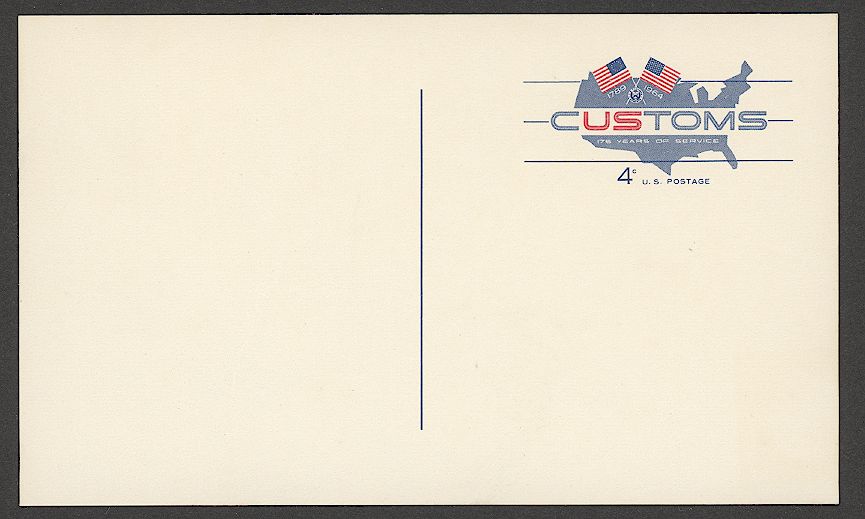 |
|
Send note to Staff
|
Al |
|
|
Bedrock Of The Community
12750 Posts |
|
|
Bedrock Of The Community
12750 Posts |
|
|
Quote:
On October 23, 2025 Mr. Tang received a followup letter from Customs and Border Protection (above) stating that the original ruling letter he received in July was "null from the beginning" and "voided", and that a new ruling letter would be issued. Note that as the original ruling was ruled "null from the beginning" it maybe the case that those parties that had paid tariffs on philatelic material may now be entitled to a refund. Affected parties may want to followup with their customs broker.
On October 29, 2025 the new ruling letter (H354294) was issued. It stated that philatelic material was covered under heading 9704, but made no claim as to whether such material was informational or not.
On October 30, 2025 Customs and Border Protection issued a followup letter to the new ruling letter (shown below) stating that philatelic material is informational and therefore exempt from duties. 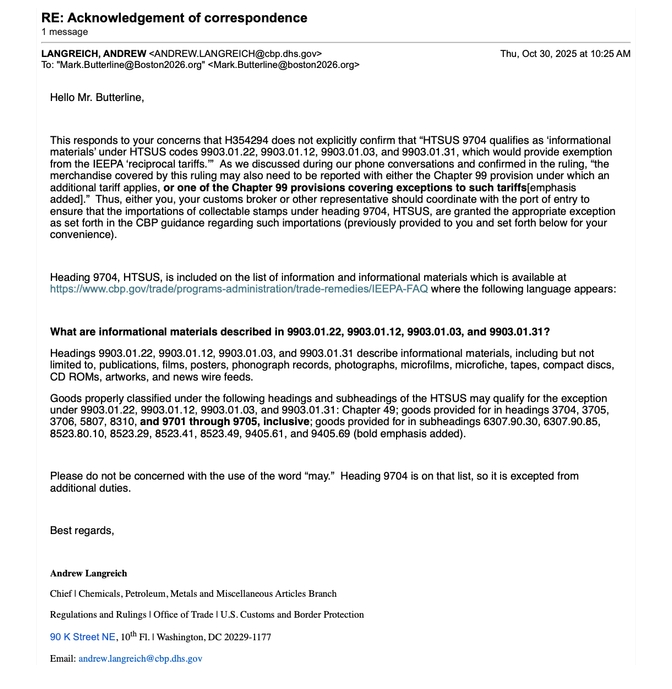 Are we done now? https://web.cvent.com/event/bbbdc1d...a3a8ae931f05 |
|
Send note to Staff
|
|
|
Replies: 22 / Views: 1,668 |
|




 Posted 11/26/2025 8:41 pm


