| Author |
 Replies: 21 / Views: 2,335 Replies: 21 / Views: 2,335 |
|
Valued Member
Germany
12 Posts |
|
|
Hello! Today I went to a stamp tradingday for the first time and got some beautiful Nepalese stamps. Unfortunately, I just noticed that about half of them have these rusty-brown spots :( I assume it's foxing? What would you do in my situation? Should I remove them from the collection, keep them, or do something else? I appreciate any advice and tips! 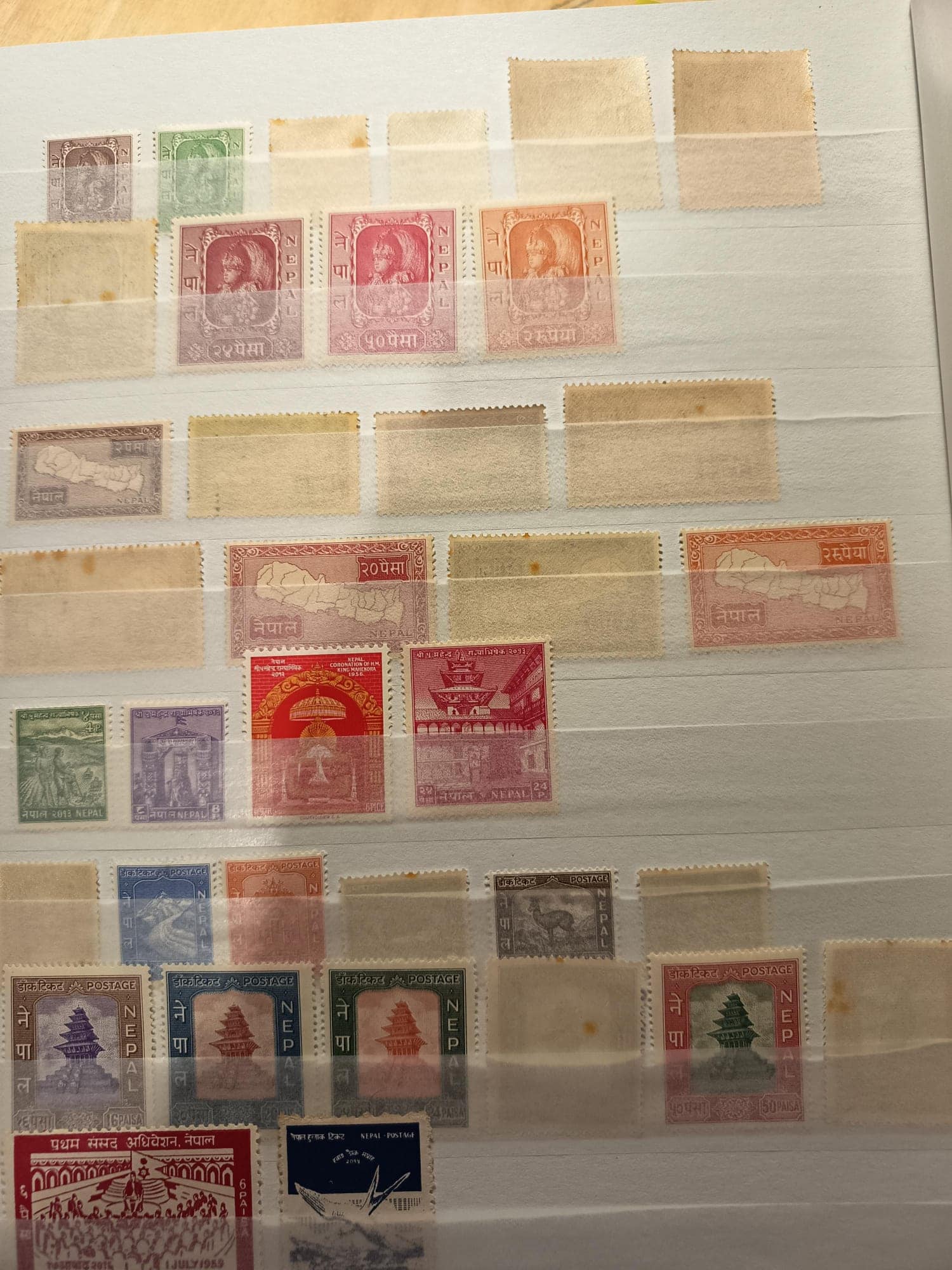 |
|
Send note to Staff
|
|
|
|
|
Valued Member
New Zealand
54 Posts |
|
|
If it was me, I'd soak the gum off in warm water. That should remove most of the active spores.
Left like that it will only get worse and spread to the other stamps.
Here in the north of NZ the humidity is such that toning like that is rife. Even fairly modern stuff I buy for postage is often in the first stages.
|
Send note to Staff 
|
|
|
Valued Member
Germany
12 Posts |
|
|
Thanks for your perspective! Yes, I never really thought about such environmental factors since I live in Germany. This was the first time I've seen it on stamps. I'll probably remove the affected stamps from my collection. Unfortunately, some beautiful ones were hit, but I'm already getting nightmares from the foxing spreading on everything else haha.
Lovely Greetings to (maybe Auckland?)
At least, in exchange for the humidity, you got some beautiful landscape! |
|
Send note to Staff
|
|
|
Pillar Of The Community
United Kingdom
8632 Posts |
|
|
The cold and damp of northern Europe can also have bad effects! Don't keep the stock-book once you've removed the stamps for soaking. |
|
Send note to Staff
|
|
|
Pillar Of The Community
United States
746 Posts |
|
|
If you are fortunate enough to know a friendly microbiologist or medical lab tech, they could sterilize the affected stamps using dry methods like ethylene oxide or radiation - either ultraviolet or nuclear. Autoclaving or a hot air oven would likely have an adverse effect on the stamp and/or gum. The stamps would have to be quite valuable to be worth the cost, and the risk. If I still had my lab, it would be a fun experiment to develop a safe process. Sterilization by any method will kill the fungal spores and prevent its spread but cannot remove any damage or discoloration already present. |
|
Send note to Staff
|
|
|
Pillar Of The Community
United States
939 Posts |
|
|
Foxing gets worse in humid, warm, stagnant air.
Ideal storage conditions:
35–45% humidity
18–22°C (65–72°F)
Good airflow, cool and dry
Keep out of direct sunlight
Use archival, acid-free albums, pages, and mounts
This prevents further deterioration. |
|
Send note to Staff
|
|
|
Pillar Of The Community
United States
859 Posts |
|
|
Sadly for me I have to toss any stamps with foxing on them. It breaks my heart for some of them but I can't risk it. Also applies to anything musty or any kind of mold. |
|
Send note to Staff
|
|
|
Bedrock Of The Community
12751 Posts |
|
|
Foxing is also caused when the environment reacts with iron in the paper. That won't spread so until you know what you are dealing with don't get too carried away with death and destruction.  |
|
Send note to Staff
|
|
|
Valued Member
United States
470 Posts |
|
|
If it's super cheap, I'd just toss in the bin straight away. As Rog pointed out, it could be that foxing/toning comes from non-mold sources, but better safe than sorry - you don't want it spreading to the rest of your collection, if in fact mold is the source.
For stamps that are slightly more valuable, I've had a certain amount of luck giving them a quick bath in near-boiling water (you want it hot, not warm, to kill the spores). Some inks might run, and you don't want to do this more than once, as submerging in any water (but particularly hot) will affect the sizing of the paper.
Others have sworn by a hydrogen peroxide bath, which can remove some less serious toning, followed by a rinse in regular water.
I'll do this for stamps I've picked up from albums with a strong musty smell - even without foxing/toning, there's more than the eye can see. For stamps that just have that musty smell, a hot bath is sufficient. For those with toning that I would have consigned to the trash, I'll try hydrogen peroxide, and usually get decent results.
If using hydrogen peroxide, make sure to use a bottle that has been recently opened and stored properly, as it naturally degrades over time.
I should emphasize that this should only be done to cheap stamps that are headed to the bin anyway. If it's rare, valuable, for future sale, etc. then more delicate methods (and better storage moving forward) are warranted, and DO NOT utilize these methods. |
|
Send note to Staff
|
|
|
Pillar Of The Community
United States
592 Posts |
|
|
I hate foxing on stamps. Yes, hydrogen peroxide fresh works. It's not perfect, but gets the job done. Many horrific sellers hide foxed stamps in boxed auction lots. You can also throw the cheap ones away. |
|
Send note to Staff
|
|
|
Valued Member
New Zealand
54 Posts |
|
|
Briefmarken, yes Auckland province. Thanks and Christmas Greetings to Deutschland.
You don't need to throw ANY away; soak off the gum (and the foxing with it). Problem solved.
Stamp collecting is a visual hobby; those stamps will look fine facially after a warm/hot bath. Nice interesting Nepalese rulers/scenes. Who cares about the backs? They are nice stamps. Nepal = interesting place and those stamps tell a story.
I agree with someone who said to dump the stockbook though. That's good advice. They will be riddled with live spores. Get the stamps out and throw those stockbook(s) in the bin.
I'd stick the stamps, after a bath, in hagner sheets. They will look great!
|
|
Send note to Staff
|
|
|
Bedrock Of The Community
12751 Posts |
|
|
Unlike mold, foxing is non-toxic and does not spread.
You people do not understand what you are talking about and the "solutions" are both crazy and unnecessary. |
|
Send note to Staff
|
|
|
Valued Member
New Zealand
54 Posts |
|
|
Rodgcam said Quote:
Unlike mold, foxing is non-toxic and does not spread.
You people do not understand what you are talking about and the "solutions" are both crazy and unnecessary After looking at the photo the OP posted, you do not think that shows fungal spores "feasting" on the gum? You claim the example shown is non-toxic. Well it might not bring down a buffalo but it's killing those stamps. |
|
Send note to Staff
|
|
|
Bedrock Of The Community
12751 Posts |
|
|
The brown spots are typical "foxing" which comes from impurities such as iron reacting with moisture. The reason everyone yells "mold" and wants to burn things to the ground is because the internet is full of misinformation. Imagine that. |
|
Send note to Staff
|
|
|
Valued Member
United Kingdom
380 Posts |
|
|
"Some "foxing" is almost certainly caused by the action of mould or mildew as enzymes used by the organisms breakdown the structure of the paper or photograph. The brown staining is caused both by the residual dead mould or mildew and also the deterioration of the substrate."
Quote from Museum of History, New South Wales website. Note the reference to "residual dead mould", so they reckon it's the putrefying corpses of the violators that cause the staining. Also "some". |
|
Send note to Staff
|
| Edited by Flightle_Bee - 12/04/2025 07:42 am |
|
|
Valued Member
United Kingdom
380 Posts |
|
|
If that's gum Arabic on the stamps, it's a good source of polysaccharides. |
|
Send note to Staff
|
|
|
Replies: 21 / Views: 2,335 |
|



 Posted 11/30/2025 7:56 pm


