The Report of the Postmaster General for the fiscal year ending June 30, 1922 mentioned that a new series of ordinary postage stamps would replace the current Washington and Franklin ordinary postage stamps that had been in use since 1908. This new series would eventually become known as the Fourth Bureau Issue. Included in its planned designs were portraits of colonial national figures, past presidents, and scenes of national landmarks. One of the selections was Rutherford B. Hayes, the nineteenth President of the United States.
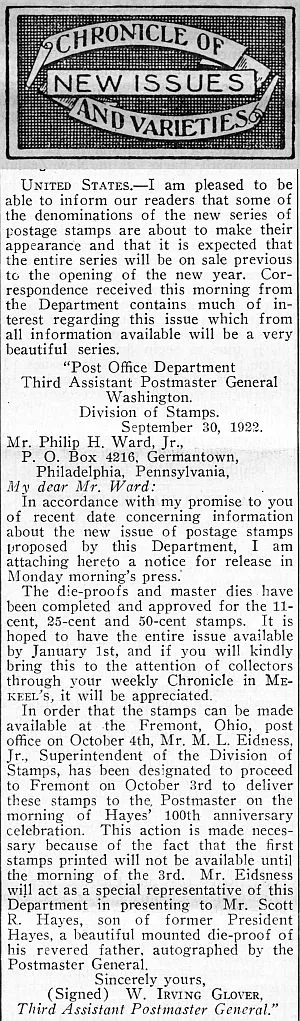
The Hayes family become aware that a stamp honoring their father was being planned and they waged a campaign to have it released on October 4. A big celebration was scheduled for that day at Hayes' hometown and burial site of Fremont, Ohio to observe the hundredth anniversary of the former president's birth. The Post Office Department relented to the unsolicited request of the release of a new stamp at a location pertinent to the subject of the stamp, possibly under political pressure from President Harding, also an Ohioan. Because of the timing, an eleven-cent Hayes stamp would then be the first release of the new series of stamps.
During a First Day ceremony at Fremont, the first event of its kind in the United States, Superintendent of Stamps Michael Eidsness presented a large die proof of the new stamp to Scott Hayes, the son of the former president who represented the Hayes family. Philatelic journalist Philip Ward mentioned in his column in Mekeel's Stamp Weekly that "this was a beautiful, mounted die proof autographed by Postmaster General Hubert Work".
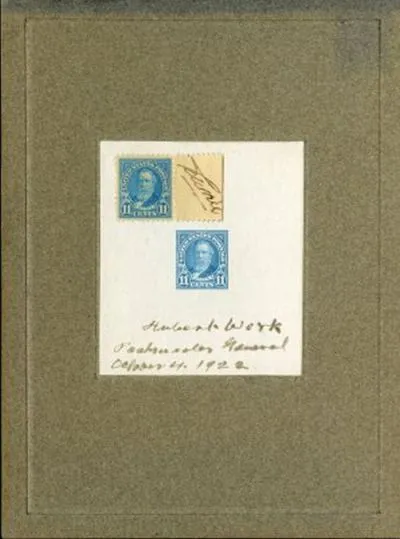
The proof has lost some of its luxurious appearance over the years. Note the unique date of October 4, 1922, on the card. All other known signed Hayes die proofs have the die approval date of September 21, 1922. The stamp attached to the proof is autographed by the Director of the Bureau of Engraving and Printing, Louis A. Hill. This was a practice employed occasionally on presentation proofs.
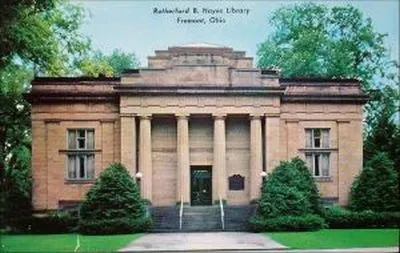
The proof was donated by the Hayes family to the Rutherford B. Hayes Library in Fremont, Ohio where it resides today.
Fourteen other Hayes die proofs would eventually leave the government. All are believed to be in philatelic hands. Nine of them exhibit Postmaster General signed die approvals.
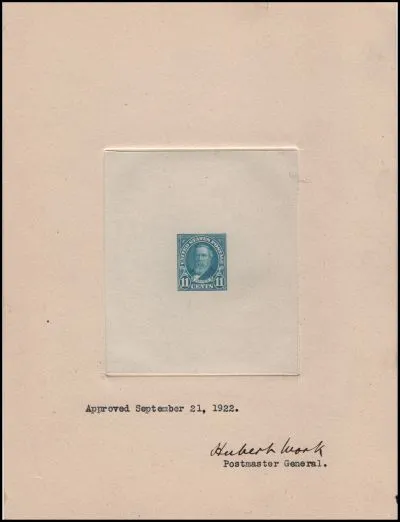
All of the different Hayes die proofs and their backgrounds can be viewed at
https://hayesdieproofs.wordpress.com.





 Posted 02/24/2026 11:43 pm



 </center>

