| Author |
 Replies: 98 / Views: 5,978 Replies: 98 / Views: 5,978 |
|
|
|
Valued Member
63 Posts |
|
|
The controversy surrounding restricted access to legacy Scott Digital Catalogues extends far beyond questions of subscription pricing and raises substantial scholarly concerns within technical philately. Specialised catalogues are not merely commercial valuation tools, but cumulative research frameworks indispensable to plating studies, postal history, revenue philately, watermark analysis, and the historiography of philatelic classification…..
Earlier catalogue editions retain enduring scholarly significance because they preserve specialised taxonomies, editorial commentary, rarity assessments, and technical observations frequently revised, condensed, or omitted in subsequent editions, a circumstance which itself generates considerable interpretative ambiguities for later researchers. Technical philatelic scholarship therefore relies upon the comparative examination of successive catalogue states in order to trace the evolution of classification systems, editorial methodologies, and specialist interpretations over time.
The transition from permanent ownership to revocable digital access consequently introduces serious archival and methodological concerns. Where historical editions remain accessible solely through proprietary authentication systems, philatelic research becomes dependent upon the commercial continuity and technological stability of private publishers. Under such conditions, the disappearance of reference material may arise not through physical destruction, but through software obsolescence, licensing alterations, platform discontinuity, or corporate restructuring.
This issue is particularly significant because philately is fundamentally documentary and citation dependent in character. Scholarly publications, expert certificates, auction catalogues, and census compilations frequently rely upon numbering systems and editorial distinctions specific to particular catalogue editions. This problem is further compounded by the absence of a centralised philatelic authority, as expertisation continues to rest upon opinion despite the role of digital and physical laboratory analysis capable of providing scientific verification.
A genuinely scholarly digital philatelic environment should therefore prioritise permanence, citability, interoperability, and archival preservation rather than merely providing subscription based access to scanned pages. Technical philatelists are not opposed to digital innovation; indeed, computational methodologies such as AI assisted identification, watermark recognition, perforation analysis, and forgery diagnostics possess substantial potential to advance philatelic scholarship. Their principal concern lies in the replacement of durable scholarly continuity with contingent licensed access lacking meaningful preservation guarantees.
Ultimately, the dispute reflects a broader tension between commercial software access models and the methodological requirements of cumulative specialist scholarship. Although classification systems and expert methodologies must continue to evolve scientifically rather than resting on opinions, these foundational principles must remain protected within any future digital catalogue architecture.
|
Send note to Staff 
|
|
|
Bedrock Of The Community
12777 Posts |
|
|
Pillar Of The Community
United States
4520 Posts |
|
|
The Scott catalog system (same with SG, Michel, etc) is used because buyers and sellers use it for collecting and commerce. It is more than an intellectual project. |
|
Send note to Staff
|
Al |
|
|
Pillar Of The Community
Netherlands
6646 Posts |
|
|
Bedrock Of The Community
12777 Posts |
|
|
Pillar Of The Community
United States
775 Posts |
|
|
Quote:
Things like topic or commem or defin isn't going to happen simply because tags would have to be added to every stamp or set so that they could be extracted to the category of interest. Too much work. And some people would still whine that some stamps were excluded or included that they don't agree with. Apparently Scott does provide tags for topics though I don't know how far back it goes. (from Scott Stamp Monthly) 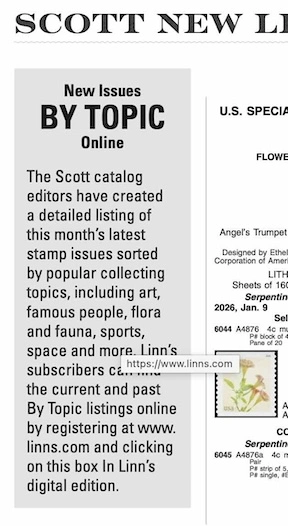 |
|
Send note to Staff
|
|
|
Pillar Of The Community
United States
775 Posts |
|
|
Pillar Of The Community
United States
8615 Posts |
|
|
Forget the great summarized statements above ----- let me translate it so everybody understands it .
e
Half of all philatelic research ends up in the trash can at the dealers home or at the stamp auction firms . With a small amount ends up in those bulk lots at the end of a stamp auction . There is very little of it stays intact . Stamp research material is a hard sell to the public . Basically it is TRASHED . Any stamp of value is pulled off the page and sold seperately .
When a firm buyers your collection they understand they want a fast sale and have no interest in studying your research or trying to find a specialised buyer . Most end up being offered as a seperate stamp not a piece of research . |
|
Send note to Staff
|
|
|
Pillar Of The Community
United States
8615 Posts |
|
|
Scott needs to understand worldwide collectors are limiting their dates where to stop collecting . There is a big drop in new issues purchasing . Keeping up with all the new issues is a huge staffing waste ,while at the same time they close their price discovery department .
It comes down to who buys the most recent catalog as dealers and collectors are satisfied with 3 and 5 year catalogs .My catalogs are 6 years old and see no reason to update . |
|
Send note to Staff
|
|
|
Pillar Of The Community
United States
4465 Posts |
|
|
AI ignore:Quote:
The controversy surrounding restricted access to legacy Scott Digital Catalogues extends far beyond questions of subscription pricing and raises substantial scholarly concerns within technical philately. Specialised catalogues are not merely commercial valuation tools, but cumulative research frameworks indispensable to plating studies, postal history, revenue philately, watermark analysis, and the historiography of philatelic classification…..
Earlier catalogue editions retain enduring scholarly significance because they preserve specialised taxonomies, editorial commentary, rarity assessments, and technical observations frequently revised, condensed, or omitted in subsequent editions, a circumstance which itself generates considerable interpretative ambiguities for later researchers. Technical philatelic scholarship therefore relies upon the comparative examination of successive catalogue states in order to trace the evolution of classification systems, editorial methodologies, and specialist interpretations over time.
The transition from permanent ownership to revocable digital access consequently introduces serious archival and methodological concerns. Where historical editions remain accessible solely through proprietary authentication systems, philatelic research becomes dependent upon the commercial continuity and technological stability of private publishers. Under such conditions, the disappearance of reference material may arise not through physical destruction, but through software obsolescence, licensing alterations, platform discontinuity, or corporate restructuring.
This issue is particularly significant because philately is fundamentally documentary and citation dependent in character. Scholarly publications, expert certificates, auction catalogues, and census compilations frequently rely upon numbering systems and editorial distinctions specific to particular catalogue editions. This problem is further compounded by the absence of a centralised philatelic authority, as expertisation continues to rest upon opinion despite the role of digital and physical laboratory analysis capable of providing scientific verification.
A genuinely scholarly digital philatelic environment should therefore prioritise permanence, citability, interoperability, and archival preservation rather than merely providing subscription based access to scanned pages. Technical philatelists are not opposed to digital innovation; indeed, computational methodologies such as AI assisted identification, watermark recognition, perforation analysis, and forgery diagnostics possess substantial potential to advance philatelic scholarship. Their principal concern lies in the replacement of durable scholarly continuity with contingent licensed access lacking meaningful preservation guarantees.
Ultimately, the dispute reflects a broader tension between commercial software access models and the methodological requirements of cumulative specialist scholarship. Although classification systems and expert methodologies must continue to evolve scientifically rather than resting on opinions, these foundational principles must remain protected within any future digital catalogue architecture. |
|
Send note to Staff
|
|
|
Valued Member
149 Posts |
|
|
Asked Claude if the above post was written by AI, just give a simple yes/no answer... Answer: Yes.  |
|
Send note to Staff
|
|
|
Pillar Of The Community
United States
1043 Posts |
|
|
I enjoyed reading AI essay above
Thought provoking and beautifully written
I wouldn't discount it just because AI generated it
It is the future of most legal arguments, contract law, accounting, philosophy, journalism, etc and the college kids love it.
Are kids worse off for it from brain power and creativity standpoint… sure
But that is the future they are choosing |
|
Send note to Staff
|
|
|
Pillar Of The Community
United States
592 Posts |
|
|
First I am glad that most of you can pick out AI content. Second, rgstamp is correct in that an AI can give a great response. It's a mixed bag. There are even AI threads where AI's debate one another like we do for stamps. |
|
Send note to Staff
|
|
|
Bedrock Of The Community
12777 Posts |
|
|
Quote:
Thought provoking and beautifully written Beautifully written?! It's verbal throw up. Quote:
But that is the future they are choosing No, they have zero choice but to use it. None of us have a choice. How do I choose to read a non-AI article, watch non-AI "entertainment", get AI out of my new vehicle, not have AI make medical decisions? There is no opt-out. |
|
Send note to Staff
|
|
|
Pillar Of The Community
United States
1043 Posts |
|
|
Opt out … easy…is for schools to eliminate computers and make students read and write and learn without phone or computer access
Colleges, high schools and elementary can do this if they elect
It's easier to do than you think
We did it before iPhones and AI came about.
Some countries are not allowing iPhones until
a certain age Australia??
USA… no way. We always choose the laziest and easiest way to educate
I didn't mean opt out completely. I was referring to education
|
|
Send note to Staff
|
| Edited by rgstamp - 05/09/2026 10:42 am |
|
|
Replies: 98 / Views: 5,978 |
|




 Posted 05/08/2026 06:00 am


