| Author |
 Replies: 12 / Views: 6,683 Replies: 12 / Views: 6,683 |
|
|
Valued Member
United States
115 Posts |
|
|
Is identification of the existence of gum on mint stamps always visual? Is gum always glossy in appearance, or are some types not (I'm thinking worldwide stamps)? If there are perhaps gums with different a different appearance, is there any other way to detect the presence of gum short of licking it?  Thanks for helping out a newbie; I've recently restarted after not collecting since my early teens. Clark |
|
Send note to Staff
|
|
|
|
|
Pillar Of The Community
United States
2972 Posts |
|
|
I know some gum is termed as glossy, dull, and crackly/cracked. Of course, there is always re-gummed, original gum, and ungummed stamps.
(he,he)I always liked Bazooka because of the comic strip,Double Bubble blew better bubbles, and Juicy Fruit had the best taste.LOL |
Send note to Staff 
|
|
|
Valued Member
USA
304 Posts |
|
|
In the last 30 years, Swedish stamps
have a gum that is nearly impossible to see.
Most other countries are either using self
adhesives or old fashion water activated clear
gum which you can see and feel.
|
|
Send note to Staff
|
|
|
Valued Member
United States
115 Posts |
|
|
Thanks for your replies...
stamperdude: you reminded me of the wonderful world of Topps baseball card chewing gum. For that, ... hm, not sure whether I should thank you or not. :-P
Is it possible for a stamp to lose some of gum over time? I was looking at the back of a Rwandan (I believe) stamp yesterday that I just could not easily tell if it still had gum. The back seemed to resist sliding my finger across it a little bit, but it wasn't obvious from looking at it that there was any gum left (but it looked smooth and unbroken if there was gum).
I'll have to remember that bit about Swedish stamps; I'm interested in polar stamps and they depict many animals that live in the Arctic on their stamps.
Clark |
|
Send note to Staff
|
|
|
Pillar Of The Community
Canada
4648 Posts |
|
|
To the best of my knowledge, there is "Dextrine Gum, Gum Arabic and PVA (Poly Vinyl Alcolhol) gum.
The Dextrine Gum appears glossy and whiter in colour whereas the Gum Arabic is the same but has a 'yellowish' colour to it. The PVA gum is smooth looking and not shiny at all and sometimes you might think that there is not any presence of gum at all, but it is there.
Hopefully, there may be someone else post a message in here that can explain it better than I can.
Chimo
Bujutsu
|
|
Send note to Staff
|
|
|
Pillar Of The Community
United States
6756 Posts |
|
|
Moderator

United States
4788 Posts |
|
|
KHJ -- don't forget in the mid-70s the U.S. used TLC gum on all those bicentennial stamps. You remember TLC... Tastes Like Cr*p I was about 12 and had several penpals; I vividly remember that taste. KirkS |
|
Send note to Staff
|
|
|
Pillar Of The Community
United States
6756 Posts |
|
|
HA HA, yes I do remember that (including the aftertaste  ) Ironically, USPS also tested a glossy sweet gum on some of the definitives of the 1970s. Those were actually quite mouth-watering! Yeah, I've done my share of first-class mailing lists. k |
|
Send note to Staff
|
|
|
Pillar Of The Community
United States
6756 Posts |
|
|
Quote:
Is it possible for a stamp to lose some of gum over time? Yes, especially with some older issues. Also, some gum is quite favored by silverfish and a few other insects. |
|
Send note to Staff
|
|
|
Bedrock Of The Community
Australia
38679 Posts |
|
|
Hi there,
here is a commentary on gum, of which I have my own views.
This is not posted to cause disharmony in this wonderful forum,
but some discussion which I believe is helpful to you, so you can make your own personal decisions on whether you will collect gum,
as long as you leave with a balanced view, you will be wiser.
There are valid arguments for both sides, so please remain balanced.
Here goes........
ORIGINAL GUM
CAN BE DETRIMENTAL
SAYS ERNEST A. KEHR (in "Western Stamp Collector")
Original gum, or "OG" as it is popularly known, is the most costly item in philately today. And the mad stampede for it is continuing to worry knowledgeable collectors.
At every counter or auction sale, dealers are getting two and more times for items that can be described as having OG and being never previously hinged than they do for the same stamps that do
not have these questionable advantages.
OG demands are neither logical nor wise and were created by misinformed speculators of the past.
There are certain 19th century classics (such as Hanover's 1850 issue) that can be differentiated from reprints only by the colour of their gum. And because philatelists want proof of genuineness,
they pay premiums to have it on the backs of such stamps.
This led many a neophyte to demand OG on all stamps, erroneously thinking that experts were spending the extra money for the stickum generally, rather than to distinguish a relatively few isolated issues.
Gum actually is detrimental to postage stamps. Some adhesives contain chemicals that can discolour the paper and ink used in stamp manufacture. Moreover, gum usually shrinks much more and faster
than the paper to which it is applied. This eventually will cause a stamp to crack, destroying its value.
It is incredible how many fine specimens have been permanently ruined by such paper cracking. The danger to mint blocks is even greater, for perforations break rather rapidly.
Only last year at the IBRA international show in Munich, several early Japanese sheets that were the only ones of their kind known to exist and rare panes of Palestinian and Gambian issues were
damaged by this gum shrinkage and perforation breakage during their display.
Through the years, experts frequently have sounded warnings, but it seems to have made little impression on those who think of stamps more as "investment" merchandise than as philatelic
treasures to be preserved for the future.
Those who insist on OG reason that because stamps with it command higher prices now, it will be the same in years to come. They simply don't realise the peril that threatens the very existence of the
stamps themselves.
|
|
Send note to Staff
|
|
|
Bedrock Of The Community
Australia
38679 Posts |
|
|
More reading on adhesives (gum, mucilage,cement)
The "altered formulations" as described in this piece refers to
"tropical gum" which you may one day come across.
I can recall the Australian Stamp booklets for Vietnam were of tropical gum.
Adhesives
The most common adhesives used for philatelic items are gum Arabic, dextrines or polyvinyl alcohol. These widely differing substances have quite different properties.
Gum Arabic is collected from the acacia tree and cast into trays to set. It has the property to absorb water to give a sticky liquid with which we are all familiar.
However, after it has been coated on to paper and dried, it is necessary that its tackiness can be recovered by the addition of moisture. To increase the effectiveness of this action, humectants, such as sugar or honey, are usually added.
Dextrines are obtained by a process of heat degradation and acid repolymerisation of starch; it is also known under the name of British gum. Because of it's mode of manufacture, it is quite often acidic in character. The adhesive properties of dextrines
are generally easier to regenerate than gum Arabic, so that additives are usually less necessary. In conditions of high relative humidity, mixtures of dextrine and gelatine
have been used to reduce tack at ambient temperatures in the absence of moisture. In fact, in a number of cases, adhesive formulations have been altered to allow for differing winter and summer atmospheric conditions. Additionally, various
combinations of gums and dextrines have been tried including the addition of root and cereal starches.
|
|
Send note to Staff
|
|
|
Bedrock Of The Community
Australia
38679 Posts |
|
|
At the gum factory. I cannot acknowledge the image, not sure of the source, but I think from a pre-war EH Harris catalogue. Going by the sacks in the foreground this is dextrine glue. 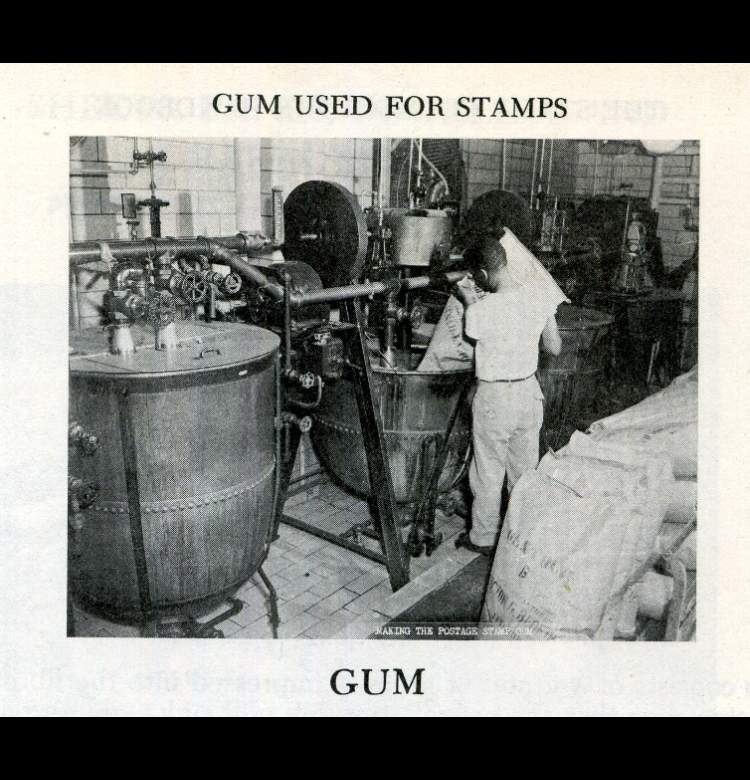 |
|
Send note to Staff
|
|
|
Pillar Of The Community
United States
1947 Posts |
|
| |
Replies: 12 / Views: 6,683 |
|




 Posted 06/29/2009 2:52 pm


 k
k


