Quote:
How about the years after QV?
Did the empire expand during the reigns of Edward VII and George V? I assume it began to contract during the reign of George VI]
Quote:
actually, Victoria's grandson, George V, held a larger empire. Britain acquired large territories after WWI, including the Middle-East regions (Palestine, Transjordan and Mesopotamia/Iraq) from the Ottomans and several African (Togo, Cameroon, South-West Africa and Tanganyika) and Indian Ocean territories (New Guinea, Western Samoa and Nauru) from Germany
This is complicated, as there was a gradual transition from British Empire to British Commonwealth - so in the early 1900s Australia, Canada, New Zealand and South Africa were granted "dominion" status, i.e. able to govern themselves, with power held by the local colonials (eg in the case of South Africa there were only token concessions to the majority population).
So these countries couldn't really be regarded as part of an "empire", which requires central rule by the metropolis - eg South Africa nearly voted to stay out of the second world war.
And I guess that the loss of the "dominion" countries from empire rule more than counterbalanced the gain in territories after the first world war, as both the areas and the populations of the dominions were relatively high.
The first territory where real control was given to the indigenous inhabitants was India / Pakistan, granted independence within the Commonwealth in 1947, ie the same "dominion" status held by Canada etc.
At first these effectively independent countries became members of the British Commonwealth - which is now called the "Commonwealth of Nations." It has no role in government, being a voluntary group of countries (and including several countries that were never part of the British Empire).
As good old Wikipedia says:
"The Commonwealth of Nations — formerly the "British Commonwealth" — is a voluntary association of 54 independent sovereign states, most of which are former British colonies, or dependencies of these colonies with three exceptions, Mozambique (which was a Portuguese possession), Rwanda (which was a Belgian mandate) and Cameroon

(which was partly a German territory and partly French and British colony) plus the United Kingdom itself. The Commonwealth's membership includes both republics and monarchies. The head of the Commonwealth of Nations is Queen Elizabeth II. She also reigns as monarch directly in a number of states, known as Commonwealth realms, notably the United Kingdom, Australia, Barbados, Canada, Jamaica, and New Zealand. The Commonwealth of Nations is sometimes referred to as the New Commonwealth in a British context."
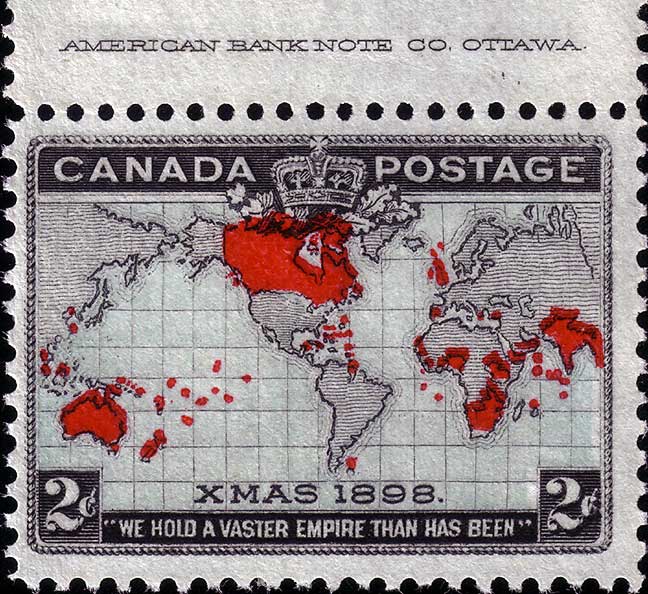
So when the British Empire was greatest is a very tricky issue, probably impossible to establish - the most "red on the map" just after the 1st world war, the largest area directly controlled from Britain probably the late 1800's. Just how complicated is illustrated by another extract from Wikipedia about Canada:
"In 1867, with the union of three British North American colonies through Confederation, Canada was formed as a federal dominion of four provinces. This began an accretion of provinces and territories and a process of increasing autonomy from the United Kingdom. This widening autonomy was highlighted by the Statute of Westminster of 1931 and culminated in the Canada Act of 1982, which severed the vestiges of legal dependence on the British parliament."
So when did Canada stop being part of the British Empire? I dunno!





 Posted 12/07/2010 11:07 am