| Author |
 Replies: 16 / Views: 2,405 Replies: 16 / Views: 2,405 |
|
Pillar Of The Community
Canada
923 Posts |
|
|
I ran across this item several years ago loose in a haphazard box of Indian Material. I am not even certain that it qualifies as a "postal" item though it definitely seems to be a communication of some sort (rather than someone's grocery list). You can see that it has been folded vertically and tucked under a folded flap at the edge of side two. Here is what little I have been able to glean, most coming from the grandfather of an student I had in a Grade 6 class about 15 years ago. 1. It's origin is somewhere in Southern India. 2.There are 3 languages represented on it, one of which is Sanskrit. 3. Somewhere in one of the circular sstamps there is a date in a regional calendar that translates out to mid 1700s. No other information was obtained. Tried sending a photocopy of the item to the Asian Studies Dept. at UBC in Vancouver, and to the same Dept. at you of S in Saskatoon (where I attended University) but received no reply in either case. Can anyone shed any further light on the subject or suggest another contact? 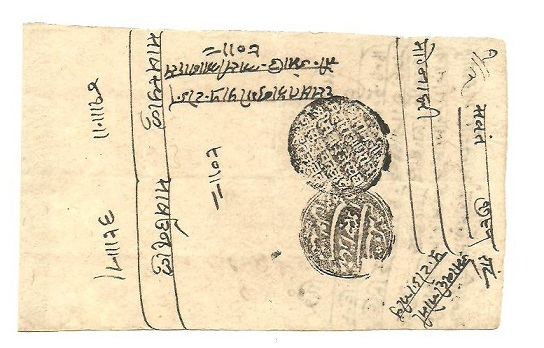 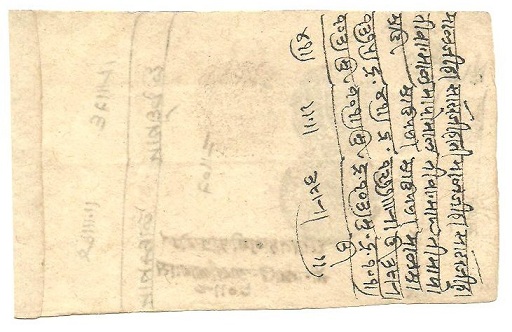 |
|
Send note to Staff
|
|
|
|
|
Pillar Of The Community
Australia
3547 Posts |
|
|
I'll defer to your first informant, but I would have thought the combination of Nagari and Persian scripts make it more likely to be North Indian. I can't spot a date there, but I do think I see references to sums of money.
My best guess, for what it's worth, is that the two seals are personal seals, representing signatures, and that the document is some sort of agreement or contract. |
Send note to Staff 
|
|
|
Pillar Of The Community
Canada
923 Posts |
|
|
Great! That all makes sense to me. In the first instance, Grandfather was just visiting and spoke no English. Grandson, who only sort of spoke Hindi, was translating as best an 11 year old could. Still, I am going to continue carrying this in my back pocket and attempt to find someone fluent in the languages involved. You mentioned Nagari and Persian scripts. Is Sanskrit, as a language, being used on the document? |
|
Send note to Staff
|
|
|
Pillar Of The Community
Australia
3547 Posts |
|
|
Backroads, Sanskrit is the ancient Indian language - akin to Latin. It's only found in ancient writings, and hasn't been in common use for well over 2000 years. There are numerous children (and grandchildren) of the Sanskrit script in use today across the northern part of India, the most widespread being Nagari ('city writing'), used to write Hindi and many other northern languages.
Urdu is very similar to Hindi, but written in Persian script, and was still regularly used across northern India a century ago by the educated classes, both Hindu and Muslim. Persian itself was also used in the same way, and you can find them mingled together. Persian occupied a position rather like that French did in Europe a century ago: every educated European would have known French, whatever their native language was. Similarly, the Urdu/Persian script was widely used in non-Muslim areas, despite its Muslim connotations. These days, Urdu appears on Pakistani stamps.
I'd certainly hang onto that document until you can find someone who can read it. That may not be an easy task, of course. How easy would you find it to read a 300 year-old handwritten English loan agreement? And anyway, the seals are delightfully decorative! |
|
Send note to Staff
|
| Edited by tonymacg - 01/05/2011 4:44 pm |
|
|
Valued Member
Canada
322 Posts |
|
|
This isn't Urdu or Persian. Its Hindi. The letter is sideways. Look at the top of the words, they are in a line with the other letters hanging out like in normal Hindi script. |
|
Send note to Staff
|
|
|
Pillar Of The Community
Australia
3547 Posts |
|
|
Actually, I was referring to the second of the seals. It is in Persian/Urdu. The body of the letter is certainly in Nagari script, but I'm not sure it's necessarily Hindi. |
|
Send note to Staff
|
|
|
Valued Member
Canada
322 Posts |
|
|
Quote:
Actually, I was referring to the second of the seals. It is in Persian/Urdu. The body of the letter is certainly in Nagari script, but I'm not sure it's necessarily Hindi. Oh sorry, I didn't see the second stamped image. |
|
Send note to Staff
|
|
|
Pillar Of The Community
Canada
923 Posts |
|
|
If this is a legal document, a contract of some sort, could the old gentleman's reference to Sanskrit just indicate a "lingua franca" - as Latin was used in Europe as a common language of trade and legalese? |
|
Send note to Staff
|
|
|
Pillar Of The Community
Australia
3547 Posts |
|
|
We're entering deep waters here, Backroads, and you have my permission to stop reading as soon as you feel your eyes glazing over. As a translator (but not of South Asian languages) in my other life, I find this sort of discussion fascinating, I'm afraid.
The more likely lingua franca in North India at this sort of time would have been Persian/Urdu, but the body of this document is written in a North Indian script. My guess is that your elderly gentleman called it 'Sanskrit' because it was the term most likely to be understood by a non-linguist European. To reverse the situation, you might imagine an Indian describing some unintelligible European manuscript to another Indian as being written in 'English' - meaning the script, but not necessarily the language, which might, say, have actually been Romanian.
The actual reading of the document could be even more of a problem because it's only in fairly recent times that spellings and vocabularies have been regularised through mass education and the publication of dictionaries. In English, the process only really got under weigh with Dr Johnson's dictionary in the 18th Century, and we're all familiar with the differences in spelling today between UK and North American English.
Then, back when this document was likely written, there would have been no standard vocabulary: no dictionary to appeal to, to determine whether a word was a 'proper' word or not. Writers would have freely used local dialect words, Persian or Arabic words for legal concepts that didn't exist in their own languages and perhaps indeed words lifted from the ancient Sanskrit. On top of that, with no formal grammar textbooks, or teaching of formal grammar, it's pretty likely the writer of the document used his own particular understanding of grammar, which may not have been that shared by others of his contemporaries.
I see a lot of this sort of thing going on today in an Indonesian language and translation bulletin board I follow. Indonesian is a good example of an evolving lingua franca. It originally developed from the Malay spoken by the traders of the Riau region in southern Sumatra. It originally included words borrowed from Arabic, Persian, Sanskrit (again!), Portuguese, Chinese and so on, and as modern Indonesian, it has picked up more words from other Indonesian dialects and other languages. There's still a great deal of confusion over some of these modern borrowings: are they permissible (because they're not yet in the Dictionary)? How to spell them, borrowed English words in particular? (There has just been a furious online debate about the proper [i]Indonesian[/] spelling of the borrowed word 'cartridge'. Indonesian spelling is quite straightforward - words are written as they're pronounced - unlike English.)
All of which is a very long-winded way of saying that reading your document could be a great headache ... |
|
Send note to Staff
|
|
|
Bedrock Of The Community
Australia
38679 Posts |
|
|
Fascinating.
I liked your usage "under weigh"
I have never read this option before, but being a sailor
immediately identified with it, "weighing anchor"
always meant to me, leaving port and on our journey.
The word still engenders excitement as leaving
a place of comfort and familiarity, with the wonder
of a port somewhere in a country some way off.
|
|
Send note to Staff
|
|
|
Pillar Of The Community
Canada
923 Posts |
|
|
Glaze over? Never. It just leaves me more curious than ever as the growth and change of language has always fascinated me. It's just unfortunate that, while I have a nephew who works as a translator in Taiwan, I have no-one to turn to for the Indian sub-continent. |
|
Send note to Staff
|
|
|
Pillar Of The Community
Australia
3547 Posts |
|
|
I should have checked before using it, Rod, but I'm fairly certain it was the original spelling, and that the derivation was indeed nautical. (Like a number of other English phrases which have become corrupted over the years: 'by the bye' and 'if worse comes to worst' spring to mind.) |
|
Send note to Staff
|
|
|
Pillar Of The Community
Australia
3547 Posts |
|
|
Quote:
It's just unfortunate that, while I have a nephew who works as a translator in Taiwan, I have no-one to turn to for the Indian sub-continent. Backroads, if you were willing to pay for the translation, it could possibly be done. I continually receive enquiries from India about translation work, despite not handling any of the languages professionally. The cost shouldn't be too awful - as you have a family connection with the translation business, you will be prepared for just how expensive we can be  I'd only caution in advance that it might be difficult to get a complete and useful translation, for the reasons I suggested. If you want to go ahead though, I can suggest a couple of places to start from. |
|
Send note to Staff
|
|
|
Pillar Of The Community
Canada
923 Posts |
|
|
Thrill of the chase???? Possible real-time solution ????? Thrill of the chase .... etc. Quite seriously, if you have a contact name or organization that does translation of this type of document, it would be appreciated though it still is fun trying to run an answer down on one's own. All this discussion has suggested a possible place - I may just wander over to the local Sikh temple and find out if I can be put in contact with someone in their community that has an interest in language. Never can tell. |
|
Send note to Staff
|
|
|
Pillar Of The Community
Australia
3547 Posts |
|
|
Backroads, your local Sikh temple might work rather well. I'd give it a try first. You may be able to at least identify what sort of document it is, and then decide if it's worth proceeding to a full translation. The biggest online translator exchange Web site is www.proz.com. You can post jobs available there for free - and then sift through the 100 trillion responses you get offering you Swahili to Dutch translations and the like, to find a suitable translator. You should be able to cut down on the irrelevants if you word your post fiercely enough. For this sort of work, you could expect to pay around $0.05 an English word, though the translator may well impose a minimum charge. (I charge $A40 - as for 200 English words.) Good luck - and do tell us what you discover! |
|
Send note to Staff
|
|
|
Rest in Peace
Canada
5701 Posts |
|
|
Replies: 16 / Views: 2,405 |
|




 Posted 01/04/2011 5:32 pm


