| Author |
 Replies: 58 / Views: 14,722 Replies: 58 / Views: 14,722 |
|
|
|
Bedrock Of The Community
Australia
38679 Posts |
|
|
I am going to throw a hand grenade here,
Stallzer has a "Line Pair" right?
He <does not> have a joint line pair, right?
A "joint line pair" is a "paste up pair" with a line between.
Have we missed a subtlety?
|
Send note to Staff 
|
|
|
Pillar Of The Community
United States
5894 Posts |
|
|
Bedrock Of The Community
Australia
38679 Posts |
|
|
Pillar Of The Community
United States
5894 Posts |
|
|
Ah, that makes sense. The Scott Specialized catalog uses the term "Join Line Pair" for modern coil stamps, so I don't think that the term can be understood to imply only paste up pairs. __________________________________________ I will add that since I first saw Stalzer used the term, I pondered why there would be the need of the descriptor "joint" if it was already a pair.  |
|
Send note to Staff
|
| Edited by smauggie - 01/09/2011 09:25 am |
|
|
Bedrock Of The Community
Australia
38679 Posts |
|
|
Admittedly, my reference is aged, but shows Stallzer's
example as a "line pair"
With respect, I await others adjudication.
|
|
Send note to Staff
|
|
|
Pillar Of The Community
United States
7104 Posts |
|
|
I've understood the "joint" to refer to the meeting up of the printing plates, making "joint line" the full description of the line, itself. |
|
Send note to Staff
|
|
|
Pillar Of The Community
United States
2480 Posts |
|
|
Let me throw myself on the grenade by first offering the following compilation from the USSS Glossary. Quote:
Guide Line Pair - a pair of flat plate stamps with a segment of a guide line between them. This term is most commonly used in association with coil stamps.
Guide Lines - lines inscribed on a plate as an aid to perforating or cutting a sheet into panes. Guide lines are not the same as Joint Lines.
*Joint Line - the printed line produced on the web by the rotary press at the point where two plates met. Two plates were used in combination with each other on the classic rotary press. Each plate would fit over half of the printing cylinder. Ink would gather in the joints between the plates, leaving an impression (a joint line) on the web. One complete revolution of the press cylinder created two joint lines on the web. Joint lines were produced on both sheet and coil stamps, but only those produced on the coil stamps are commonly collected. A Joint Line is not the same as a Guide Line.
Joint Line Gap Pair - A joint line pair of precancelled coil stamps that shows the gap between the auxiliary plates used to print the precancel.
*Joint Line Pair - a pair of coil stamps produced from the rotary press with a joint line between them. A joint line pair will contain one stamp from each of two different plates. See also Joint Line.
Line Pair - see Joint Line and Guide Line.
Paste-up - the location on a flat plate coil stamp (or, more commonly, on a pair or more of such stamps) where two sheets of flat plate stamps were pasted together. Rolls of coil stamps were made from lengths of flat plate sheets that were 20 stamps long. Thus a paste-up is normally found at 20 stamp intervals.
Paste-up Pair - a pair of coil stamps joined together by a paste-up.
From the above, it seems the key determinant is whether the stamp was printed using the flat plate or rotary press method. And from 1847USA.com comes the following: Quote:
Note that this is the only Franklin Head that was printed using the Rotary Press Method. Therefore, if the 10¢ Franklin is rotary, i.e. wider than the flat plate stamp, it must be genuine. It is unlikely that unused copies of this stamp would be faked by trimming a perf 10 stamp, since the coil is less expensive than the fully perforated stamp in the unused state. If all of the above are taken as true, then Stallzer's pair of 10 cent Franklins (U.S. Scott 497) is a joint line pair. |
|
Send note to Staff
|
|
|
Pillar Of The Community
United States
2547 Posts |
|
|
Coils made from flate plate printing used the same plate layout as was used for the sheet stamps with the vertical and horizontal guideline (guigeline pair). Coils from rotary pess produced a ink line at the joint of the plates *joint line pair). Flat plate coils were pasted together with a lap joint every 20 stamps (paste-up pair). Early rotary coils were continuous for the length of the roll. Shorter than roll length remainders were cut on the joint lines and perforated into panes (150 or 170 stamps) and perforated as sheet to produce the coil waste stamps. Later the rotary press remainders were spliced together on the joint line to produce splice pairs. 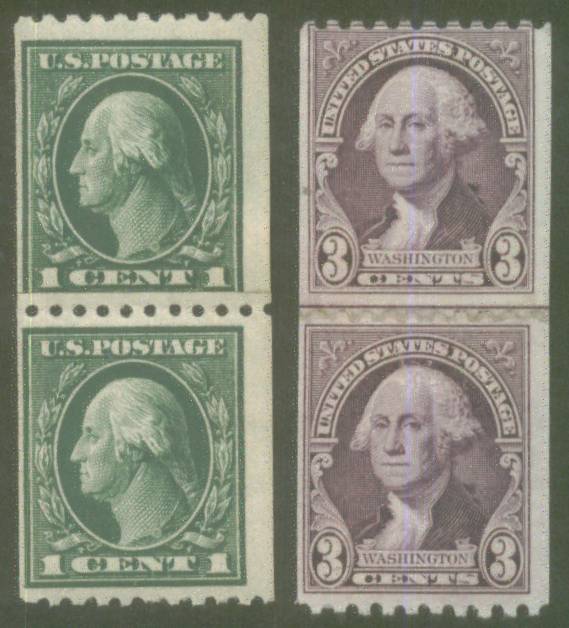 Above is 441 (flat plate) paste-up and 722 (rotary) splice. The paste-up can be seen at the bottom of the design of the top stamp. The splice can be seen at the edge of the perforations between the 2 stamps. 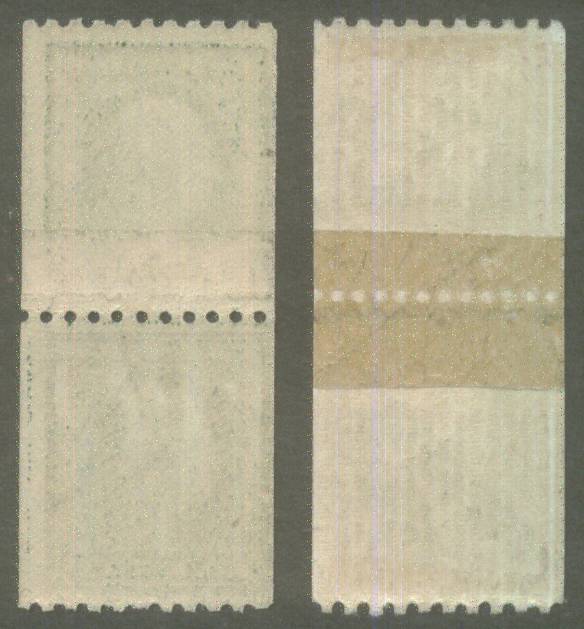 From the back the paste-up can be seen about 1/4 the way up the top stamp. the splice is very visible on the rotary (right) stamp. |
|
Send note to Staff
|
|
|
Pillar Of The Community
United States
6668 Posts |
|
|
Bedrock Of The Community
Australia
38679 Posts |
|
|
Quote:
I will add that since I first saw Stalzer used the term, I pondered why there would be the need of the descriptor "joint" if it was already a pair. What had me smelling a rat, was the price. I could imagine a "paste up joint line pair" attracting a $300 price tag, but not a line pair. |
|
Send note to Staff
|
|
|
Pillar Of The Community
United States
6668 Posts |
|
|
I am just going off my 2009 Scott Specialized catalog. There are 2 types of pairs listed for the 497, 1st is just a plain old pair never hinged @ $95.00 and below that is listed Joint line pair @ $280.00 for never hinged. The Philatelic dictionary states the following. A line pair in philately is a coil pair of postage stamps bearing an inked line between the two stamps. There are at least two kinds of these: * A guide line pair has a guide line between the stamps. Since the guide lines are deliberately incised into the plate, they will generally be sharp and clear. * A joint line pair has a joint line between the stamps, deriving from the seam in the cylindrical plate used to print the stamps. Also - Line Pair - "see Joint Line and Guide Line". So the last line of "See joint Line" tells me that we are simply talking about different terminology, that is all. It does appear as if I've landed a joint line pair of 497's. There is no listing of a Guide line pair on this Stamp but Scott #'s 441 - 447 list guide line pairs, not Joint line pairs so there is a difference. 1 other thing that should end all doubt, here is the exact same pair with a certificate http://cgi.ebay.com/USA-497-VF-NH-J...em3f04837a0f |
|
Send note to Staff
|
| Edited by stallzer - 01/09/2011 4:17 pm |
|
|
Pillar Of The Community
United States
2547 Posts |
|
|
The 497 pair you posted is definitely a line pair. The whole issue becomes terminology. Flat plate (coils through Scott no. 447) have the guideline and are very clear and crisp. 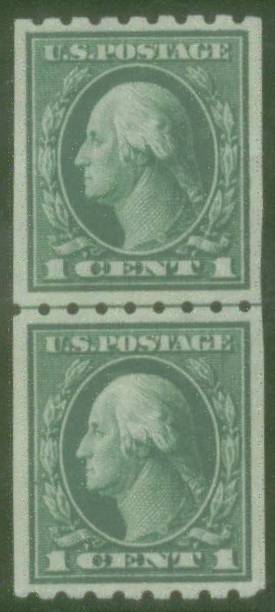 410 Guideline (flat plate) 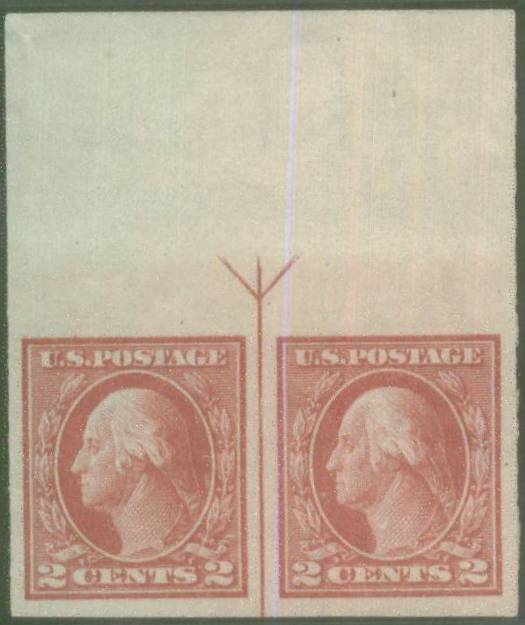 The source of the line is the guidelines on the sheet. Rotary press (coils from Scott no. 448 and higher) have the joint lines and tend to be blurred and less defined. 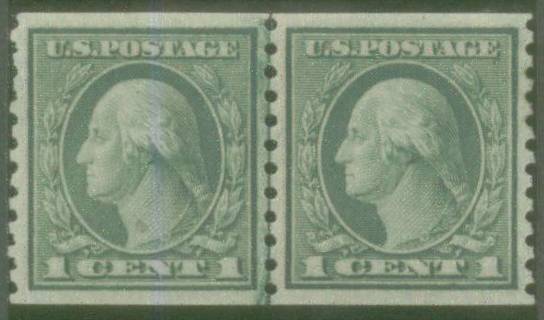 490 joint line (rotary press) 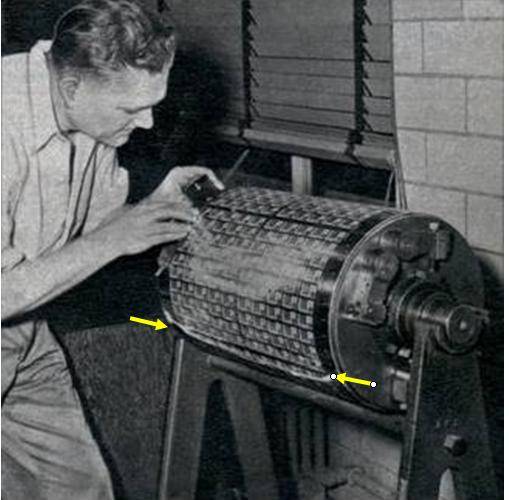 The source of the line is ink from the joint between the two plates (see arrows). |
|
Send note to Staff
|
|
|
Pillar Of The Community
United States
6668 Posts |
|
|
Valued Member
Australia
312 Posts |
|
|
Hi stallzer,
The PSE population report only refers to stamps certified by PSE. So that is the total number sent to them for certification/grading and not the total in existence.
Very nice Line Pair btw, a great find!
Balf |
|
Send note to Staff
|
Be yourself. Everyone else is taken. |
|
|
Pillar Of The Community
United States
6668 Posts |
|
|
I now realize that, after further reading through the population report I see that they only show 17 used C1 - 6¢ Jenny's. There are probably at least that many on ebay right now. BTW, Thanks. |
|
Send note to Staff
|
|
|
Replies: 58 / Views: 14,722 |
|




 Posted 01/09/2011 02:00 am