| Author |
 Replies: 8 / Views: 4,939 Replies: 8 / Views: 4,939 |
|
|
Pillar Of The Community
Canada
923 Posts |
|
|
I am guessing that this item was a favor cancel for someone as the actual envelope does not appear to have been in the mails. I am also guessing that the occupation iss is, in fact, Burmese, and that the cancellation originates in that country and indicates a date in 1944. Can anyone confirm the stamp's origin? Or recognize the postmark? Or explain why all of the pre-printed envelope is in English with not a trace of Japanese or Burmese script anywhere on the cover except for the stamp and the postmark? 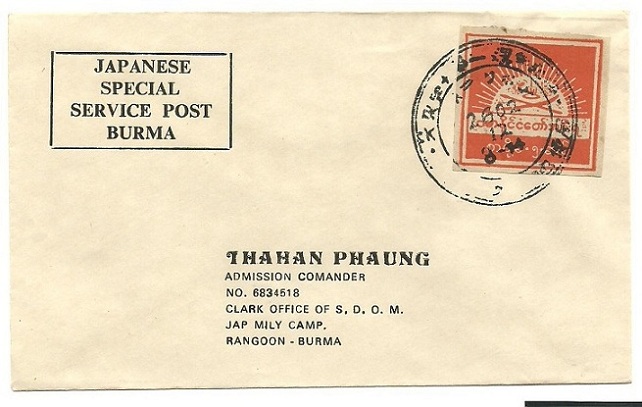 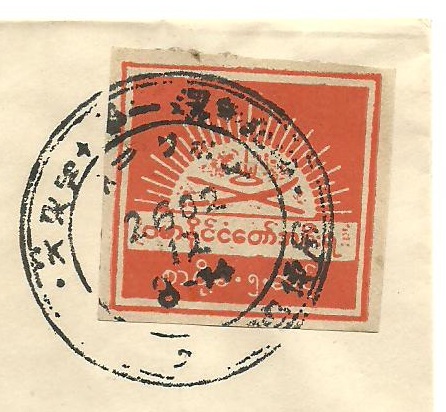 |
|
Send note to Staff
|
|
|
|
|
Pillar Of The Community
United States
2758 Posts |
|
|
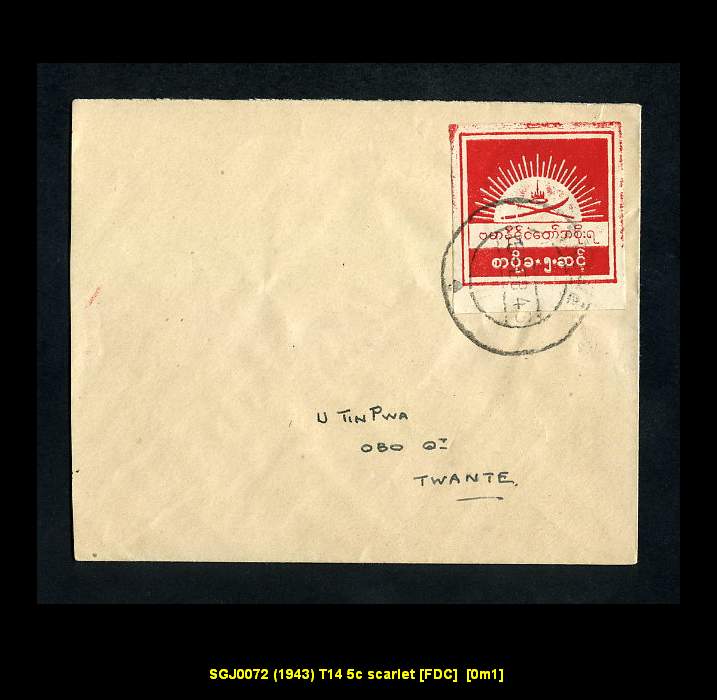
The stamp displays the crest of the Burma State Government a puppet state of Japan.
Issued on Feb. 15, 1943 was intended to be used to be affixed over the top of a embossed George VI envelope stamp, but are known on other envelopes.
This being from Rangoon, was not retaken by the allies until May 3, 1945.
The name appears to be Burmese not Japanese.
|
Send note to Staff 
|
|
|
Bedrock Of The Community
Australia
38679 Posts |
|
|
Pillar Of The Community
Canada
923 Posts |
|
|
Thanks both. I guess it's off into the wilds of Google to see what I can find out about that military camp. |
|
Send note to Staff
|
|
|
Pillar Of The Community
Australia
3547 Posts |
|
|
Backroads, I think your cover looks very, very dubious. There are numerous fakes and manufactured items from the Japanese occupation of Burma. Many originated in the early days after liberation in 1945: a number of philatelically-minded gentlemen created all sorts of items for sale to the collectors among the Allied troops.
The cancel on your cover would concern me. The lettering at the top of the cancel seems to have been damaged: it isn't Burmese, nor is it Japanese. The lettering around the bottom has also been damaged. I can make out (Japanese) 'go' (part of Rangoon?) and 'Post Office'. The date is given in the Wartime style. This is also a problem: the year shown is 2602, which would have been 1942 - but this stamp wasn't issued until 1943.
The misspelling 'clark' for 'clerk' is strange. 'Clerk' is one English word I'd have expected every educated Burmese to know, because so many held clerical positions in the administration. The use of English itself isn't quite so strange. It was necessary to retain it to an extent, to allow communication between the locals and the Japanese. However, the cover has a distinctly made-up look about it.
Of the stamp itself (SG J72), Gibbons says 'No. J72 was usually sold affixed to envelopes, particularly those with the embossed 1a. King George VI stamp, which it covered.' This makes any other use prima facie suspect.
Taken all in all, I'd say the stamp might be OK, but everything else about the cover gives off a bad smell of fish. |
|
Send note to Staff
|
|
|
Pillar Of The Community
Canada
923 Posts |
|
|
Thank you, Tony, for the information and for confirming my suspicions about what I called a favor cancel and a somewhat wonky envelope. I also note a very obvious difference in the colour of mine compared to the colour shown in Rod's cover. Significant?
I am still going to dig after the history aspect - I get sidetracked easily. |
|
Send note to Staff
|
|
|
Pillar Of The Community
Australia
3547 Posts |
|
|
Backroads, I couldn't agree more strongly with you on digging into the history - both general and philatelic - of the period. I see the occasional snapshot of it in the India Study Circle journal, and it's clearly fascinating.
As to the difference in colour between your copy of the stamp and Rod's, I can't comment definitively of course. But when you consider that the stamps were printed in Rangoon, by a printer with no experience of printing stamps, in the middle of WWII, a bit of variation doesn't seem too madly unlikely. |
|
Send note to Staff
|
|
|
Bedrock Of The Community
Australia
38679 Posts |
|
|
That sort of history intrigues me, and one never hears about
the background,
Burma WW2, where did they source their inks?
how did they mix the colours etc, who drew the design
etc. Compelling stuff.
|
|
Send note to Staff
|
|
|
Pillar Of The Community
Australia
3547 Posts |
|
|
According to Gibbons, locals were the sources of the designs, presumably after careful inspection by the Kenpeitai. The inks and papers, I don't know about. Kolff in Batavia/Jakarta seem to have operated pretty well throughout the War - they did the 1943 definitives for Burma - probably using inks from Japan. Some of the papers used in Burma suggest desperate, or at least economy, measures, probably while awaiting the supplies from Batavia.
There seem to have been all sorts of philatelic shenanigans immediately after Liberation in 1945. For one thing, if I remember aright, the plates for the Chalo Delhi stamps turned up in Rangoon, in rather dubious company. |
|
Send note to Staff
|
|
| |
Replies: 8 / Views: 4,939 |
|




 Posted 01/30/2011 7:03 pm