Stamp Community Family of Web Sites
Thousands of stamps, consistently graded, competitively priced and hundreds of in-depth blog posts to read


Stamp Community Forum
 
Username:
Password:
Save Password
Forgot your Password?

This page may contain links that result in small commissions to keep this free site up and running.

Welcome Guest! Registering and/or logging in will remove the anchor (bottom) ads. It's Free!

US : Paper : Double Paper.

 
To participate in the forum you must log in or register.
Author Previous TopicReplies: 4 / Views: 1,815Next Topic  
Bedrock Of The Community
Australia
38679 Posts
Posted 06/05/2011   10:58 am  Show Profile Bookmark this topic Add rod222 to your friends list Get a Link to this Message
(US) Double Paper

A type of paper invented and patented by C. F.
Steel in the U.S.A. about 1870, and consists
of two thin sheets of differing character, substance,
tint, or colour, cemented together.

Designed to prevent forgery, erasure, and
tampering, e.g. a 'security' paper. It was
(vide Gibbons) used for printing some of the
1873 (official) issues of the U.S.A.

There is a modern tendency to use the term for
double-thick paper which makes for confusion.

- R. J. Sutton 6th edition revised by K. W. Anthony
The Stamp Collector's Encyclopaedia
Published 1966

Note:
Playing upon the government's fear of
counterfeiting, Steel inaugurated another
set of paper experiments in 1875, while
working at the new Continental banknote
contractor's plant. The first was another
double paper experiment. The January
1877 Coin and Stamp Journal reported
this 1875 experiment, "It is not generally
known, and will be news to our collectors,
that about a year ago, 20,000,000 stamps
were issued to the public, printed on
double paper. The upper portion receiving
the impression was soft and porous and
it was supposed that any attempt to
clean off the canceling mark would render
the impressed portion perfectly pulpy and
thus effectively destroy it. The stamps did
not meet with much favor and the plan was
abandoned."

George Sloane gave a different version of
this story. He reported that from
January 1, 1875 until April 15th, 28 million
such stamps were issued. They were
ordered withdrawn on the 15th because
of complaints from postmasters that the
top layer of paper had a tendency to
shrink away from the heavier backing
causing tears, and would not pack
resulting in confusion in accounts, loss
of time, and great waste as a
consequence of stock that was
returned from the postoffices.

It is not clear that the experiment
was stopped at this point, for the
5˘ Taylor which was printed later and
sent to postoffices in June 1875
(although its earliest use is currently
July 12th) is recorded on thin paper
as early as lot 630 in the
Worthington sale of 8/21-23/1917.

To the extent that the top layer
was a thin soft paper, the thin paper
stamps we know do not fit this
patent, but it is not improbable that
a reverse paper process was used
with a thin hard paper on top and
a thicker soft paper below.

Sloane comments that the 2˘
Continental brown double paper is
frequently mistaken for the
American soft paper special printing
(Scott 193), which is not known used.
Send note to Staff

Pillar Of The Community
United States
2547 Posts
Posted 06/05/2011   12:38 pm  Show Profile Bookmark this reply Add Russ to your friends list  Get a Link to this Reply
Rod, thanks for bringing up this subject, a very interest part of U.S. stamp production.

Charles Steel had a large influence on U.S. stamps. He was National Banknote Co (ABC) superintendent and was the patent holder for the grill concept used by NBC from 1868-70. When Continental Banknote Co. (CBN) won the stamp contract in 1873 Steel jointed them in the same capacity that he had at NBC (which explains the grills on some CBN stamps). With the merger of CBN and American Banknote Co. (ABC) he continued at the same position.

In 1893 he pursued the contract as an independent entity and attempted to sue the Post Office Department and the Bureau of Engraving and Printing (BEP) over the award of the contract to BEP.

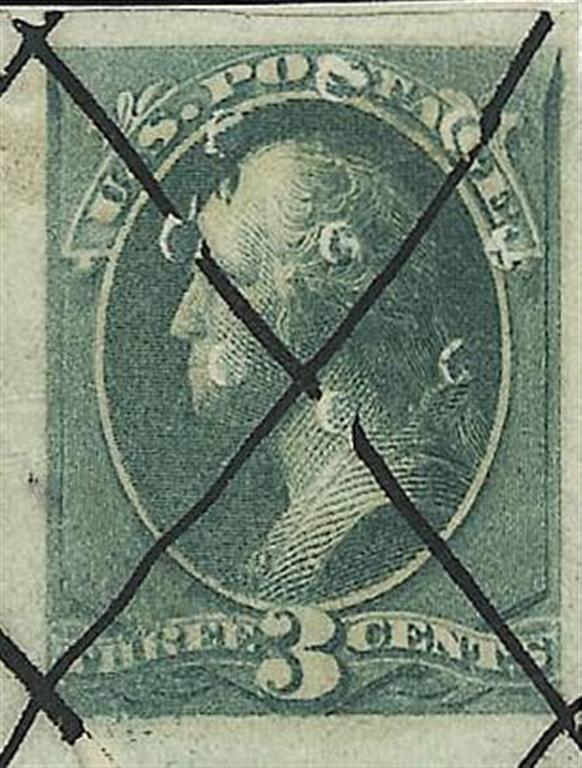
Here is an example of the Scott 158 (CBN) double paper on cover
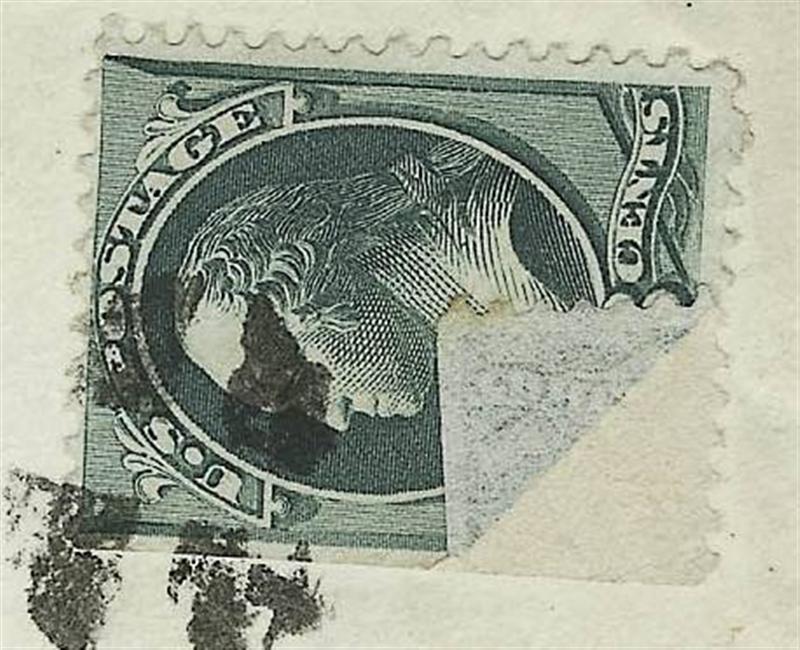


In addition to these double paper issues some experimental double paper issues were applied to the 1881 re-engrave ABC issues (Scott 206, 207 and 209)

Here is an example of the Massey double paper large hole punch on a Scott 207
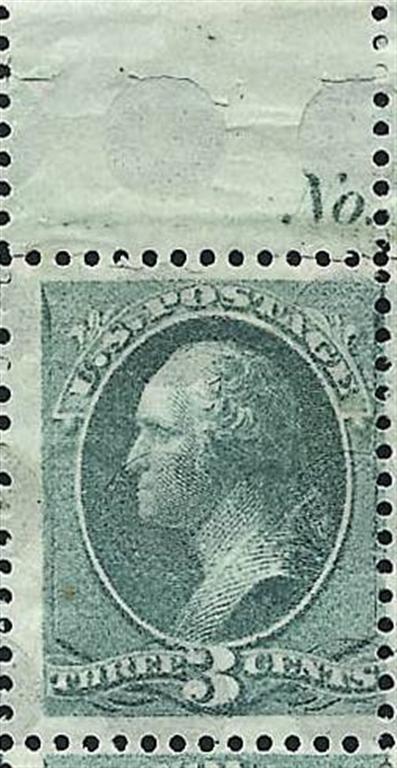


And another double paper variety the Douglas 8 hole punch on Scott 207


Send note to Staff  Go to Top of Page
Bedrock Of The Community
Australia
38679 Posts
Posted 06/05/2011   10:31 pm  Show Profile Bookmark this reply Add rod222 to your friends list  Get a Link to this Reply
Great stuff Russ,
the images are the icing on the philatelic cake.
I hadn't seen these before.
Send note to Staff  Go to Top of Page
Pillar Of The Community
United States
2547 Posts
Posted 06/06/2011   9:01 pm  Show Profile Bookmark this reply Add Russ to your friends list  Get a Link to this Reply
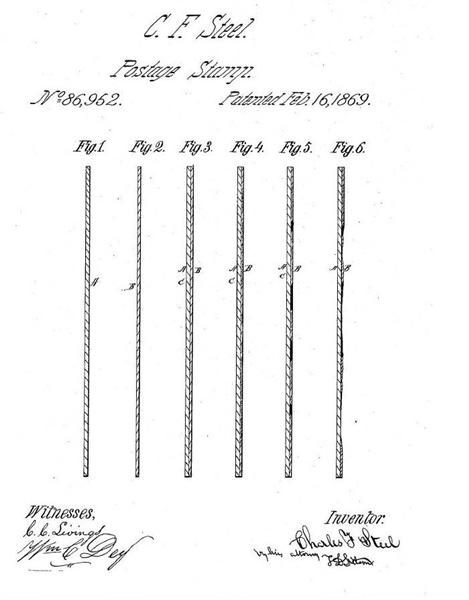
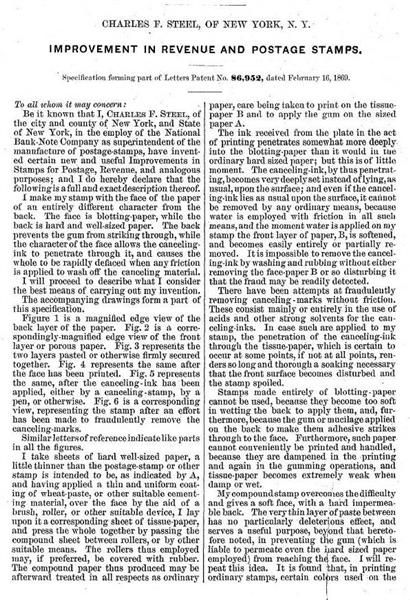
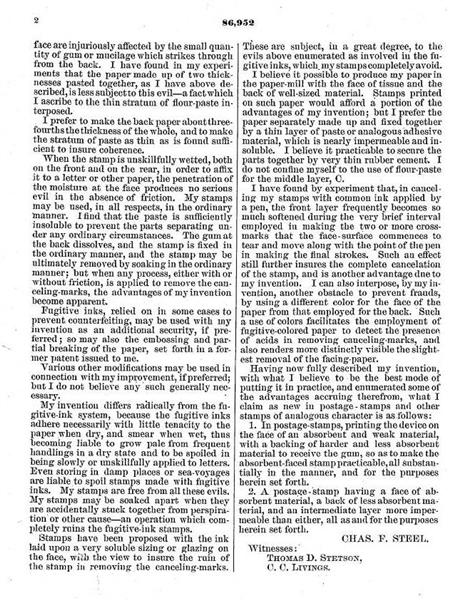
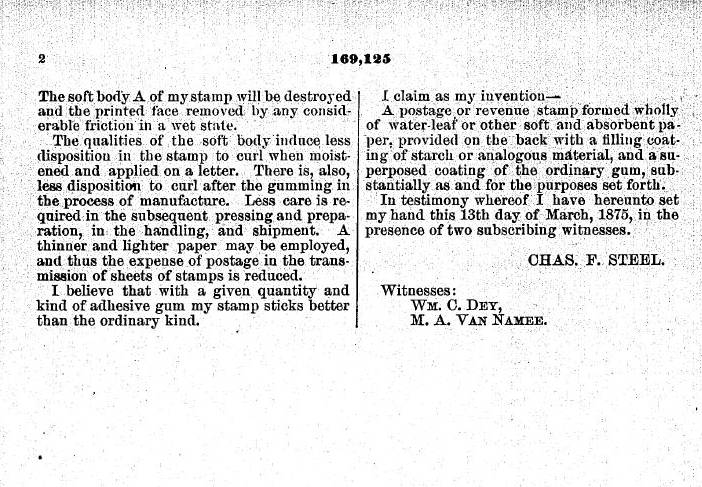
This is the Charles Steel patent for the double paper stamps.


Send note to Staff  Go to Top of Page
Pillar Of The Community
United States
2547 Posts
Posted 06/08/2011   12:28 am  Show Profile Bookmark this reply Add Russ to your friends list  Get a Link to this Reply
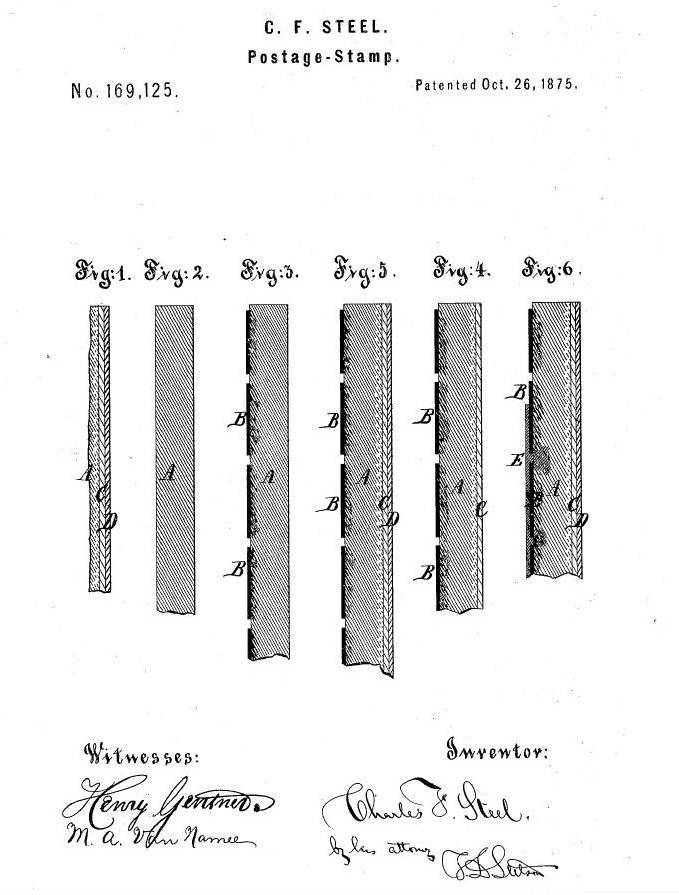
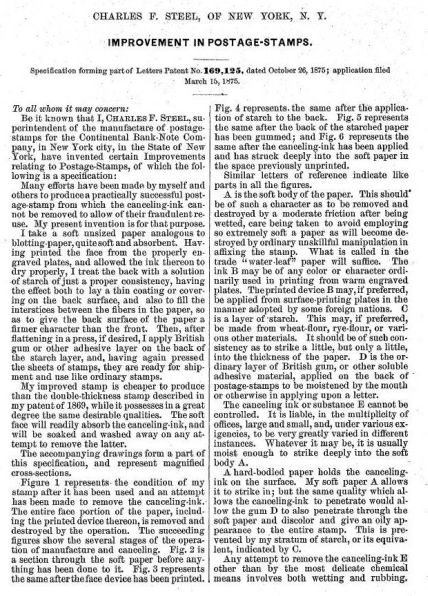
Another interesting Charles Steel patent to prevent stamp re-use involving vegetable starch backed paper.


Send note to Staff  Go to Top of Page
  Previous TopicReplies: 4 / Views: 1,815Next Topic  
 
To participate in the forum you must log in or register.

Go to Top of Page

Disclaimer: While a tremendous amount of effort goes into ensuring the accuracy of the information contained in this site, Stamp Community assumes no liability for errors. Copyright 2005 - 2026 Stamp Community Family - All rights reserved worldwide. Use of any images or content on this website without prior written permission of Stamp Community or the original lender is strictly prohibited.
Privacy Policy / Terms of Use    Advertise Here
Stamp Community Forum © 2007 - 2026 Stamp Community Forums
It took 0.27 seconds to lick this stamp. Powered By: Snitz Forums 2000 Version 3.4.05