| Author |
 Replies: 9 / Views: 4,273 Replies: 9 / Views: 4,273 |
|
|
Valued Member
67 Posts |
|
|
|
|
Pillar Of The Community
Australia
898 Posts |
|
|
Jcstamp hello and WELCOME, thank you for the effort put into this post, has my undivided attention. |
Send note to Staff 
|
|
|
Pillar Of The Community
United States
2547 Posts |
|
|
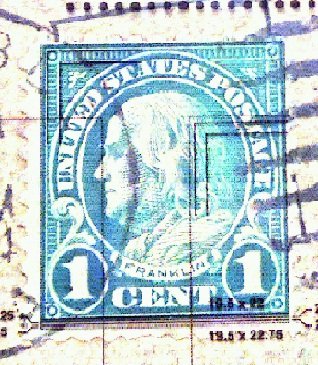
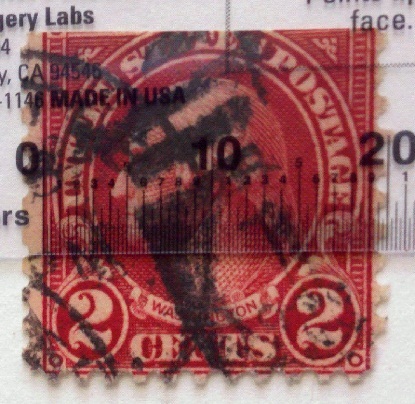
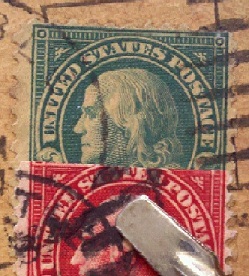
Jcstamp. Welcome to SCF. Looking at the measurements the stamp appears to be slightly under 19.5mm wide. The flat plate width is nominal 19.25 but 19.5 is within variance due to inconsistency in shrinkage. The flat plate process used wet paper which was normally 20-40% moisture content. Paper that was drier would experience less shrinkage. The Rotary press was was 19.75 wide and was also subject to shrinkage but in no case would the width be below 19.65-19.70.
The stamp is 552 at the upper limit of width. |
|
Send note to Staff
|
|
|
Valued Member
67 Posts |
|
|
Thank you for your input Russ. I did need to know that it should be more than 19.5mm rather than to 19.5mm minimal. I will continue the search for and try to organize my aunts collection.  I look forward to it. Thanks again. |
|
Send note to Staff
|
| Edited by Jcstamp - 06/07/2011 8:33 pm |
|
|
Pillar Of The Community
United States
1947 Posts |
|
|
Does anyone know of a device to measure stamp widths and heights beyond the millimeter scale. Use of the scale is iffy at best, particularly when you are trying to distinguish a fraction of a millimeter. Surely in this digital age there is a digital way which can be used and is very accurate.
I noticed on the measurements pictured in the images above that the scale(s) do not line up well with the zero mark. In some cases, differences in measurement is less than the width of the lines used to make the scale. (Not necessarily in this case, though). |
|
Send note to Staff
|
| Edited by rohumpy - 06/08/2011 05:35 am |
|
|
Pillar Of The Community
Australia
898 Posts |
|
|
Rohumpy, using the two top or bottom measuring arms on these vernier calipers, very precise.  |
|
Send note to Staff
|
|
|
Bedrock Of The Community
Australia
38679 Posts |
|
|
Maybe I am stating the obvious,
but due to the fact the outside limit of the 552 is such
that it can be used as a gauge to compare the 594.
No 954 will come close to an establish 552.
As KG5 collector uses established perf sizes to
measure other doubtfuls.
So no gauge is really required.
Comments?
|
|
Send note to Staff
|
| Edited by rod222 - 06/08/2011 10:00 am |
|
|
Pillar Of The Community
United States
1947 Posts |
|
|
Rod222, it is not the perforations which are in question. It is the size of the stamp design. The coil waste perforated on all sides (Scott 594) should be the exact same size as the issued coil, Scott 597. This is true of the coil waste stamps. The sheet waste stamp (Scott 596) must be compared with the original perf 10 rotary press sheet stamps.
Thanks finches, I suppose that is what I am looking for. You still have the problem of the exact placement of the zero starting point. |
|
Send note to Staff
|
| Edited by rohumpy - 06/08/2011 10:52 am |
|
|
Bedrock Of The Community
Australia
38679 Posts |
|
|
Sorry Rohumpy, perhaps I wasn't clear,
I do not mean perforations.
I mean the outside allowable parameter for a 552 is such
that it should immediatly indicate a 594 if the printed image is bigger.
You get an established 552 with a large image (small shrinkage)
and use that as a guage for the example you have doubts with,
or as an easy guage to measure others.
I guess you could go to the length perhaps of cutting off the perfs
and cut the print as a guage.
Cut a cardboard piece to size or even mill a steel rule :)
You couldn't get any finer than that :)
If you milled a guage at 19.6, then any stamp over that <must> be a 594
|
|
Send note to Staff
|
|
|
Pillar Of The Community
United States
2547 Posts |
|
|
Rod, that is correct. The upper limit for flat plate width would be about 19.4 and the lower wtdth for rotary press vertical coil would be 19.65-19.7 the .25mm zone is easilt detectable. |
|
Send note to Staff
|
|
| |
Replies: 9 / Views: 4,273 |
|



 Posted 06/07/2011 4:56 pm