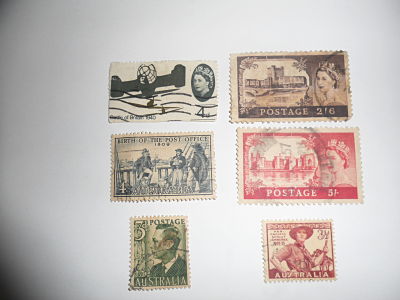
The airplane stamp is 1965 GB (Great Britain) or UK (United Kingdom) and part of a set of 8 stamps about World War II and the 25th anniversary of the Battle of Britain air war. I like them, nice airplane action sequences and all that. That one shows British Spitfire supermarine fighters attacking a German Heinkel HE-111H bomber.
It is priced at GBP (Great Britain Pounds) 1.00 in the 2005 Stanley Gibbons catalogue I have but SG mostly overprices the stamps. The wavey-lined cancel detracts from the price (as far as I am concerned) as a circular dated cancel would be much better or even one that let you see the stamp design more clearly. This also comes with only three phosphor bands (edging) instead of four and is worth a touch more at 1.50. Not everyone collects the tagging or phosphor stuff and doesn't care about it as they can't be bothered with the UV lamp. They want to see the stamp and that is that (I think). Also extra expense.
See what catalogues will give you. Makes the stamps a lot more interesting.
A side note about cost and value and worth of stamps. The catalogues say a price, this is what a dealer would charge you for a very very nice copy of the stamp at his shop to cover his time and efort. The price is not what a stamp is worth. When the other fellow and gals say that a stamp is common or 20c that means that most (80%) of stamps are priced at 20c or so in cataloges to show what it cost the dealer to go through the morions to sell you a stamp. That is all.
The value is always relative. Condition matters quite a bit, better conditions commands higher prices. Eye appeal.
Depends on supply and demand also. If I really wanted that airplane stamp amd loved airplanes and was missing that stamp from my set to complete it and it was priced a bit above what I would expect to normally pat I just might pay that extra money because it would make me happy at the time.
If you are selling, depends on your salesmanship skills also. Maybe you could get a $1 for that stamp. I couldn't gat 10c for it, well maybe 10c.
Stamps are different than coins. They do not have an intrinsic value, their value is based on supply and demand and the perception of the buyer. That's it.
Sorry I got carried away and ran on a bit here.
The castles: 1955-1957 perf 11 horizontal x 12 vertical are the expensive ones. There were printed by two printing companies (or printers) Waterlow or Del La Rue. The differences are very subtle and sometime rely on the colour shade or the warmth of the engraving lines, whatevr that is!?? Probably do some searching on these and there is probably some info available on determining the two types.
Check watermarks of course. I am not sure when the later issue of these (the more common) came out.
Australia:
Last stamp: 1948, Scouting Jamboree - Pacific, basic common value, 0.25
King George VI (6th) 1949, common
Long Grey stamp, 1959 anniversary of post office, common, people would buy this because it has a ship on it (they are standing on a ship).
Again appearance and condition (no rips, tears, thins, creases, extra bits of pocket lint, bird droppings, mouse tooth marks, missing perforations, heavy cancels, etc will detract from the price (for most).

It is well centered so that is a plus and the cancel is light and not heavy and obscuring so another plus. Needs a good soak in water to clean it and a flattening between books to flatten it. Then it will present better. Still common but if someone just collects ships (or something else showing on the stamp) and just want ships and not a whole lot of anything else then he may pay $1 for that stamp, nicely presented and all.
Most folks would pay 10c or less for a nice one. Real life pricing.
Glad to answer all the questions you never even thought of asking and are overwhelmed with now. Happy to be of service.
We need a musketeer icon bowing with one of those feathered hats. No not Elton John type but the old French type. Cape and sword and all.





 Posted 07/15/2011 3:03 pm




 with Kirk.


