Here's a more complete biography for the Hon. Amos Gould:
Quote:HON. AMOS GOULD.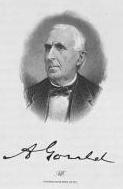
The life-work of few men illustrates more graphically a series of struggles and triumphs than does that of Judge Amos Gould, of Owosso. An honored and successful counselor, a faithful and industrious practitioner, he has ever maintained that reputation for fidelity to duty which is the general characteristic of the American lawyer. His acquirements were not attained as light and idle pastimes. Each advance step was taken after due deliberation, and was then laboriously maintained. Years added to his strength, and untiring industry greatly increased his stock of knowledge, until in the full and complete man we scarcely discern the feeble beginning.
The knowledge of Mr. Gould's ancestry begins with his grandfather, Capt. Ebenezer Gould, of Killingly (Windham Co.), Conn. He was a young married man of good repute, by occupation a farmer, who attained the rank of captain of militia during the Revolutionary war, and later removed to Granville, Washington Co., N. Y. He purchased a large farm, which he improved and lived upon until his death, which occurred about 1808. Mrs. Gould, his wife, was a Miss Robbins, of Connecticut, and became the mother of eighteen children, who were at one time all residing under the parental roof. The father of Amos Gould, after his marriage, about the year 1805, to Miss Polly Simmons, removed from Granville to the old town of Aurelius, south of Auburn, N. Y., where their son Amos was born, Dec. 3, 1808. The father there purchased a farm and began the work of clearing, to which he devoted himself with vigor until called again to the early home to participate in the settlement of the estate of his parent. In 1813 he returned to his purchase in Cayuga Co., N. Y.
Amos has a vivid recollection of those early days, and recalls distinctly the war of 1812. On their return from the East troops were seen encamped along the Mohawk River. Farther west, in Onondaga County, the camp-fires were burning, and a regiment of cavalry overtook the emigrants on the route to their home, and having divided, rode swiftly past and disappeared in the distance.
The son remained on the farm with his father assisting in the labors of the husbandman, and devoting the winter to such study as was afforded by the public school of the neighborhood.
From the age of ten years Amos developed a fondness for reading, and eagerly availed himself of such material as was afforded by the ladies' library established in the vicinity. One or two private collections were also accessible to him.
In 1824 an opportunity occurred of enjoying the superior advantages of a school in Auburn, where the languages were taught, and where he added greatly to the limited knowledge of Latin he had previously acquired. This continued with interruptions for two years, after which the academy at Aurora, Cayuga Co., opened its doors to him, and in 1827 he entered the sophomore class at Hamilton College, Clinton, N. Y.
Mr. Gould pursued his studies until an unfortunate circumstance caused the temporary suspension of the institution, when, lacking means to enter another seat of learning, he engaged in teaching in Auburn, N. Y. He also "entered at this time the office of William H. Seward as a student of law.
Later he became associated with Theodore Spencer, son of Chief Justice Spencer, of New York, and received as clerk a compensation which materially aided him in his early struggles. His admission to the bar of the Supreme Court and the Court of Chancery of New York occurred in the fall of 1832.
He soon after opened an office, and at once found himself in rivalry with the leading talent of Western New York, including Judge F. J. Jewett, of Skaneateles, James R. Lawrence, Judge B. D. Noxon, of Syracuse, and other noted lawyers. He ultimately formed a co-partnership with George Rathbun and continued it several years, the firm having enjoyed an extensive practice throughout the State.
The partnership was dissolved in 1840, and Mr. Gould, having become involved and rendered liable for debts of his brother and brother-in-law, who were merchants in Owosso, Mich., and unsuccessful in business, concluded to go to that place, and, if possible, close up the matter by the payment of the debts. He was also influenced by a desire to enjoy a change of climate, and thereby regain his health, which was much impaired by close application to professional duties. He therefore made Owosso his residence in 1843, and has remained there since that time. Two years later he resumed the practice of his profession in Shiawassee and adjoining counties, and engaged actively in its duties until the year 1865, when he surrendered its cares and profits to his brother and former partner, Col. E. Gould, for whom he had retained the business during his service in the army. While in practice in New York Mr. Gould was appointed master in chancery by his friend William H. Seward, then Governor of the State, and later made by Chancellor Walworth injunction master for the Seventh Judicial Circuit, the courts having been held at Auburn, N. Y. These offices he held till his removal to Michigan. In the fall of 1844 he was elected probate judge for Shiawassee County, and in the year 1852 to the Senate of the State of Michigan. He was also prosecuting attorney of the county, and was supervisor of the township of Owosso from 1844 to 1850. Mr. Gould has, since the Rebellion, affiliated with the Republican party, but has ever made principle a stronger motive than party in the casting of his ballot. He has even been induced to change his relations with one great party when its platform and measures did not accord with his views of right. The State election of 1855 found him a candidate of the Democratic party for the office of attorney-general, but when circumstances arising from the late war witnessed the withdrawal of many of the strongest supporters of the party, Mr. Gould was among them. He organized, in 1865, the First National Bank of Owosso, and has been since that time its president, owning a majority of the stock. He is also engaged in the superintendence of his large farm of twelve hundred acres, and the management of extensive land and lumber speculations, which, at the advanced age of seventy-two years, make him still an active man, and one immersed in business enterprises.
He is an earnest member of the First Congregational Church of Owosso, and was one of its early founders. Mr. Gould's spacious residence is filled with the genial members of a happy family circle. His wife, to whom he was united in 1841, was Miss Louisa Peck, of New York State. They are the well-beloved parents of five grown sons and daughters, whose delight it is to comfort their declining years.





 Posted 07/19/2011 10:01 pm


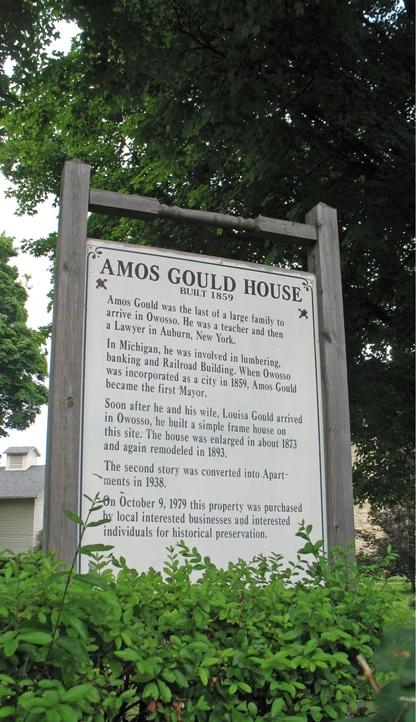
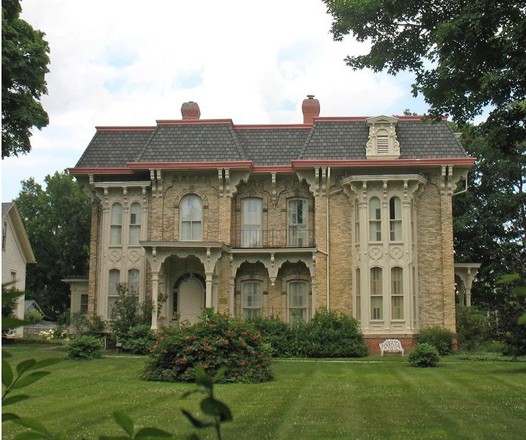


 Great work everyone, what an informative thread from an address request (why don't we have a "clap clap" smiley?)

