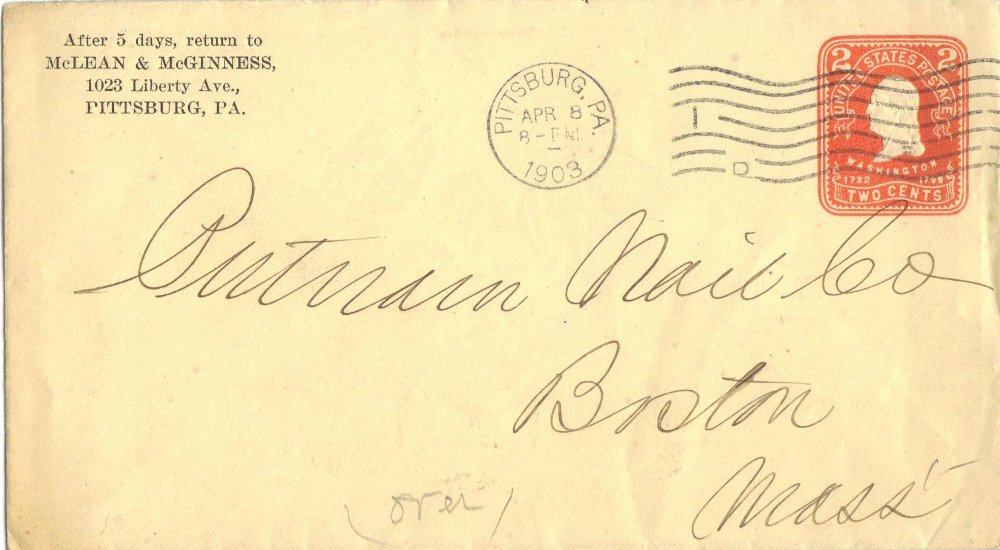
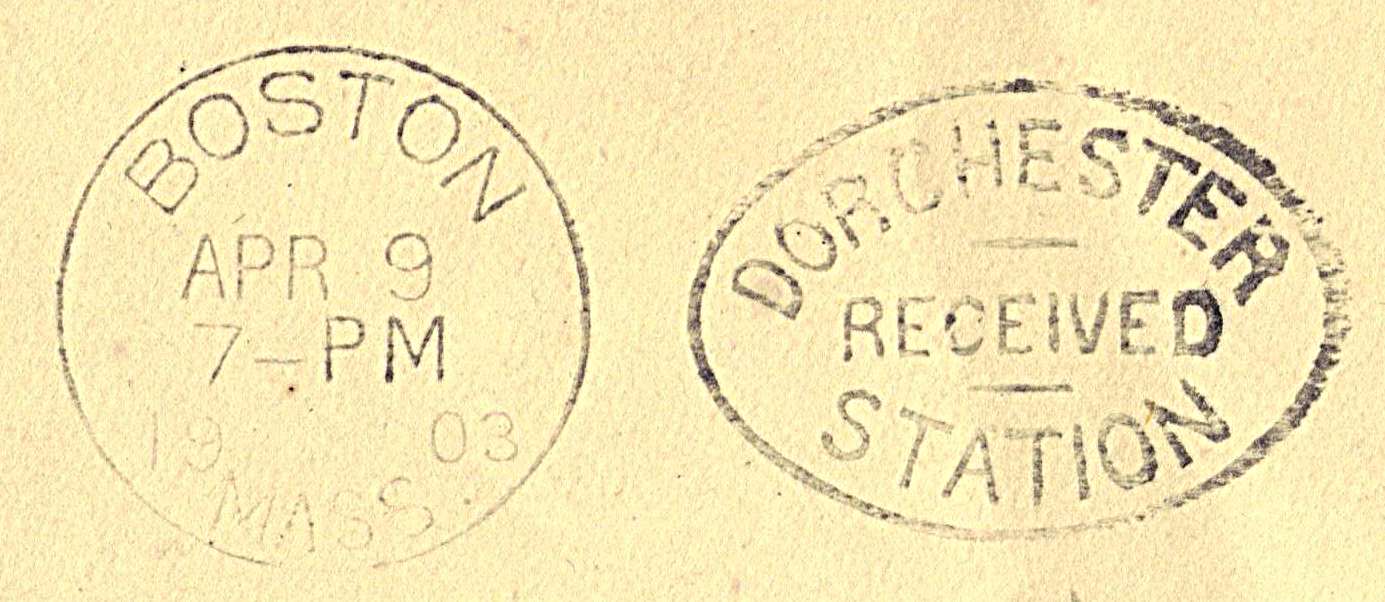
Smauggie: That's a very nice cover you posted, not only for the machine cancel identification, and the great backstamp, but also for the fact that the postmark and return address is Pittsburg (without the "h" on the end). As you may know, there was quite a controversy that developed back in the day about the spelling of Pittsburg v. Pittsburgh, as recited below, so given that your cover is dated 1903, it was right in the middle of the 1891-1911 period when "Pittsburg" without an "h" was the accepted city name (copied from Wiki):
Quote:
In 1891 the United States Board on Geographic Names adopted thirteen general principles to be used in standardizing place names, one of which was that place names ending in -burgh should drop the final -h. The Board compiled a report of place name "decisions", also in 1891, in which the city's name was rendered Pittsburg.
The Board's primary concern in revising the spelling of Pittsburgh was to ensure that all municipality names ending in -burgh be standardized to end in -burg. However, the Board also supported its decision to rename Pittsburgh by referencing the printed copies of the 1816 city charter which featured the spelling Pittsburg rather than Pittsburgh. Based on those copies of the city charter, the Board claimed that the official name of the city had always been Pittsburg. However, the members of the board seem to have been unaware that the original copy of the 1816 charter specified the name of the city to be Pittsburgh, and that only the printed copies of the charter featured the erroneous spelling Pittsburg. The full decision and rationale from the Board follows:
Pittsburg. Pennsylvania.
The city was chartered in 1816, its name being spelled without the h, and its official form is still Pittsburg. The h appears to have been added by the Post-Office Department, and through that action local usage appears to have become divided. While the majority of local newspapers print it without the h, certain others use the final h.
The Board's decisions had limited but effective power; they were compulsory upon all federal government agencies, including the Post Office. The new official spelling was resisted by many people in the city. The Pittsburgh Gazette refused to adopt the Board's decision, as did the Pittsburgh Stock Exchange and the University of Pittsburgh. Official city documents continued to use the old spelling. Responding to mounting pressure and, in the end, political pressure from senator George T. Oliver, the United States Geographic Board (a successor to the original United States Board on Geographic Names) reversed the decision on July 19, 1911, and the Pittsburgh spelling was restored. The letter sent to senator Oliver to announce this decision, dated July 20th, stated:
Hon. George T. Oliver, United States Senate:
Sir: At a special meeting of the United States Geographic Board held on July 19, 1911, the previous decision with regard to the spelling of Pittsburgh without a final H was reconsidered and the form given below was adopted:
Pittsburgh, a city in Pennsylvania (not Pittsburg).
Very respectfully,
C. S. SLOAN,
Secretary.
The confusion and controversy surrounding the aborted spelling change means that both the Pittsburgh and the Pittsburg spelling were commonly encountered around the turn of the 20th century, and continued uses of Pittsburg still occur to this day. Many cities across the United States named after the city of Pittsburgh, such as Pittsburg, Kansas, Pittsburg, California, and West Pittsburg, Pennsylvania continue to use the Pittsburg spelling in their names. Other independent municipalities, such as the borough of East Pittsburgh, Pennsylvania, reflect the modern spelling.





 Posted 07/27/2011 8:39 pm