|
Continuing with the history of U.S. Airships.
Art
The first American-built rigid airship was the USS Shenandoah, followed by the USS Los Angeles, the USS Akron and the USS Macon.
The Airship USS Macon:
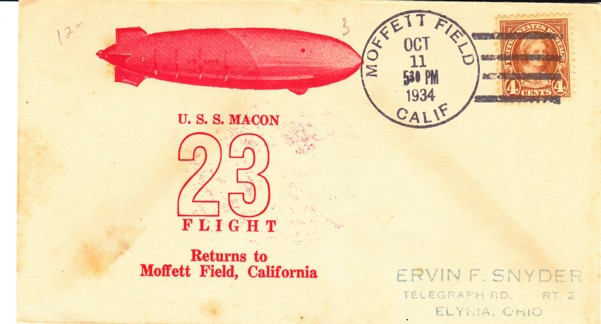
USS Macon (ZRS-5) was a rigid airship built and operated by the United States Navy for scouting. She served as a "flying aircraft carrier", launching Curtiss F9C Sparrow Hawk biplane fighters. In service for less than two years, in 1935 Macon was damaged in a storm and lost off California's Big Sur coast, though most of her crew were saved. The wreckage is listed as USS Macon Airship Remains on the U.S. National Register of Historic Places.
Less than 20 ft (6.1 m) shorter than Hindenburg, she and her sister ship, Akron, were among the largest flying objects in the world in terms of length and volume. Although the hydrogen-filled Hindenburg was longer, the two sisters still hold the world record for helium-filled airships.
USS Macon was built at the Goodyear Air Dock in Springfield Township, Ohio by the Goodyear-Zeppelin Corporation. Because this was by far the biggest airship ever to be built in America, a team of experienced German airship engineers, instructed and supported design and construction of both U.S. Navy airships Akron and Macon.
The airship was named after the city of Macon, Georgia, which was the largest city in the Congressional district of Representative Carl Vinson, the then chairman of the House of Representative's Committee on Naval Affairs.
Macon was christened on March 11, 1933 by Jeanette Moffett, wife of Rear Admiral William A. Moffett, Chief of the U.S. Navy's Bureau of Aeronautics. The airship first flew one month later, shortly after the tragic loss of her sister ship Akron. Macon was commissioned on June 23, 1933.
Macon had a structured duraluminum hull with three interior keels. The airship was kept aloft by 12 helium-filled gas cells made from gelatin-latex fabric. Inside the hull, the ship had eight German-made Maybach, 12-cylinder, 560 hp gasoline-powered engines that drove outside propellers. The propellers could be rotated down or backwards, providing an early form of thrust vectoring, to control the ship during take-off and landings. Designed to carry five F9C Sparrow Hawk biplanes, Macon received her first aircraft on board July 6, 1933 during trial flights out of Lakehurst, New Jersey. The planes were stored in bays inside the hull and were launched and retrieved using a trapeze.
Departing the East Coast on October 12, Macon's home field became Naval Air Station (NAS) Sunnyvale (now Moffett Federal Airfield) in Santa Clara County, California. Macon had a far more productive career than her sister ship, Akron. Macon's commanders developed the doctrine and techniques of using her aircraft to do scouting while the airship remained out of sight of the opposing forces in exercises. Macon participated in several fleet exercises, though the men who framed and conducted the exercises lacked an understanding of the airship's capabilities and weaknesses. It became standard practice to remove Sparrow Hawk's landing gear aboard the airship and replace it with a fuel tank, giving the aircraft 30% more range.
Later in 1934, Lieutenant Commander Herbert Wiley surprised President Franklin D. Roosevelt, and the Navy when Macon searched for, and located the heavy cruiser Houston, which was then carrying the President back from a trip to Hawaii. Newspapers were dropped to the President on the ship, and the following communications were sent back to the airship: "from Houston: 1519 The President compliments you and your planes on your fine performance and excellent navigation 1210 and 1519 Well Done and thank you for the papers the President 1245."
During a crossing of the continent, Macon was forced to fly up to 6,000 ft to clear mountains in Arizona. As the ships pressure height, the height at which the gas cells would start to leak and eventually rupture due to pressure difference, was less than 3,000 ft, a large amount of helium was vented to reach this altitude without rupturing the gas cells. To compensate for the loss of lift, 9,000 lb of ballast and 7,000 lb of fuel had to be dumped. Macon was being flown 15,000 lb "heavy" and was operating at full power not only in order to have sufficient dynamic lift, but to have enough control to fly in the severe turbulence through a mountain pass near Van Horn, Texas. Following a severe drop, a diagonal girder in ring 17.5, which supported the forward fin attachment points, failed. Rapid damage control by Chief Boatswain's Mate Robert Davis repaired the girders before further failures could occur. Macon completed the journey safely but the buckled ring and all four tailfins were deemed in need of strengthening. The appropriate girders adjacent to the horizontal and lower fins were repaired, but the repair to the girders on either side of the top fin were delayed until the next scheduled overhaul when the adjacent gas cells could be deflated.
On February 12, 1935, the repair process was still incomplete when, returning to Sunnyvale from fleet maneuvers, Macon ran into a storm off Point Sur, California. During the storm, she was caught in a wind shear which caused structural failure of the un-strengthened ring (17.5) to which the upper tailfin was attached. The fin failed to the side and was carried away. Pieces of structure punctured the rear gas cells and caused gas leakage. Acting rapidly and on fragmentary information an immediate and massive discharge of ballast was ordered. Control was lost and, tail heavy and with engines running full speed ahead, Macon rose past the pressure height and kept going until enough helium was vented to cancel the lift. It took her 20 minutes to descend from 4,850 ft and, settling gently into the sea, Macon sank off Monterey Bay. Only two crewmembers died from her complement of 76, thanks to the warm conditions and the introduction of life jackets and inflatable rafts after the Akron tragedy. The two that perished did so needlessly: the radioman jumped ship after she had lost most of her altitude but was still high above the ocean surface and a mess attendant drowned while swimming back into the wreckage to try to retrieve personal belongings. An officer was rescued when Commander Wiley swam to his aid, an action for which he was later decorated.
The cause of the loss was operator error following the structural failure and loss of the fin. Had the ship not been driven over pressure height (where the cells were expanded fully and lifting gas released) Macon could have made it back to Moffett Field. Four Sparrow Hawks carried aboard were lost with the airship.
Macon, having completed 50 flights from her commissioning date, was stricken from the Navy list on February 26, 1935. Subsequent airships for Navy use were of a non-rigid design.
The Monterey Bay Aquarium Research Institute (MBARI) succeeded in locating and surveying the debris field of Macon in February 1991, and was able to recover artifacts from her. The exploration included sonar, video, and still camera data, as well as some artifact recovery.
In May 2005, MBARI returned to the site as part of a year-long research project to identify archeological resources in the bay. Side-scan sonar was used to survey the site.
A more complete return, including exploration with remotely operated vehicles and involving researchers from MBARI and the National Oceanic and Atmospheric Administration's Office of National Marine Sanctuaries, took place in September 2006. Video clips of the expedition were made available to the public through the Oceans Live Web Portal, a service of NOAA.
The 2006 expedition was a success, and revealed a number of new surprises and changes since the last visit, 15 years ago. High-definition video and more than 10,000 new images were captured, which will be assembled into a photo-mosaic of the wreck.
The wreckage of Macon was listed in the National Register of Historic Places on January 29, 2010. The wreck site remains secret, and is within a marine sanctuary, the Monterey Bay National Marine Sanctuary, and is not accessible to divers due to depth (1,500 ft). It is also a U.S. Navy gravesite.
According to the U.S. National Park Service:
When the USS Macon was christened on March 11, 1933, she was the most sophisticated of the Navy's lighter-than-air (LTA) fleet. The Macon exhibited the highest expression of naval LTA technology during her short career. At 785 feet in length, the airship's size captured American fascination during flyovers of U.S. communities as chronicled in numerous advertisements, articles, and newsreels. The dramatic loss of the Macon and her sister ship, the Akron, within two years of each other contributed to the cancellation of the Navy's rigid airship program. The archeological remains of the USS Macon lie off California's Big Sur coast in NOAA's Monterey Bay National Marine Sanctuary. The site also contains the remains of four of the airship's squadron of small Curtiss F9C Sparrow Hawk scout aircraft which the Macon carried in an internal hangar bay.
The site was listed on the U.S. National Register of Historic Places on January 29, 2010. The listing was announced as the featured listing in the National Park Service's weekly list of February 12, 2010.
|





 Posted 09/19/2011 11:26 pm


 ART:
ART: