| Author |
 Replies: 21 / Views: 3,701 Replies: 21 / Views: 3,701 |
|
Valued Member
Sweden
141 Posts |
|
|
Hi there.. As I am in the middle of sorting through my foreign covers, I have trouble ID:ing this stamp. To me the paper looks very bluish, and the only bluish 5c stamp that I can see in my .pdf of 2009 Scott Vol 1 is worth $15,000 used.. I believe I must be doing something wrong. Note the date says 1919 and the bluish paper was issued 1909... Maybe it's just very "smudgy"? However it looks much more blue than other 5c Washington I've got.   It's okay to bring me bad news, I'm not expecting anything. I'd just like to know which stamp it is. Thanks in advance. EDIT: I also find it quite interesting that there was a Swedish Singing Society, and that they had their own print on envelopes. |
|
Send note to Staff
|
| Edited by Tomten - 11/22/2011 11:10 am |
|
|
|
|
Pillar Of The Community
United States
2546 Posts |
|
|
Valued Member
Sweden
141 Posts |
|
|
That's what I thought at first too, but since I only have a ruler and I'm not any experienced at all with perf, and it being all that blue I had to ask. :)
It's just not the edges that are blue, the whole picture is MUCH bluer than other Washingtons I've got, is there any reason for this? |
Send note to Staff 
|
|
|
Bedrock Of The Community
United States
12128 Posts |
|
|
Valued Member
Sweden
141 Posts |
|
|
Pillar Of The Community
Canada
4648 Posts |
|
|
Hi Tomten
I am not an expert on US stamps but after looking at your scan, I am inclined to think that maybe your stamp has the bluish effect because it has 'wiping ink smears'?
Just a guess of course.
Chimo
Bujutsu |
|
Send note to Staff
|
|
|
Valued Member
Sweden
141 Posts |
|
|
Hi Bujutsu.
Well yes, looks that way.. The paper isn't bluish all the way to the edges.. It's just that the face of Washington is extremely much bluer than other Washingtons I've got.. So it's not only smeared to the edges. The whole stamp is more bluish. |
|
Send note to Staff
|
|
|
Pillar Of The Community
United States
1947 Posts |
|
|
Since the stamp in question is not the bluish paper issue, the following is probably moot, but---
The bluish paper stamps are not really that blue. They are more of a gray color and the color shows best on the back of the stamp. |
|
Send note to Staff
|
|
|
Valued Member
Sweden
141 Posts |
|
|
Well I've always had trouble with different shades and colours.. I always need to compare with a similar stamp to be able to figure out which shade.
Since I'm sorting through covers, it's hard to see anything at all on the back of the stamp.. watermarks are impossible on some envelopes, since they are too thick in some cases. |
|
Send note to Staff
|
|
|
Pillar Of The Community
Romania
886 Posts |
|
|
Quote:
'wiping ink smears'?
That`s my guess too (and I`m neither an expert). Here is what I found in a stockbook, the two in the center seem somehow similar to your`s: 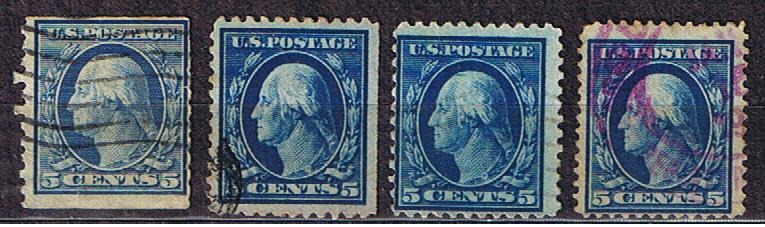 But no difference when you turn them: 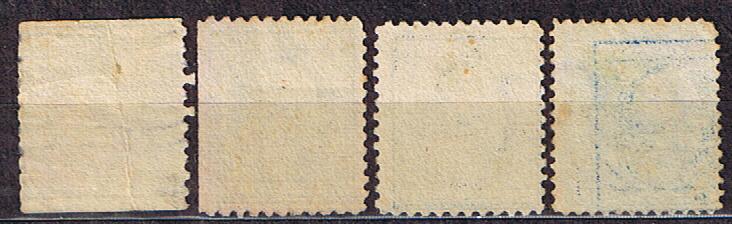 |
|
Send note to Staff
|
|
|
Valued Member
Sweden
141 Posts |
|
|
Thanks a lot for that picture Wadmalatz. Well of course I would check the back of my stamp if I could :)
|
|
Send note to Staff
|
|
|
Pillar Of The Community
United States
2963 Posts |
|
|
WT1, your penchant for finding obscure articles is on the verge of becoming legendary. As always, you've found something interesting and unusual about a cover. Well done!
Edit:
This article is of particular interest to me. My maternal family tree includes family members who were a part of the Swedish migration to Oregon during the 1890s, and remained in contact with extended family in Sweden at least through the early 1990s. My mother's sister is now the keeper of all family genealogy. Perhaps I'll ask if there were any choir members in the family :)
Edit:
More randomness ...
I saw my aunt and grandma over Thanksgiving, and alas, we have no family members that were a part of the Swedish Singing Society. I did, however, get the timeline right! Grandma stated that her grandmother immigrated to Brainerd, Mn from Sweden in the 1890s and moved to Portland shortly after that.
|
|
Send note to Staff
|
| Edited by Rileysan - 11/29/2011 7:35 pm |
|
|
Pillar Of The Community
Guatemala
1500 Posts |
|
|
I have read that the blue tint to some of the stamps of this era are due to the type of printing. If I recall correctly, the stamps that are faintly blue all over on the face are printed by a "wet" printing process. A "dry" process was also in use and does not tint the entire face of the stamp with color. |
|
Send note to Staff
|
|
|
Rest in Peace
United States
7097 Posts |
|
|
Quote:
I have read that the blue tint to some of the stamps of this era are due to the type of printing. If I recall correctly, the stamps that are faintly blue all over on the face are printed by a "wet" printing process. A "dry" process was also in use and does not tint the entire face of the stamp with color.
Exactly what quigngt said! I was just ready to reply with very similar information! |
|
Send note to Staff
|
|
|
Pillar Of The Community
United States
1947 Posts |
|
|
Perhaps I am off base here, but I thought that the dry printing of US stamps did not start until the 1950s. |
|
Send note to Staff
|
|
|
Pillar Of The Community
United States
2963 Posts |
|
|
Quote:
Perhaps I am off base here, but I thought that the dry printing of US stamps did not start until the 1950s.
I'm not sure. I kind of hope that Russ will chime in here. I thought the term referred to a deliberate printing method. In this case, the wet printing on this stamp was accidental. |
|
Send note to Staff
|
|
|
Replies: 21 / Views: 3,701 |
|



 Posted 11/22/2011 11:06 am


