My latest
ebay purchase is this stampless folded letter postmarked April 17, 1845 in Harrodsburg, KY -- it is my first and only SFL from Kentucky.
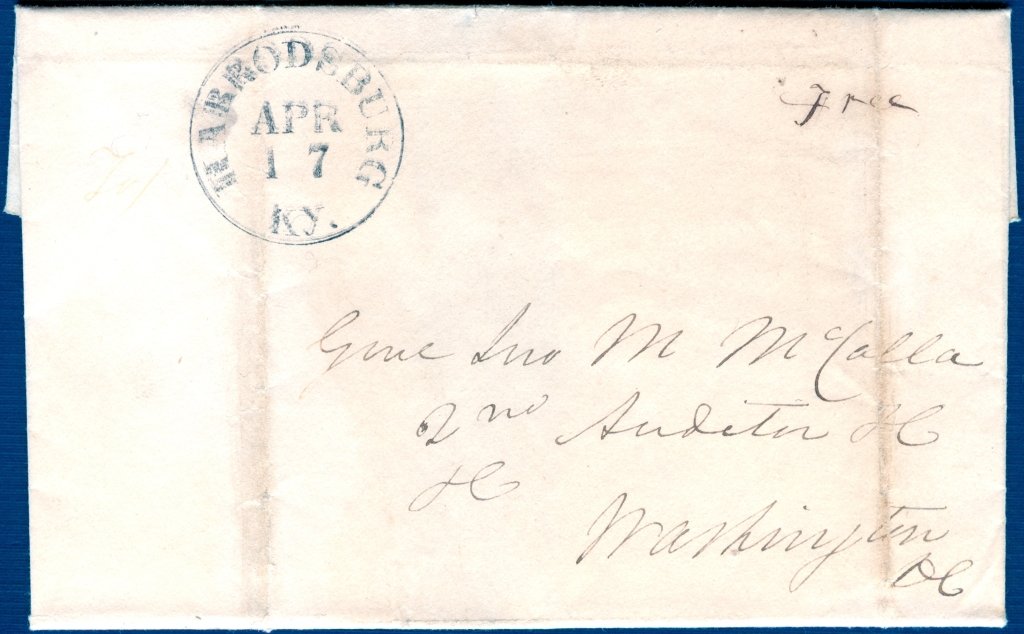
After conducting a little research into the persons involved with the letter I found it quite interesting to see that political maneuvering hasn't changed much in the 167 years that have elapsed since the letter was written.
The letter is addressed to General John M. McCalla in Washington, DC and was written by Major T.P. Moore -- the box following the image is my best guess at what Moore had written.
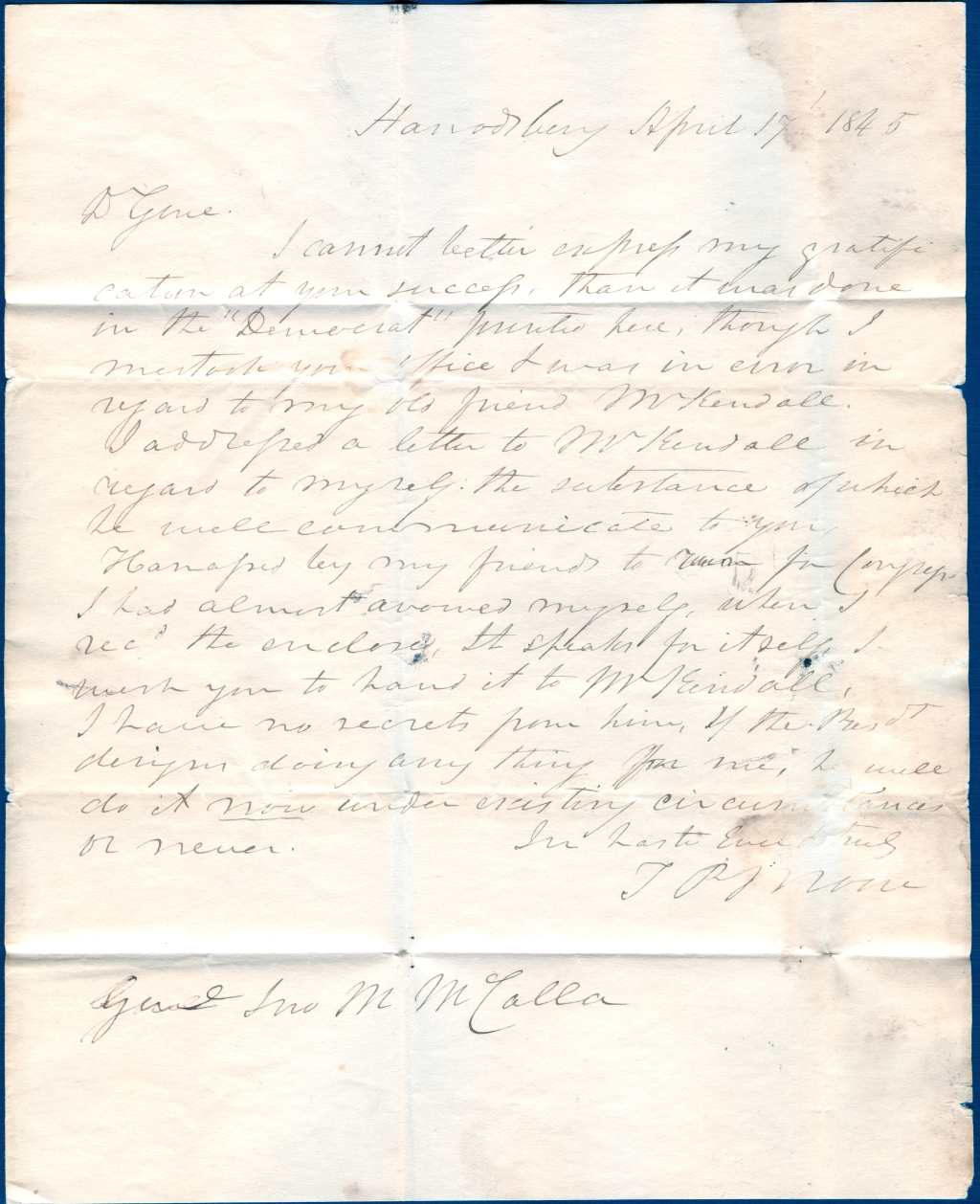
Quote:Harrodsburg April 17, 1845
D(ear) Gene(ral),
I cannot better express my gratification at your success than it was done in the "Democrat" [[??]] here, though I mistook your office I was in error in regard to my old friend Mr. Kendall. I addressed a letter to Mr. Kendall in regard to myself the substance of which he will communicate to you. Harnessed by my friend to run for Congress I had almost avowed myself when I received the enclosed. It speaks for itself. I wish you to hand it to Mr. Kendall. I have no secrets from him, if the President desires doing anything for me, he will do it now under existing circumstances or never.
In haste ever [[??]]
// T P Moore //
Genl Jno M McCalla
Moore, no stranger to politics, is writing to a fellow Kentuckian who had recently been appointed by President Polk as 2nd Auditor in the Treasury Department. Apart from a cursory congratulatory remark to McCalla, the purpose of Moore's letter is to ask McCalla to pass on an enclosure to the letter to a common acquaintance--Mr. Kendall. It appears that Moore would like Kendall to inform the President that Moore would consider a position in his Administration.
President Polk would eventually do something for Moore but it wasn't the Administration assignment he had wanted (he did get to see Mexico at government expense!). Brief biographies of all four parties follow so I'll let you draw your own conclusions.
Quote:
MCCALLA, John M. was born near Lexington, Ky., in 1793 and was a graduate of Transylvania University. When war with England was declared in 1812, Mr. McCalla, then but nineteen years old, was among the first to respond to the call for troops. He soon rose to the rank of adjutant and afterwards obtained the rank of brigadier general. In the report made by the commanding general of the actions of January 18 and January 22, 1813, he was named among those who had distinguished themselves in those battles. He practiced law in Lexington for many years prior to his departure for Washington, DC, and was well known for his bold and skillful support of the Democratic Party. He was a clear, astute, and efficient political debater, and is well remembered for the earnestness, energy and integrity. He became a resident of Washington, DC in 1845 and that continued to be his home until his death in 1873, with the exception of seven years (1848 to '55). During his early life in Washington Mr. McCalla was second auditor under President Polk's administration (1845-1849), but after that time his profession was that of lawyer and claim agent.
Quote:
MOORE, Thomas Patrick, a Representative from Kentucky; born in Charlotte County, Va., in 1797; attended the common schools; moved with his parents to Harrodsburg, Mercer County, Ky.; attended Transylvania University, Lexington, Ky.; served in the War of 1812; captain in the Twelfth Virginia Infantry March 12, 1812; major in the Eighteenth Infantry September 20, 1813; honorably discharged June 15, 1815; member of the State house of representatives in 1819 and 1820; elected as a Jackson Republican to the Eighteenth Congress and reelected as a Jacksonian candidate to the Nineteenth, and Twentieth Congresses (March 4, 1823-March 3, 1829); chairman, Committee on Revisal and Unfinished Business (Nineteenth Congress); appointed by President Jackson as Minister Plenipotentiary to New Grenada March 13, 1829, and served until April 16, 1833; returned to Kentucky; presented credentials as a Member-elect to the Twenty-third Congress, but the election was contested by Robert P. Letcher and the House declared a new election necessary; appointed lieutenant colonel of the Third United States Dragoons in the war with Mexico and served from March 3, 1847, to July 31, 1848; delegate to the Kentucky constitutional convention in 1849 and 1850; died in Harrodsburg, Ky., July 21, 1853.
Quote:
KENDALL, Amos was born on August 16, 1789, in Dunstable, Massachusetts, graduating from Dartmouth College in 1811. Kendall studied law in Massachusetts before earning admission to the Kentucky bar in 1814. He was appointed fourth auditor of the Treasury during the administration of President Andrew Jackson (1832-1835), and later served as postmaster general for both Jackson and President Martin Van Buren (1835-1840). Many historians regard Kendall as the intellectual force behind Andrew Jackson's presidential administration, and an influential figure in the transformation of America from an agrarian republic to a capitalist democracy. In 1857, Kendall opened a school for deaf children, which later expanded and became Gallaudet University for the deaf. Prior to becoming Postmaster General, Kendall was editor of both the Argus of Western America, the organ of Kentucky progressivism, and the Washington Globe, the organ for the Jackson Administration. He worked closely with Van Buren, Francis P. Blair, and other members of Jackson's official and kitchen cabinets. John Quincy Adams, a bitter foe of both Jackson and Van Buren, confided to his diary in December 1840 that he believed both men had been "for twelve years the tool of Amos Kendall, the ruling mind of their dominion."
Quote:
POLK, James K.
Often referred to as the first "dark horse" President, James K. Polk was the last of the Jacksonians to sit in the White House, and the last strong President until the Civil War. He was born in Mecklenburg County, North Carolina, in 1795. Studious and industrious, Polk was graduated with honors in 1818 from the University of North Carolina. As a young lawyer he entered politics, served in the Tennessee legislature, and became a friend of Andrew Jackson. In the House of Representatives, Polk was a chief lieutenant of Jackson in his Bank war. He served as Speaker between 1835 and 1839, leaving to become Governor of Tennessee.
Until circumstances raised Polk's ambitions, he was a leading contender for the Democratic nomination for Vice President in 1844. Both Martin Van Buren, who had been expected to win the Democratic nomination for President, and Henry Clay, who was to be the Whig nominee, tried to take the expansionist issue out of the campaign by declaring themselves opposed to the annexation of Texas. Polk, however, publicly asserted that Texas should be "re-annexed" and all of Oregon "re-occupied."
The aged Jackson, correctly sensing that the people favored expansion, urged the choice of a candidate committed to the Nation's "Manifest Destiny." This view prevailed at the Democratic Convention, where Polk was nominated on the ninth ballot.
"Who is James K. Polk?" Whigs jeered. Democrats replied Polk was the candidate who stood for expansion. He linked the Texas issue, popular in the South, with the Oregon question, attractive to the North. Polk also favored acquiring California. Even before he could take office, Congress passed a joint resolution offering annexation to Texas. In so doing they bequeathed Polk the possibility of war with Mexico, which soon severed diplomatic relations.
In his stand on Oregon, the President seemed to be risking war with Great Britain also. The 1844 Democratic platform claimed the entire Oregon area, from the California boundary northward to a latitude of 54'40', the southern boundary of Russian Alaska. Extremists proclaimed "Fifty-four forty or fight," but Polk, aware of diplomatic realities, knew that no course short of war was likely to get all of Oregon. Happily, neither he nor the British wanted a war. He offered to settle by extending the Canadian boundary, along the 49th parallel, from the Rockies to the Pacific. When the British minister declined, Polk reasserted the American claim to the entire area. Finally, the British settled for the 49th parallel, except for the southern tip of Vancouver Island. The treaty was signed in 1846.
Acquisition of California proved far more difficult. Polk sent an envoy to offer Mexico up to $20,000,000, plus settlement of damage claims owed to Americans, in return for California and the New Mexico country. Since no Mexican leader could cede half his country and still stay in power, Polk's envoy was not received. To bring pressure, Polk sent Gen. Zachary Taylor to the disputed area on the Rio Grande. To Mexican troops this was aggression, and they attacked Taylor's forces. Congress declared war and, despite much Northern opposition, supported the military operations. American forces won repeated victories and occupied Mexico City. Finally, in 1848, Mexico ceded New Mexico and California in return for $15,000,000 and American assumption of the damage claims.
President Polk added a vast area to the United States, but its acquisition precipitated a bitter quarrel between the North and the South over expansion of slavery. Polk, leaving office with his health undermined from hard work, died in June 1849.
The Presidential biographies on WhiteHouse.gov are from "The Presidents of the United States of America," by Michael Beschloss and Hugh Sidey. Copyright 2009 by the White House Historical Association.





 Posted 03/04/2012 9:27 pm


