| Author |
 Replies: 12 / Views: 7,188 Replies: 12 / Views: 7,188 |
|
|
Pillar Of The Community
United States
566 Posts |
|
|
|
|
Valued Member
United States
389 Posts |
|
|
I pulled out my 2012 Sakura catalogue of Japanese stamps and found the Post Card listed as PC11, issued 9.19.1876 price used 500 yen. |
Send note to Staff 
|
|
|
Valued Member
United States
389 Posts |
|
|
Pillar Of The Community
United States
566 Posts |
|
|
Thank you both! I wasn't expecting to recruit a translator but I'm glad to know the postal information.
BAYERN1kreutzer, I'm really impressed that you can tell that it comes from Kioto. How did you know that?
I read a very tiny bit of Kanji and I see 6 and 19 on the cancellation. Does anyone know if that means June 1919 or June 19 or (month) 6, 1919? What order is used in Japan month-day-year or day-month-year?
|
|
Send note to Staff
|
|
|
Rest in Peace
Canada
6750 Posts |
|
|
If a year date is shown (not sure) it would be in Emperor year date format, or for this date (before 1912) the Meiji Emperor (started 1868 = Meiji 1)) so add 1867 to the number to get the Western year. I cannot read Japanese either. One reference dates site: http://www.sljfaq.org/afaq/dates.htmlSince 1868 the usual format is Month / day. |
|
Send note to Staff
|
|
|
Pillar Of The Community
Australia
3547 Posts |
|
|
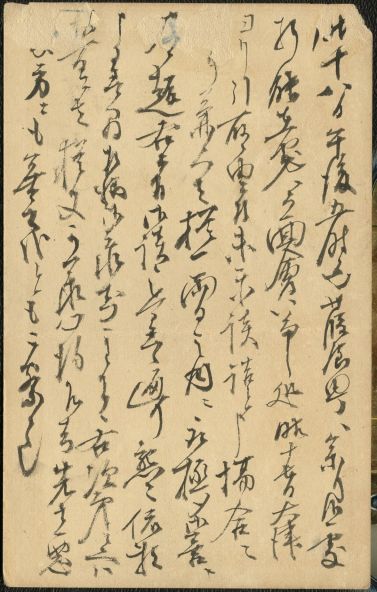
I can confirm that the card was posted in Kyoto, from Yamagoe Post Office. It's dated 19 June (also in manuscript on the front) but no year, and I can't find a year mentioned anywhere on the card. It was addressed to Kameoka ('Turtle Hill'), which these days falls within Kyoto Prefecture. |
|
Send note to Staff
|
|
|
Pillar Of The Community
United States
566 Posts |
|
|
Thanks tonymacg!
That's great information! I recognized the character for mountain but I didn't know how it related to a specific place name. It's nice to have the infrmation all the way to the post office level. And thanks for checking for a year. I wish there were one but it's good to have confirmation.
Karen |
|
Send note to Staff
|
|
|
Pillar Of The Community
Australia
3547 Posts |
|
|
Kehess, this http://www.mapion.co.jp/address/ is a very handy site for locating modern place names. Tracking down older locations can take a bit of delving. 'Yamagoe' doesn't appear in the first level list for Kyoto Prefecture, so I had to dig down into the lists of locations within the 'Ku' in Kyoto City to find it. Kameoka is still there, listed directly under Kyoto Prefecture, though. I can understand your frustration at trying to find a location 'Yama-?' though ... |
|
Send note to Staff
|
|
|
Pillar Of The Community
United States
566 Posts |
|
|
Tonymacg,  The very tiny bit of Kanji that I can read comes from learning some Chinese many years ago. So for me the character is Shan and now I know it's also Yama. That will give me a clue for future reference. Since I have been reading the forum I have enjoyed getting back into the world-wide portion of my collection. But I know so little and there is so much to learn! Thanks for the website but it's way beyond my abilities both for my language skills and for the depth of understanding my Japanese stamps. I certainly hope to improve my skills in both areas because the stamps are so beautiful! I really appreciate the help with the postcard information provided by all of you and the postmark information is icing on the cake! Thank you!  Karen |
|
Send note to Staff
|
|
|
Pillar Of The Community
Australia
3547 Posts |
|
|
Karen, knowing some Chinese is both a great help and a great hindrance to tracing Japanese names. The Japanese borrowed the Chinese pronuncations at the same time as the characters (that is, the pronunciations current around Shandong in about the 7th Century ...), but many characters can be read two ways, the borrowed Chinese version and the native Japanese word. 'Shan' is a perfect example. The 'borrowed' Japanese pronunciation is 'san', and the native Japanese word is 'yama'. So the famous Japanese mountain is referred to either as Fuji-san or Fuji-yama. (And 'Fuji' is two borrowed Chinese pronunciations: fu (fortunate) and shi (gentleman).) |
|
Send note to Staff
|
|
|
Pillar Of The Community
2361 Posts |
|
|
Japanese Emperors and Eras:
Meiji, September 1868 to July 1912; Year 1 is 1868.
Taisho, July 1912 to December 1926; Year 1 is 1912.
Showa, December 1926 to January 1989; Year 1 is 1926.
Heisei, January 1989- Year 1 is 1989.
The same calculations apply for dating modern coins.
The card's denomination is 5 rin, which corresponds to the lowest denomination stamp of that period, such as Scott #55, 75, or 91. |
|
Send note to Staff
|
| Edited by doug2222 - 06/10/2012 08:31 am |
|
|
Pillar Of The Community
Australia
3547 Posts |
|
|
BAYERN1Kreuzer, both your cards are also from Kyoto, and the right hand one is from Yamagoe again.
The left hand one is from Kyoto also, but precisely where I can't say. In the position where 'Yamagoe' appears on the right hand card, there are just the figures '14'. I've tried a quick Google search on it, but I can't find anything useful about it.
The right hand card has a nice clear 2 November date, but I'm not sure of the date on the other.
The left hand card has a handstamp down the right-hand side: Kyoto Court#12539;Examination Office.
Both cards may be linked. The left hand card is addressed to a Mr Tanaka, probably in Kawagoe as well, and the right-hand card has several personal seals, including one for 'Tanaka'. Unfortunately, 'Tanaka' is probably the most common surname in Japan ... |
|
Send note to Staff
|
|
|
Pillar Of The Community
Croatia (Local Name: Hrvatska)
1131 Posts |
|
|
Does Sakura catalogue are listing prices only for the entire postal cards, or also for the cut outs? |
|
Send note to Staff
|
|
| |
Replies: 12 / Views: 7,188 |
|



 Posted 06/07/2012 4:31 pm