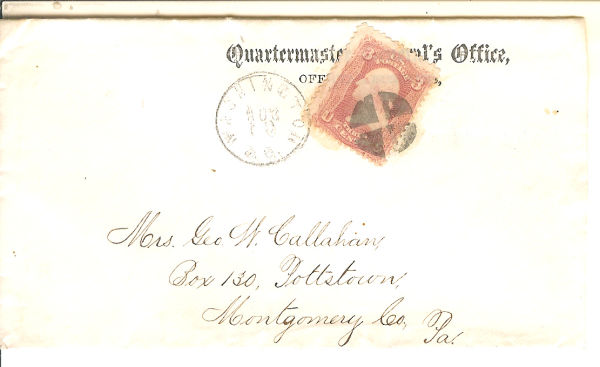
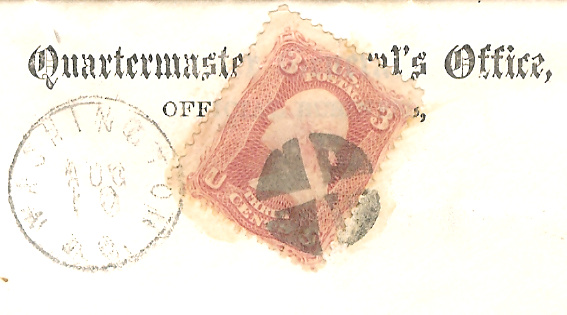
I also found that the addressee was later promoted to Sergeant and some of his diaries from January to August 1865 are at a library in their PA Civil War collection.
As for the connection between the Signal Corps and Quartermaster Corps, consider these quotes from Wiki:
Quote:
The U.S. Military Telegraph Corps employed civilian telegraph operators, with supervisors who received military commissions in the Quartermaster Department, under the general management of Anson Stager, a former official of the Western Union Telegraph Company. In February 1862, Lincoln took control of the nation's commercial telegraph lines, which were then used by Stager's organization. Secretary Stanton, a former director and attorney for the Atlantic and Ohio Telegraph Company, understood the technical and strategic importance of telegraphy and located the telegraph office directly next to his own in the War Department. One of his biographers described the operators as Stanton's "little army ... part of his own personal and confidential staff." Myer began a campaign to supersede this organization by proposing the purchase of equipment to form telegraph trains (in the sense of wagon trains, not railroad) in the Signal Corps, to provide mobility for telegraph operators supporting armies on the move.
and
Quote:
The Signal Corps completed its wartime service and was dissolved in August 1865. During its lifetime, 146 officers were commissioned in the corps or were offered commissions. There were 297 acting signal officers appointed, although some were for very brief periods. The total number of enlisted men who served during the war was about 2,500.





 Posted 08/12/2012 12:59 pm