|
This page may contain links that result in small commissions to keep this free site up and running.

Welcome Guest! Registering and/or logging in will remove the anchor (bottom) ads. It's Free!
To participate in the forum you must log in or register.
| Author |
 Replies: 14 / Views: 3,546 Replies: 14 / Views: 3,546 |
|
|
Bedrock Of The Community
United States
12128 Posts |
|
|
I'm not particularly excited about this upcoming issue, but as a pane of only 12 stamps, at least it can be acquired for a modest $5.52. While admittedly I'm not into "Modern Art", I never heard of any of the named artists, either: 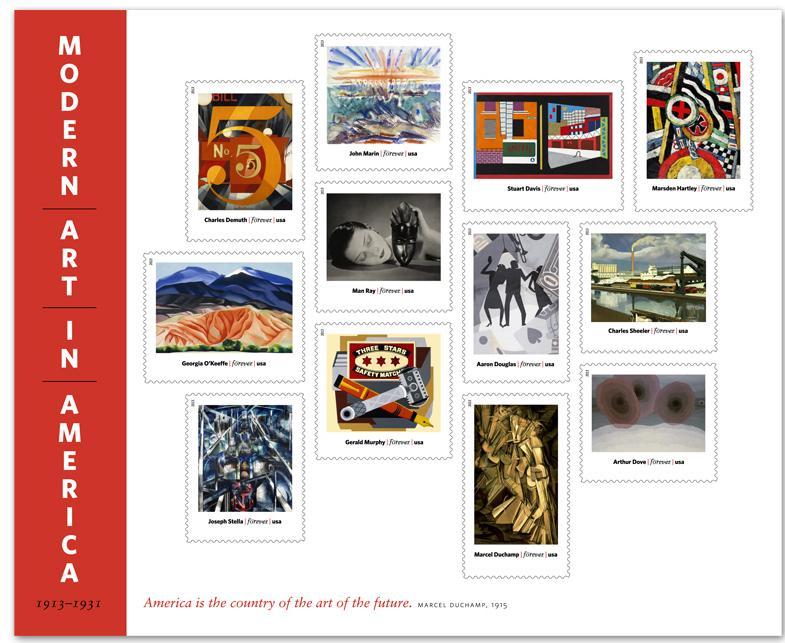 Quote:
Stuart Davis's oil-on-canvas painting, House and Street (1931), measures 26 x 42 ¼ inches. The painting is in the collection of the Whitney Museum of American Art.
Charles Demuth's I Saw the Figure 5 in Gold (1928), oil, graphite, ink, and gold leaf on paperboard, measures 35 ½ x 30 inches. The work is in the collection of the Metropolitan Museum of Art.
Aaron Douglas' gouache-on-paper painting, The Prodigal Son (1927) measures 14 ½ x 10 #8540; inches. The work is in the collection of the Beinecke Rare Book and Manuscript Library at Yale University.
Arthur Dove's oil-on-canvas painting, Fog Horns (1929), measures 21 ½ x 28 ½ inches. The painting is in the collection of the Colorado Springs Fine Arts Center.
Marcel Duchamp's oil-on-canvas painting, Nude Descending a Staircase, No. 2 (1912), measures 57 #8542; x 35 #8539; inches. The painting is in the collection of the Philadelphia Museum of Art.
Marsden Hartley's oil-on-canvas painting, Painting, Number 5 (1914-15), measures 39 ½ x 31 ¾ inches. The painting is in the collection of the Whitney Museum of American Art.
John Marin's watercolor-on-paper painting, Sunset, Maine Coast (1919), measures 15 ½ x 18 ½ inches. The painting is in the collection of the Columbus Museum of Art in Columbus, Ohio.
Gerald Murphy's oil-on-canvas painting, Razor (1924), measures 32 1/16 x 36 1/2 inches. The painting is in the collection of the Dallas Museum of Art in Dallas, Texas.
Georgia O'Keeffe's oil-on-canvas painting, Black Mesa Landscape, New Mexico / Out Back of Marie's II (1930), measures 24 ¼ x 36 ¼ inches. The painting is in the collection of the Georgia O'Keeffe Museum in Santa Fe, New Mexico.
Man Ray's gelatin-silver print, Noire et Blanche (1926), measures 6 ¾ x 8 #8542; inches. The photograph is in the collection of the Museum of Modern Art.
Charles Sheeler's oil-on-canvas painting, American Landscape (1930), measures 24 x 31 inches. The painting is in the collection of the Museum of Modern Art.
Joseph Stella's oil-on-canvas painting, Brooklyn Bridge (1919-20), measures 84 x 76 inches. The painting is in the collection of the Yale University Art Gallery. More information at this link: https://store.usps.com/store/browse..._S_NewStamps |
|
Send note to Staff
|
| Edited by wt1 - 11/30/2012 11:28 pm |
|
|
|
|
Valued Member
United States
197 Posts |
|
|
Bedrock Of The Community
United States
12128 Posts |
|
|
Quote:
Georgia O'Keeffe was honored with a stamp in 1996 I had forgotten about that issue. Interesting that the USPS would issue another stamp representing the work of Georgia O'Keeffe in such short order, especially when there is a CSAC guideline that states: Quote:
No stamp shall be considered for issuance if one treating the same subject has been issued in the past 50 years. Although maybe the technicality is that the stamps don't depict Georgia O'Keeffe as the subject matter, but simply as the artist. |
Send note to Staff 
|
|
|
Bedrock Of The Community
United States
12128 Posts |
|
|
In case some would like to get a close-up look at a single stamp from this upcoming pane of stamps: 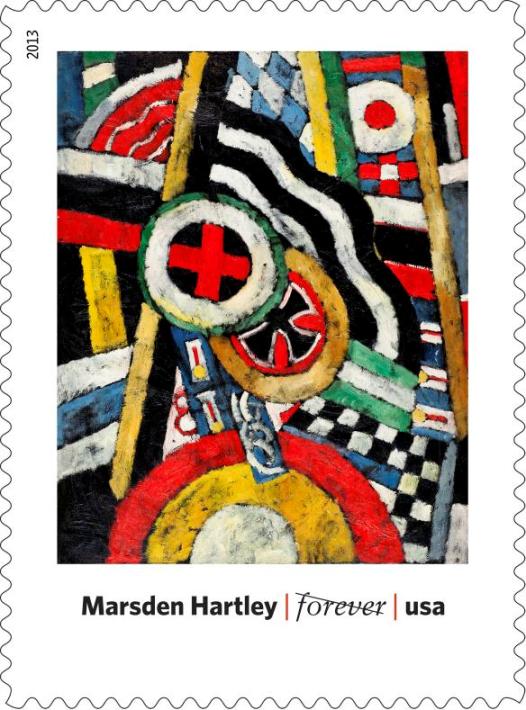 |
|
Send note to Staff
|
|
|
Moderator

United States
4788 Posts |
|
|
Pillar Of The Community
United States
2782 Posts |
|
|
Marcel Duchamp is actually French, but I guess it's included in the set since the painting is in the U.S. It was considered very controversial in its day.
At least the USPS didn't pick his "Fountain" artwork which was voted the most influential artwork of the 20th century in 2004 by 500 artists and historians. |
|
Send note to Staff
|
|
|
Pillar Of The Community

United States
3046 Posts |
|
|
The most annoying thing I find about modern art is this designation between artist and illustrator. My modern definition, Norman Rockwell is an illustrator and not an artist. Illustrator artwork is worth next to nothing and is not supposed to up in value. To this day Maxfield Parish is considered by many in art circles to be an illustrator and his work undeserving of display in an art gallery. |
|
Send note to Staff
|
|
|
|
Pillar Of The Community
Canada
6525 Posts |
|
|
I have to disagree apastuszuak. An illustrator is an artist, just to a different market. And to consider an illustrators work worth next to nothing is also a discredit.
As an illustrator myself, my work is included in a number of corporate collections, as well as quite a few private ones. As an art director I've hired numerous illustrators who's work is very interpretive and would beautifully grace any wall (I have several on my own).
The work of all the early 'fine' artists (remember Da Vinci, Michaelangelo, El Greco?) were illustrative. Most had sponsors in government or the church who paid for their work, the definition of illustration (commercial). The Sistine Chapel ceiling is really one big illustration of a book called the Bible.
Even the cave paintings in Lascaux France can be considered illustrative in their interpretation of every day life of Paleolithic man.
So those who consider Maxfield Parrish unworthy need to take a second look.
Thanks |
|
Send note to Staff
|
|
|
Pillar Of The Community
United States
3046 Posts |
|
|
I mean no disrespect to illustrators. I'll type up my explanation after I get some sleep. |
|
Send note to Staff
|
|
|
|
Pillar Of The Community
United States
3046 Posts |
|
|
Ok, here is my explanation about art in America. Feel free to correct me if I am wrong.
My wife has a friend who is, but every definition I have, an artist. He draws amazing pictures of dinosaurs. Because he sells his work for things such as book covers, magazine covers, cups and other commercial work, by IRS definition, he is an illustrator. An artist, he tells me, is someone who has ONLY sold works through direct commission and/or art gallery sale. The art community of the 20th and 21st century places little to no long term value on the works of illustrators, and places all value on the works of "true artists" who forgo commercial gain.
Supposedly there have been court cases where an "illustrator" has sold a piece of art to someone for a large some of money and the purchaser has demanded a refund because the found out the artists was an "illustrator," whose works are not suitable for long term investment. Art, in my opinion is not defined by some art critic. If someone created something, and you liked it enough to pay a large sum of money for it, then things should stay the way there are. You do not get to back out of the deal because you suddenly found out, the person did not fit the art world's definition of artist. That's the way art used to work.
I find all this to be cr*p. I know that Norman Rockwell is officially an "illustrator" and not an artist. But I place very high value on his work. His "Triple Self Portrait" is absolutely brilliant. I have a copy hanging on my bedroom wall, and I admire it every day.
I went to the National Gallery of Art when I was in high school. I was disgusted to see a blank canvas hanging on a wall titled "Unfinished" with full alarms and a guard standing in the room. The only artist this guy is, is a con artists. Another painting has one black dot in the middle and is also hanging there fully alarmed and protected. My wife calls that one "Polar Bear In A Snow Storm.'
I have a simple definition of art. I am not an artist. If I can do it, it's not art. To see the "Stations of the Cross" depicted on floor the ceiling canvases with a single black line painted as "Station of the Cross 1" disgusts me, knowing this canvas was completed in about 2 minutes, while Rembrandt worked for days on his masterpieces (which are in the other National Gallery painting, and ARE NOT barrier alarmed) |
|
Send note to Staff
|
|
|
|
Pillar Of The Community
Canada
6525 Posts |
|
|
This is interesting. Where do I begin? First of all, this morning you wrote ... Quote:
I mean no disrespect to illustrators. But last night you wrote... Quote:
Illustrator artwork is worth next to nothing and Quote:
his (Parrish's) work undeserving of display in an art gallery I'd have to say that certainly does not show respect. But don't back pedal. We have a wonderful forum here to voice opinions etc (albeit about stamps) which people in other countries would and have literally died for. You wrote what you wrote, stand by it. I'm not insulted. I know how difficult the job can be. The downside of our social media etc is it's too easy to write or say something, press enter without self editing, then deny it later. I call it 'Electronic Tourette's'. If we don't mean it, we shouldn't say it. Anyway, I think your friend is wrong, or at least is too narrow in his definition of an illustrator. And the IRS does not have the last say, at least in this. Their definition serves their own purpose, not the world at large. An illustration is a commissioned piece of art, used for commercial purposes to enhance a story, sell a product or idea, decorate or instruct (example Ikea instructions or an exploded view of a your cars engine. Leonardo's anatomy drawings are technical illustrations. I saw them at the Metropolitan Museum of Art many years ago). Anything can be used as an illustration. A painting, a photograph, a great big red letter A. As long as it does the job of enhancing or elaborating on the subject matter. So, those pieces of fine modern art are now illustrations, because they've appeared on these stamps. But it does not diminish their monetary value. And since monetary value seems to be your friends yardstick, I'd like to see how much he would pay for an original Maxfield Parrish. Or an N.C. Wyeth (father of American fine artist Andrew Wyeth) or Beatrix Potter or Edmund Dulac. An artist is someone who creates a piece of art (whether you like the art or not) regardless whether he/she sells it in a gallery. A painter is an artist. A sculptor is an artist. A printmaker is an artist. A stamp designer is an artist. An illustrator is an artist. Your friend's definition is inaccurate. I wrote a paragraph here about where my career is right now, but deleted it because it is personal and irrelevant to this discussion. I have had some minor success. A few illustrators are very successful. Many disappear altogether. But success does not define art. There are good and bad illustrators, just as there are good and bad fine artists, politicians, doctors, plumbers and parents. But the bottom line is it's not necessarily about the bottom line. It's about creating something that you hope someone will like or relate to, and possibly buy. Whether you draw dinosaurs, presidents, naked ladies or Ektorp bookshelves. By any name, art is a skill, a craft and a possibly a calling. Even the effort is deserving of respect. Quite honestly, I'm not even sure how you got from the stamps shown above to the subject of illustrators, since illustrators were never even mentioned. But I'll close this rant by pointing out illustrators honoured on US stamps. Rockwell, Frederick Remington (yes he was), John J. Audubon, Dr. Suess, Charles Schultz (cartoonists are illustrators), Walt Disney, Bill Mauldin and of course there's the American Illustrators pane of 20 stamps issued in 2001. So I'm done. I'll climb down off the box. Have a nice day. |
|
Send note to Staff
|
| Edited by jamesw - 01/07/2013 11:52 am |
|
|
Pillar Of The Community
United States
3046 Posts |
|
|
Sorry. I was attempting to say that, in the current art climate, an Illustrator's work is not valued even close to as highly as that of what is defined as an artist by current standards. I have read websites debating whether Parish was an illustrator or an artist, and whether his work is deserving of display. I think Parish is brilliant. If I was not clear about that, then it was middle of night tired head talking. I am not backpedaling, just trying to make my intent clear.
My bashing was not against illustrators, but how I perceive them being treated by the art community. I have no issue with illustrators, and I find some book/magazine cover and interior art to be of a higher caliber than a lot of stuff that passes for art these days. Sh*tting in a can is not art, it's unsanitary.
I am not a fan of cubism. Though I think Picasso was a talented artist, I much prefer the early works in the Red and Blue period to his cubist works. When I took Art History in college, my professor nearly threw me out of class for saying this, claiming art historians and art critics praise Picasso as one of the greatest artists of the 20th century and they know better than I do, a pissant 19 year old.
My idea that art was completely subjective was appalling to him, because, as a trained art professor he was far more qualified to tell me what was art, and what was not. |
|
Send note to Staff
|
|
| Edited by apastuszak - 01/07/2013 8:08 pm |
|
|
Pillar Of The Community
United States
3046 Posts |
|
|
I see the problem here: Quote:
My modern definition should have read Quote:
By modern definition Holy completely changing the meaning of what you wrote, Batman.... |
|
Send note to Staff
|
|
| Edited by apastuszak - 01/07/2013 8:03 pm |
|
|
Pillar Of The Community
Canada
6525 Posts |
|
|
I don't know what to tell you. Art IS subjective, and some 'experts' take things too seriously. Now, admittedly I was turned away from a prestigious art school in Toronto when I was 19 because I said I didn't understand Picasso. I get him now, and back then that school should have embraced me and made me understand. But you find people like that even in the commercial art world. But the notion that Parrish or any other illustrator is not an artist is absurd. It's like saying my urologist isn't a doctor. Lots of things are debated on the web...doesn't make them true. We have to separate the proverbial wheat from chaff. Often the primary concern of artists, whether fine artists or commercial artists is concept. You can make anything mean anything. Andy Warhol turned simple soup cans into high art. And again, just because we don't like or understand something, doesn't mean it's bad. My sister doesn't believe rap is music, because she doesn't like it. Believe me, there are a lot of things she doesn't like. That's not going to make them go away. For the record, my definition of illustration above, is a little off. I said that it was a commissioned piece of art. That is not always true. I later said that anything can be used as an illustration, including those modern art pieces. That is also true. The avatars that we all use here on SCF are illustrations. They represent how we want to present ourselves, but they are borrowed images. They are no less illustrations and no less valid. I may be prejudice on this subject (there's an understatement!) and yes, illustrators are undervalued in the art world. We are sluts, we prostitute our talents to make a living. But someone has to do it. I figured it was a way I could pursue my art and make a living, sort of the best of both worlds. Believe me, both worlds are a struggle and littered with egos. As I said on my previous post, there are good and bad illustrators and fine artists. But certainly a good illustrators work is worth a lot more, monetarily, than a bad fine artists. And certainly just as enjoyable. There are a lot of blinkered views out there, whether it's an art professor or my sister. Our job, here or anywhere else, is to get all the information we can and keep an open mind. That's why this forum is important. Discourse, whether about postage stamps or high art is the only way to reach reasonable conclusions. The exchange of ideas, and an open mind. ...but your friend is still wrong.  |
|
Send note to Staff
|
| Edited by jamesw - 01/07/2013 9:28 pm |
|
|
Pillar Of The Community
United States
3046 Posts |
|
|
Sounds like we're both on the same page.
I get Picasso. I just don't like his later work.
And despite what some stodgy art professor thinks, I am allowed to.
I boggles my mind that there are 50,000 pieces of Picasso's work that is known. I have heard there are rumors of even more work being held onto by his family to prevent existing works from devaluing due to market over-saturation. The man painted a lot and he was able to paint rather quickly. Good for him. That shows talent. |
|
Send note to Staff
|
|
|
| |
Replies: 14 / Views: 3,546 |
|
|
To participate in the forum you must log in or register. | |
 Verification Check: US 1869 10c Eagle & Shield (Scott 116 Vs 127) Various Precancels With Blurred Or Other Interesting Cancelations Part 1 Help Identifying US Scott 482A (Type 1A) Vs 482 (Type 1) Bisected Mexico Sc#358 Amazing 1867 Grills At Siegel Yesterday Returning A Stamp For Refund To Canada, Import Duty Fee 1c Franklin Archive Website New Book: "masterpieces Of The Mail, 1775-1875" Trying To Determine What Canadian King Edward Pre-Stamped Envelope I Have 2c Gun Apparent Harvey Ill Precancel With Additional Lettering Loyd's Penny Post Genuine Or Forgery 1c Franklin Imperf - Help Please Kem Playing Cards Still Sealed, Year? Help With 3 Cent Queen Victoria Stamp Type/Color? Nashville Philatelic Society-Your Invitation To Our Auction Night Meeting Monday, September 28, 2026 Serbia 2025 - Second Half Of The Year: The Strand Stamp Fair Closes After 57 Years Don't Use Magic Photo Albums For Stamps Egyptian And Near Eastern Mythologies Norse Mythologies On Stamps Last Of My Australian Recent Charity Kiloware Has Happened Foreign Exchange Control Board Indypex 2026, September 18, 19, And 20, 2026 Value Question: Full Sheet, Austria Scott # 840A-H, Issued 5'24'1969. Wanted: On-Cover Solo Uses Of United States 14¢ American Indian Stamp Verification Check: US 1869 10c Eagle & Shield (Scott 116 Vs 127) Various Precancels With Blurred Or Other Interesting Cancelations Part 1 Help Identifying US Scott 482A (Type 1A) Vs 482 (Type 1) Bisected Mexico Sc#358 Amazing 1867 Grills At Siegel Yesterday Returning A Stamp For Refund To Canada, Import Duty Fee 1c Franklin Archive Website New Book: "masterpieces Of The Mail, 1775-1875" Trying To Determine What Canadian King Edward Pre-Stamped Envelope I Have 2c Gun Apparent Harvey Ill Precancel With Additional Lettering Loyd's Penny Post Genuine Or Forgery 1c Franklin Imperf - Help Please Kem Playing Cards Still Sealed, Year? Help With 3 Cent Queen Victoria Stamp Type/Color? Nashville Philatelic Society-Your Invitation To Our Auction Night Meeting Monday, September 28, 2026 Serbia 2025 - Second Half Of The Year: The Strand Stamp Fair Closes After 57 Years Don't Use Magic Photo Albums For Stamps Egyptian And Near Eastern Mythologies Norse Mythologies On Stamps Last Of My Australian Recent Charity Kiloware Has Happened Foreign Exchange Control Board Indypex 2026, September 18, 19, And 20, 2026 Value Question: Full Sheet, Austria Scott # 840A-H, Issued 5'24'1969. Wanted: On-Cover Solo Uses Of United States 14¢ American Indian Stamp
Disclaimer: While a tremendous amount of effort goes into ensuring the accuracy of the information contained in this site, Stamp Community assumes no liability for errors. Copyright 2005 - 2026 Stamp Community Family - All rights reserved worldwide. Use of any images or content on this website without prior written permission of Stamp Community or the original lender is strictly prohibited.
Privacy Policy / Terms of Use Advertise Here |
| Stamp Community Forum |
© 2007 - 2026 Stamp Community Forums |
| It took 0.31 seconds to lick this stamp. |
 |
|
|
|


 Posted 11/30/2012 11:26 pm


