Ed,
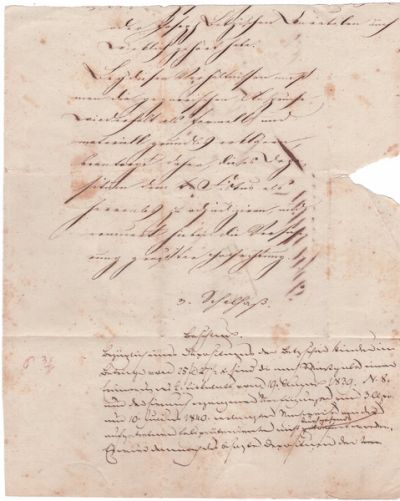
Bad news. The handwriting is just too much for me to decipher more than a few words. The more compressed of the two handwritings is almost impossible. The more ornate of the two is a little easier to read, but my German's not good enough to overcome the script.
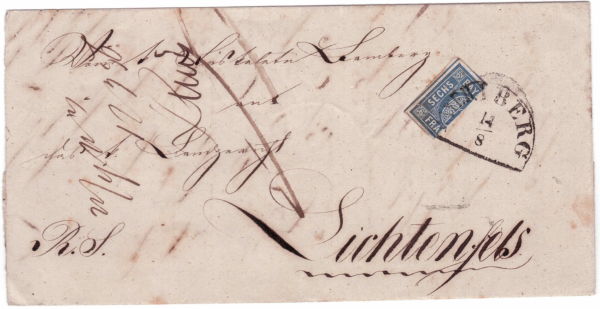
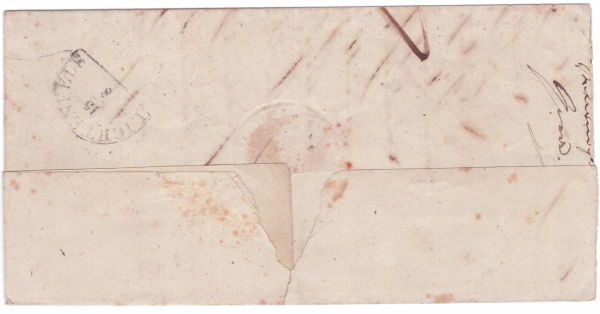
This isn't my area of expertise, but I'm almost positive you have genuine letter from the early 1840s, a time before Bavaria used postage stamps. There's a mention of two dates in the more compressed handwriting (19 August 1839 and 10 January 1840). During this period, the half-circle cancels were used (though not on stamps, obviously), though I'm not sure the two on this letter are genuine. I haven't been able to ID the town on the front, and I haven't been able to find the Lichtenfels cancel in my references. My references aren't terribly complete with regard to Bavaria, however, as that's not an area I collect.
The stamp usage is almost certainly bogus. The stamp used on this letter was valid from 1862-1869. It would be highly unusual to find it (1) on a letter that appears to be 20 years older, and (2) with the half-circle cancel, as from 1856-1869 Bavaria primarily used the open millwheel cancels. The half-circles were often still used as receiving marks, but usually not to cancel stamps.
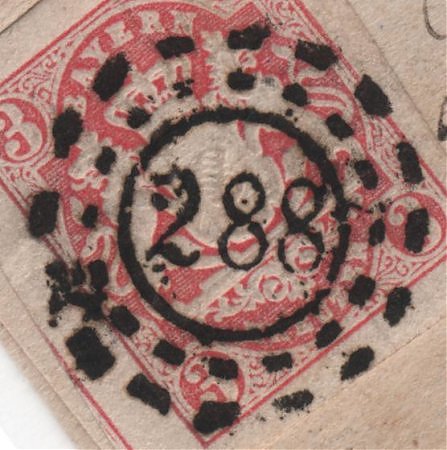 Lichtenfels Open Millwheel Cancel
In addition, Michel notes that the bisects of that issue should be bisected diagonally, not vertically.
So why ruin a perfectly good old letter with a fake stamp? Michel CV for an intact letter with a legitimate bisect (Mi #10 H) is €12,000.





 Posted 06/23/2013 5:07 pm