Stamp Community Family of Web Sites
Thousands of stamps, consistently graded, competitively priced and hundreds of in-depth blog posts to read


Stamp Community Forum
 
Username:
Password:
Save Password
Forgot your Password?

This page may contain links that result in small commissions to keep this free site up and running.

Welcome Guest! Registering and/or logging in will remove the anchor (bottom) ads. It's Free!

Introducing The Continental Large Numeral Essays

Previous Page | Next Page    
 
To participate in the forum you must log in or register.
Author Previous TopicReplies: 39 / Views: 7,617Next Topic
Page: of 3
Pillar Of The Community
United States
545 Posts
Posted 07/17/2013   8:28 pm  Show Profile Bookmark this reply Add Zipper to your friends list  Get a Link to this Reply
They're fabulous! Thank you so much for showing them.
Send note to Staff  Go to Top of Page
Pillar Of The Community
United States
808 Posts
Posted 07/17/2013   8:30 pm  Show Profile Bookmark this reply Add guykickinit to your friends list  Get a Link to this Reply
I still wanna know where to find these works of art!
Send note to Staff  Go to Top of Page
Member of the Central Oregon Stamp Club.
Redmond, OR 97756 Mailer's Postmark Permit #1
APS 239403
Rest in Peace
United States
7097 Posts
Posted 07/17/2013   9:04 pm  Show Profile Bookmark this reply Add I_Love_Stamps to your friends list  Get a Link to this Reply
I just love this stuff. I own a few proofs and always look at essays but afraid to jump in. I do however love to read about them. Any good links or books ou would reccomend on essays in general since these particular ones is
Send note to Staff  Go to Top of Page
Bedrock Of The Community
United States
10599 Posts
Posted 07/17/2013   9:12 pm  Show Profile Bookmark this reply Add revcollector to your friends list  Get a Link to this Reply
All of these are almost certainly part of the ten boxcars full of "waste paper" saved in the late 1890's by Deats and Sterling, two famous dealer/collectors of that time. Revenue collectors (and others, like collectors of high value officials on cover) should bow at the very mention of their names.
Send note to Staff  Go to Top of Page
Edited by revcollector - 07/17/2013 9:13 pm
Pillar Of The Community
United States
1942 Posts
Posted 07/17/2013   9:19 pm  Show Profile Bookmark this reply Add essayk to your friends list  Get a Link to this Reply
Sorry about that Guy. Didn't know if you were serious. These come up at auction from time to time. More of them have come through Siegel in the last 20 years than from anyone else. They are not the kind of thing that you will find on ebay, generally, but there is a dealer who sells on ebay who has one for sale right now. However, it is cut down to stamp size, is entirely off card and is way over priced. There is also a similar one that will come up at the Regency-Superior auction at STaMpsHOW, for which he has an outrageous reserve behind his unfounded claim. Still it could get some action because there are only two or three of each color item in existence. People who want them can get a little desperate about it. FWIW, the two off paper items floating around should go for something in the neighborhood of $600, but these sellers won't hear of anything like that. You won't get any competition from me on either one (unless they succumb to a fit of rationality).
Send note to Staff  Go to Top of Page
Pillar Of The Community
United States
1942 Posts
Posted 07/17/2013   9:23 pm  Show Profile Bookmark this reply Add essayk to your friends list  Get a Link to this Reply
@revcollector : is that story told in the Boston Revenue Book? If not, do you know where? Stanley Bierman?

Yeah, I just checked. Bierman tells the story of the 200 ton acquisition of Treasure Dept stub-books in 1889. That material was primarily related to the two firms connected to Joseph R. Carpenter. Bierman gives an inventory of what came out of the hoard, and that included 557 essays and experiments from the period 1862-1883.

Bierman does not mention records from Continental, which had become a part of the American Bank Note Co consolidation ten years earlier, but he does refer to a revenue collection that Deats bought from Sterling in 1888, which had been formed up in independent parts by Carpenter and Albert Goodall, whose term as president of ABNCo had just ended in 1887. How much if anything of these essays came through that route is anyone's guess. But it is tantalizing to think about it.
Send note to Staff  Go to Top of Page
Edited by essayk - 07/17/2013 10:37 pm
Bedrock Of The Community
United States
10599 Posts
Posted 07/17/2013   11:12 pm  Show Profile Bookmark this reply Add revcollector to your friends list  Get a Link to this Reply
ABN had to sell off excess too as they consolidated, there was only so much room to keep the old material from the various companies they bought up.
Most of the data in the Boston Book came from that purchase plus any other info that was known from the holdings of the group and their friends.
Send note to Staff  Go to Top of Page
Pillar Of The Community
United States
1942 Posts
Posted 07/18/2013   9:25 pm  Show Profile Bookmark this reply Add essayk to your friends list  Get a Link to this Reply
In the first picture below, the item on the left* is interesting to us in two ways. First it is a progress essay toward the creation of a design by Continental for a tax paid revenue stamp covering the tax on 8 ounces of tobacco. It is listed in the essay-proof catalog for revenue stamps by George Turner, and there identified as T-23. It is also interesting because as you can see, this specimen has been mounted on Kraft paper. That is because it was pasted onto the outside of a file folder in the archives of the American Bank Note Company. With the dispersal of those archives in the early 1990s a large amount of this kind of material became available to collectors for the first time.

Comparing this essay to the essay on the right, you can see that the contours of the figure "8" in this design were the inspiration for the shape of the figure "3" in the first 3-cent essay type Continental was proposing for postage stamps. This is only true in a general way, for if you look carefully at the bases of the two figures and follow the forms up the right side, you will see that they differ in curve and proportion as they outline their respective numerals. So in this case Continental was not merely modifying a laydown from an existing die, but was re-engraving and adapting an existing form of numeral to a new use. This is as close as the connection gets between the series of tax paid revenue designs and what Continental was preparing as its first design for the three cent postage stamp.
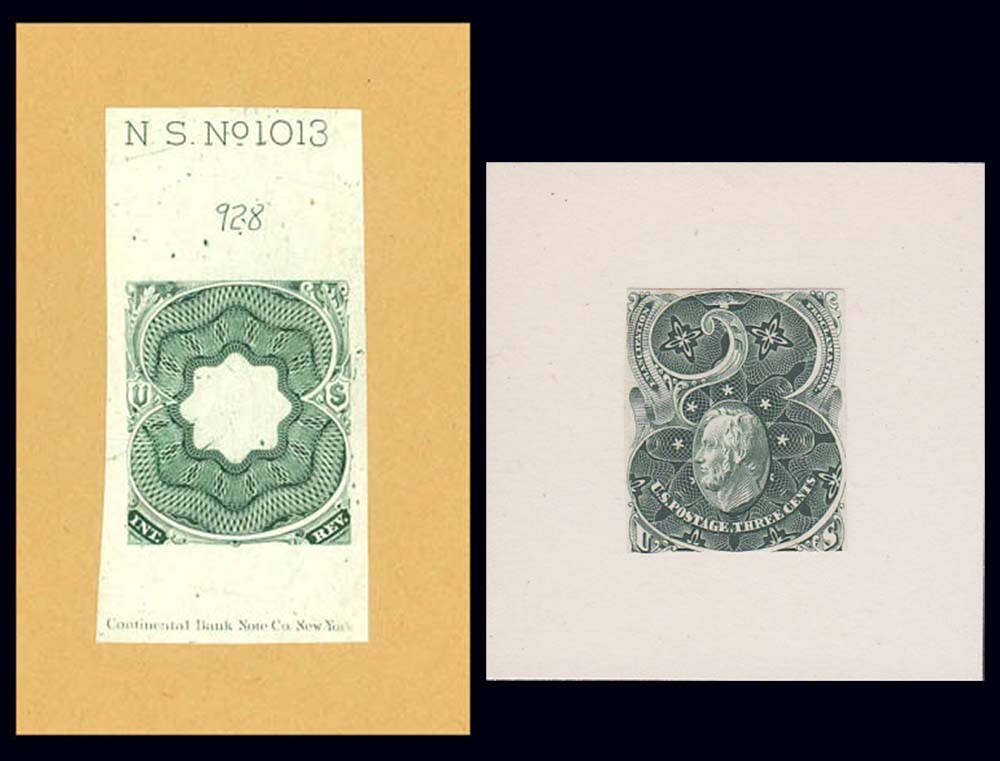

*left image from Kelleher sale 625 lot 1303


Scott lists this three cent design as 147-E1. As before, the contour lines of the numeral form a boundary line between the styles of decoration inside the numeral and around it. Inside the numeral rose engine swirls create complex patterns as a groundwork for inlaid patterns of stars of various geometries. Outside the numeral the use of banner ribbon and acanthus scrollwork with its shells, balls and beads dominate. Taking a close look one cannot help but be impressed by the intricacy of the design work, especially where the decoration outside the numeral swirls into the region of interior decoration.
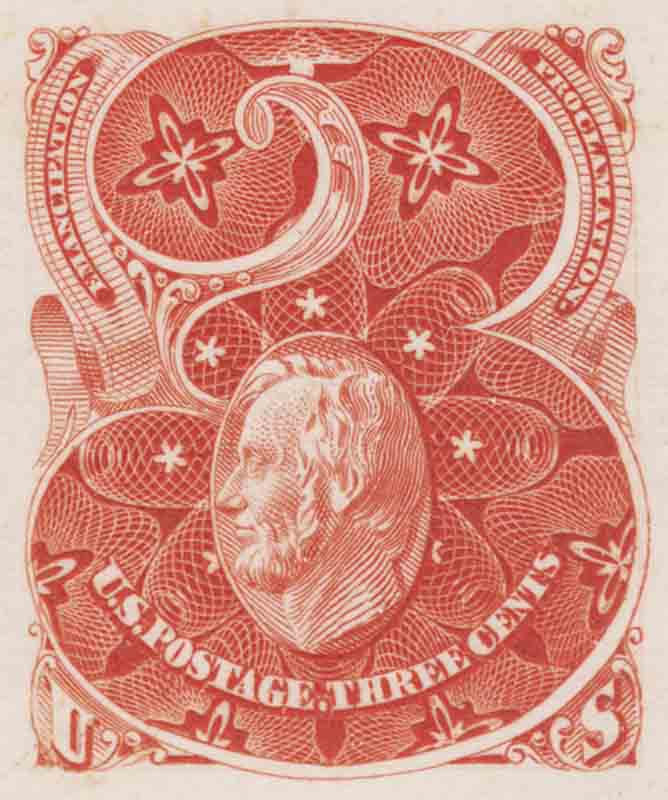


Thematically we must ask if this design continues or alters the pattern we have seen in the first two denominations which named a critical point of dispute in a major U.S. military conflict. Independence in 1776 and Impressment in 1812. Here the Emancipation Proclamation is featured, but without reference to a year date. Does the artist mean to disassociate it from the Civil War by omitting the date, or imply causality by its inclusion in the series? Was the Proclamation fundamentally the reason for the civil war, or was it an outcome? The design invites reflection by its ambiguity, which is a desired goal in all fine art. However the thematic connection to Abraham Lincoln is not at all ambiguous as a cameo portrait figures prominently into the design as the vignette. Below this, in another departure from the design style, the words "U.S. POSTAGE" and "THREE CENTS" appear continuously in a single curved entablature and are separated by a mark of punctuation. In all this is a most remarkable design.

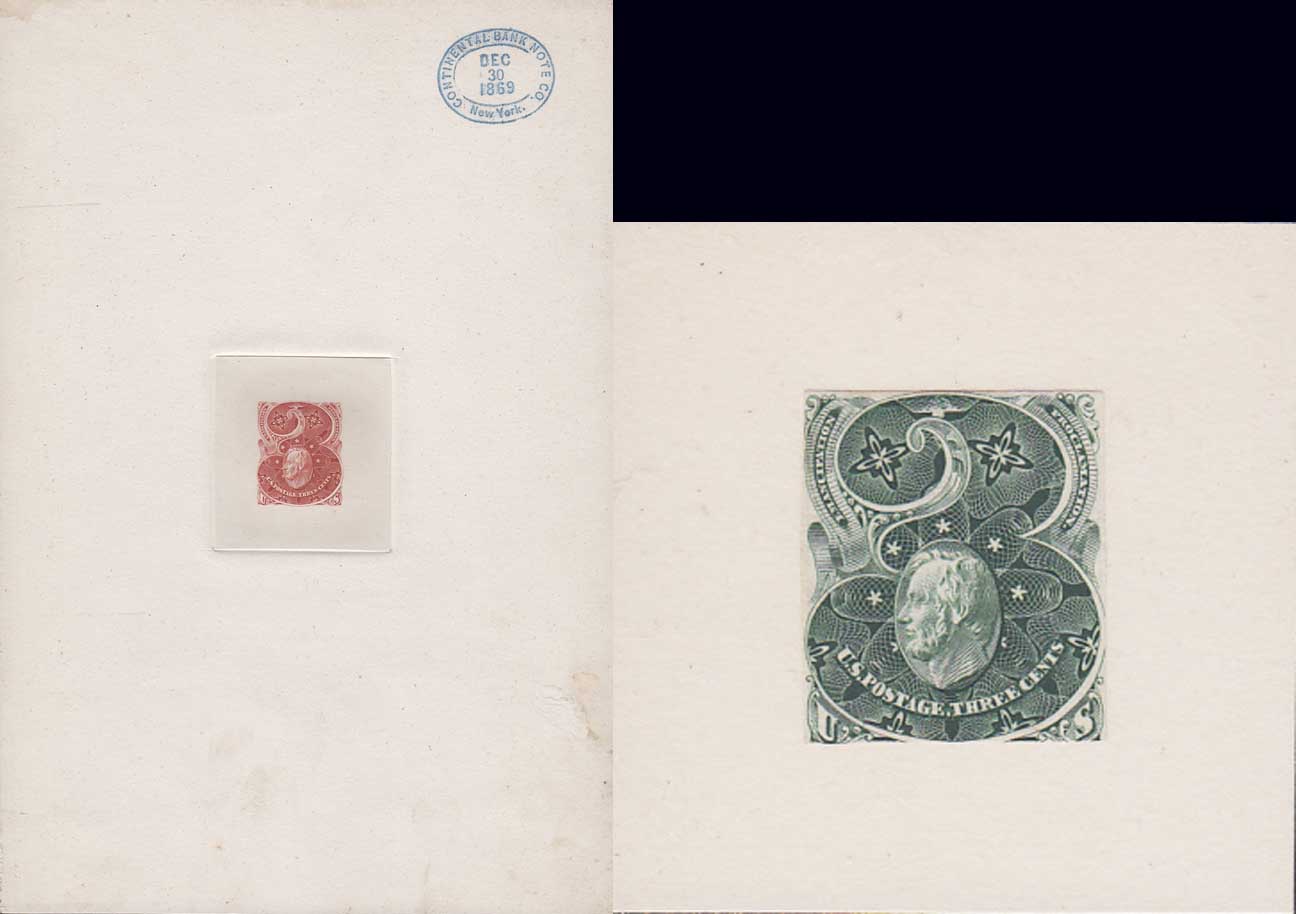
The normal form for this engraved essay is printed on India die sunk on card, although the original full size card is exceptional. It is also know as a hybrid die essay printed on India paper, cut close to the design and block sunk on card. This format is known for all the denominations of this series, but none are yet listed in Scott.


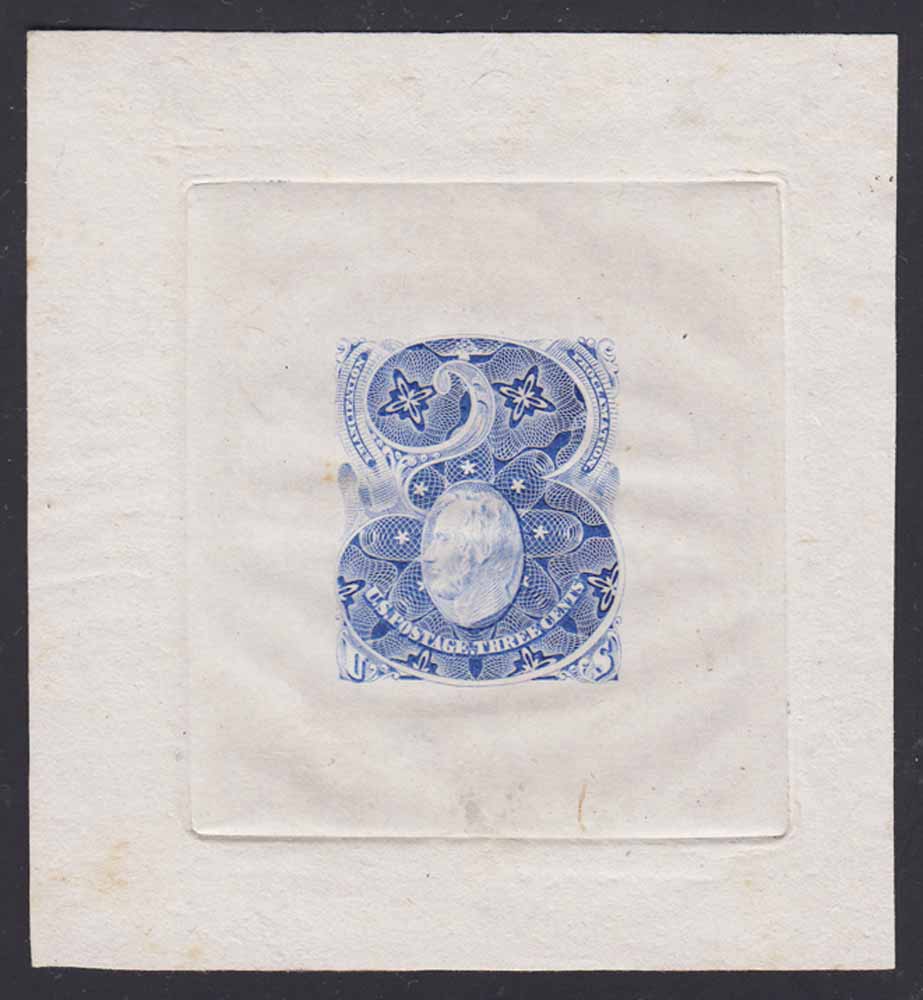
There is one other format for this denomination which is somewhat anomalous and not yet Scott listed for this denomination. This is printed on proof paper, die sunk, but not on card and is only known by the item pictured below so far. Something like this was listed by Brazer for both the 1c and 2c designs, and Scott preserved the listing for the 1c only. However, nothing quite like this for those denomination has come to market for the last 20 years, and it is uncertain whether they are of the same character or not. The whole matter is under investigation.


---------------------------------------------------
Those who are following along with these posts using the listings in the Scott Specialized Essays section will note that there are several more three cent essays listed. Those are from a second series of designs for the three cent, and I am going to skip them for a bit so I can finish off the first series.
---------------------------------------------------

The first series ends with a six cent essay also directly derived from the tobacco tax paids. The image on the left* shows an essay for a 32c stamp that paid the tax on six ounces of tobacco. The design features a vignette with the image of a Black field hand, presumably an emancipated slave, inside a numeral "6" with significant rose engine interior background decoration. This is framed in filagree with the insignia US in an oval at upper left and abbreviations for "Internal Revenue" in small tablets at bottom left and right.

The picture on the right shows 148-E1, Continentals design proposal for a six cent postage stamp. As you can see, the same central numeral "6" with its rose engine work has been taken over unaltered, but the words "six cents" have replaced "six ounces" and "US Postage" no fills ths space the original numeral of value occupied. The framing decoration around the "6" has been simplified, and a stars and stripes shield has replaced the US insignia.
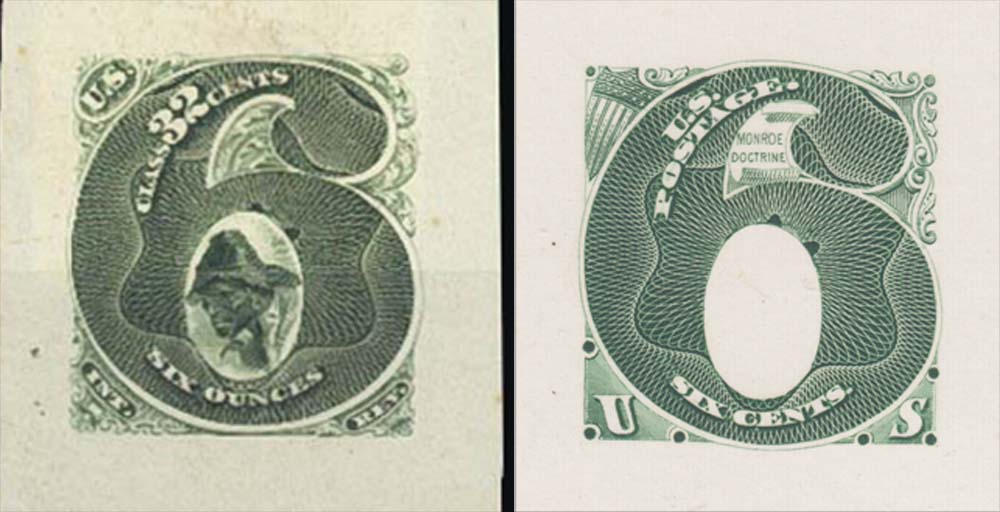

*left image from an H.R. Harmer sale


The figure of an open scroll with the words "Monroe Doctrine" situated in the upper curve of the numeral announces the theme behind the design, but it is clear from the absence of a vignette, as well as the bare simplicity of the design that it is not yet developed. At the time of this design's creation the Monroe Doctrine had not yet been put to the test of war, which breaks the war motif as the linking theme for the series. That further calls into question the connection between the Emancipation Proclamation and the civil war on the three cent, but both these two denominations are also without a year date association to the theme.

In addition to the normal India paper die sunk on card, usually reduced, the six cent essay also appears in hybrid form as you can see from the telltale marks of a mounted reduced die print.* None of these have yet been listed in Scott.
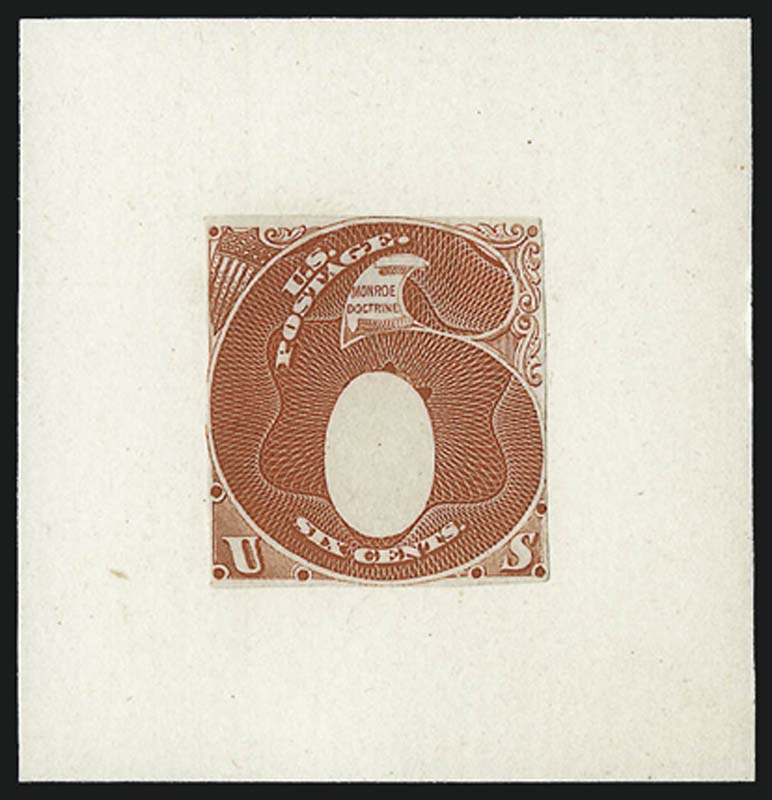

*image from Siegel sale 1040 lot 1066


Send note to Staff  Go to Top of Page
Pillar Of The Community
United States
1942 Posts
Posted 07/19/2013   11:53 pm  Show Profile Bookmark this reply Add essayk to your friends list  Get a Link to this Reply
I see the thread has cooled. Since I have already hit you with all of the first series, and on the principle that it is possible to have too much of a good thing, I will hold off on series 2 for a bit until some interest returns for these. It may be that I am giving too much info with them [= B-O-R-I-N-G], so I will rethink that too. Maybe just pics and cat numbers?

Glad to see though that you were enjoying them for a while. Now if I can just figure out how to turn it into a one-framer.
Send note to Staff  Go to Top of Page
Pillar Of The Community
United States
898 Posts
Posted 07/20/2013   11:51 am  Show Profile Bookmark this reply Add Philatarium to your friends list  Get a Link to this Reply
Essay: Please do continue! I don't think it's too much information -- I really appreciate it, and I imagine that others do, too. I just don't happen to know enough to ask much in the way of follow-up questions.

Please continue with your write-ups.

-- Dave
Send note to Staff  Go to Top of Page
Pillar Of The Community
Canada
528 Posts
Posted 07/20/2013   12:20 pm  Show Profile Bookmark this reply Add stamporator to your friends list  Get a Link to this Reply
Hi Essayk,

Keep them coming. I am overwhelmed and dumbfounded by the information and scans.

Great information!

- stamporator -
Send note to Staff  Go to Top of Page
Pillar Of The Community
United States
1942 Posts
Posted 07/20/2013   12:35 pm  Show Profile Bookmark this reply Add essayk to your friends list  Get a Link to this Reply
Let me think about that a little more, Dave. Stampshow is coming up in a couple of weeks, as is the NSDA "show," the application for the one framer I've been thinking about is due in mid-August, and "the Club" has a couple of events planned too. Some of these require special preparation, so time is getting short.

In the meantime you might enjoy a pic of my most recent acquisition. It is one of the three items I have shown you from the series that at the time of writing I did not own. You have seen it close up, but here is the broad view. I think you will get a kick out of it.

https://www.ebay.com/itm/-/200658828513 target _blank 200658828513 /a -999.jpg" border="0" style='cursor:default' onClick='doimage(this,event)'>

The four digit number in black at the top is on the folder stock, and it matches one of the numbers engraved on the die. What do you think it all means?

Send note to Staff  Go to Top of Page
Pillar Of The Community
Canada
4648 Posts
Posted 07/20/2013   2:28 pm  Show Profile Bookmark this reply Add Bujutsu to your friends list  Get a Link to this Reply
Truly interesting material essayk

While I do not have any of these in my collection, it is still quite interesting. The Die Embossed ones are really fancy.

Chimo

Bujutsu
Send note to Staff  Go to Top of Page
Pillar Of The Community
United States
1942 Posts
Posted 07/24/2013   5:41 pm  Show Profile Bookmark this reply Add essayk to your friends list  Get a Link to this Reply
I see that the list/Classic forum has been rather quiet for the last couple of days, so it will not be amiss for me to hit you with more of the story on the large numeral essays as some of you have requested.


SECOND SERIES, DIE STATE I

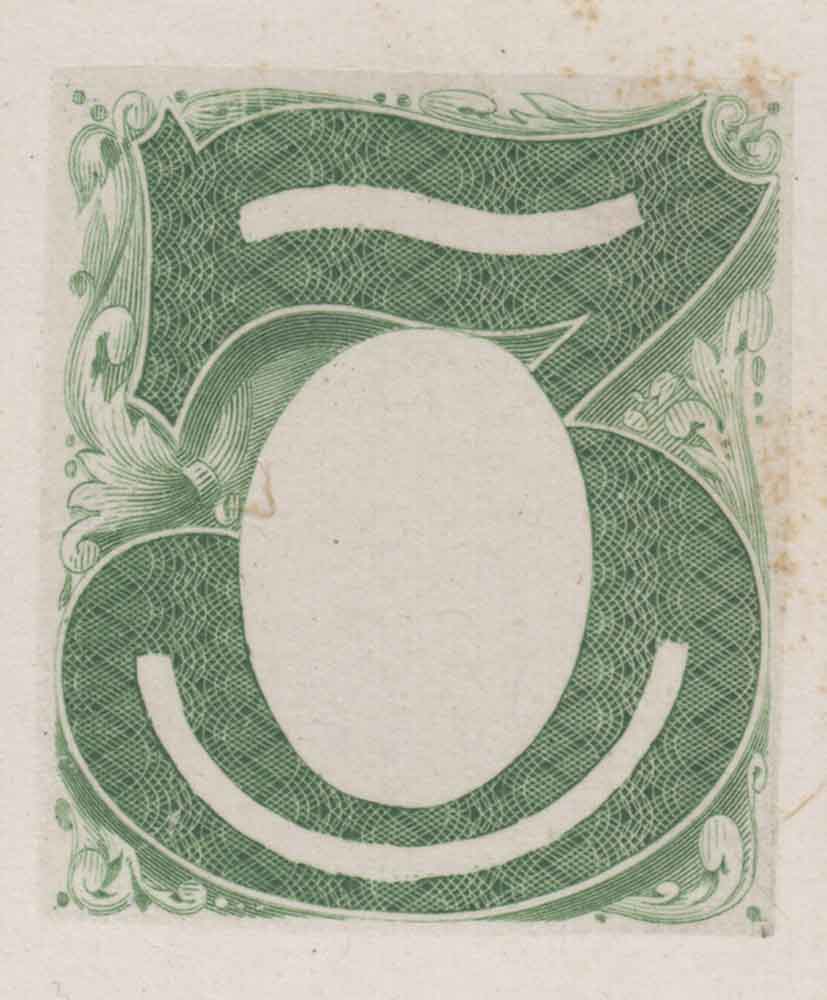
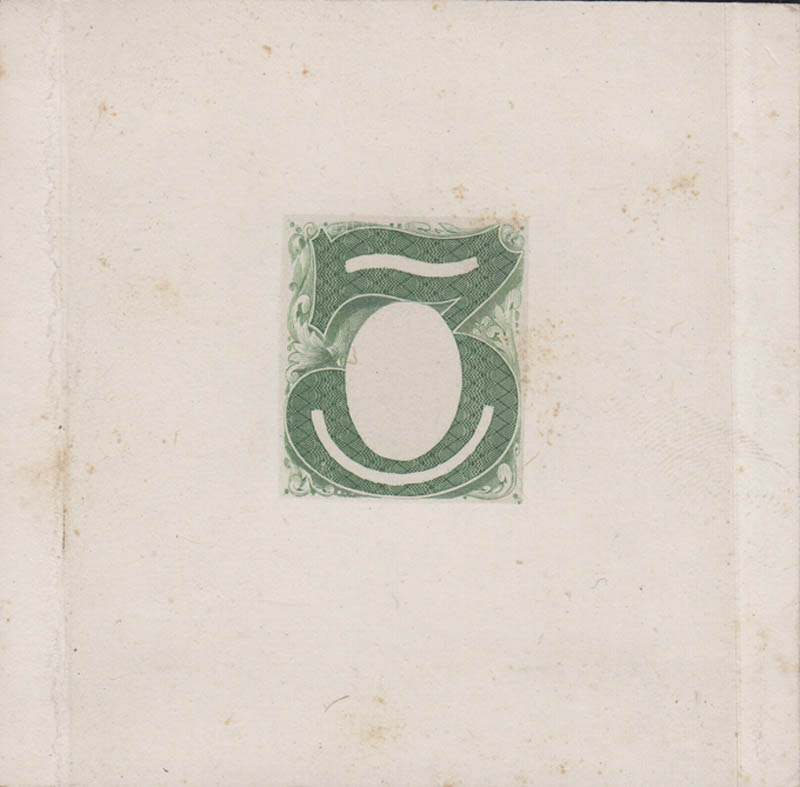
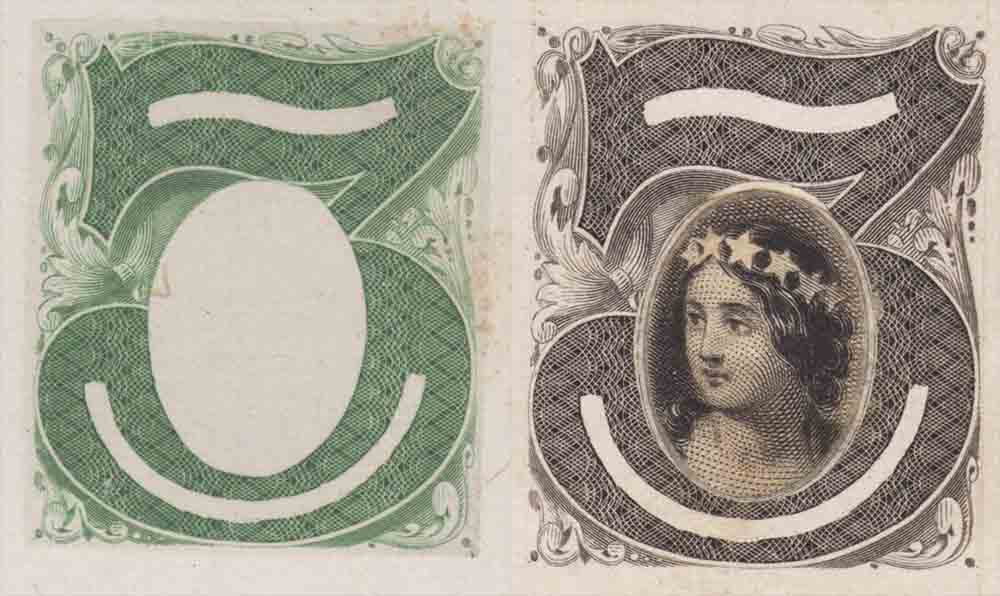
In addition to the series with rounded numerals, derived almost directly from their tax paid revenue designs, Continental explored an alternative large numeral three cent design in a couple of different styles. This resulted in creating a number of different essay types all based on a flat topped numeral three, possibly all from the same die in various progressive states. The first state of this die appears to be what we see in the essay listings in Scott as 147-E1B, which is pictured here.


As in the first series, the numeral of value is the most prominent figure, and a rose engine fill is used to flesh out its form. The entablature above and below the space for the vignette is empty, and there is no vignette. The numeral is surrounded by ornament that is flowing and flowery, to which I have applied the term "foliate." This ornament style is an important feature to watch as the die states progress.


The material for this first die state is very scant, being limited to two die print essays, one each in green and black. These are hybrid prints, inasmuch as a die print was pulled on India paper, then cut close to the design and mounted on India and block sunk on card. Scott has used an image of this item as the illustration for its listing, but does not mention that this is a hybrid, misreporting it as die sunk. Of the two known examples, both are hybrids.


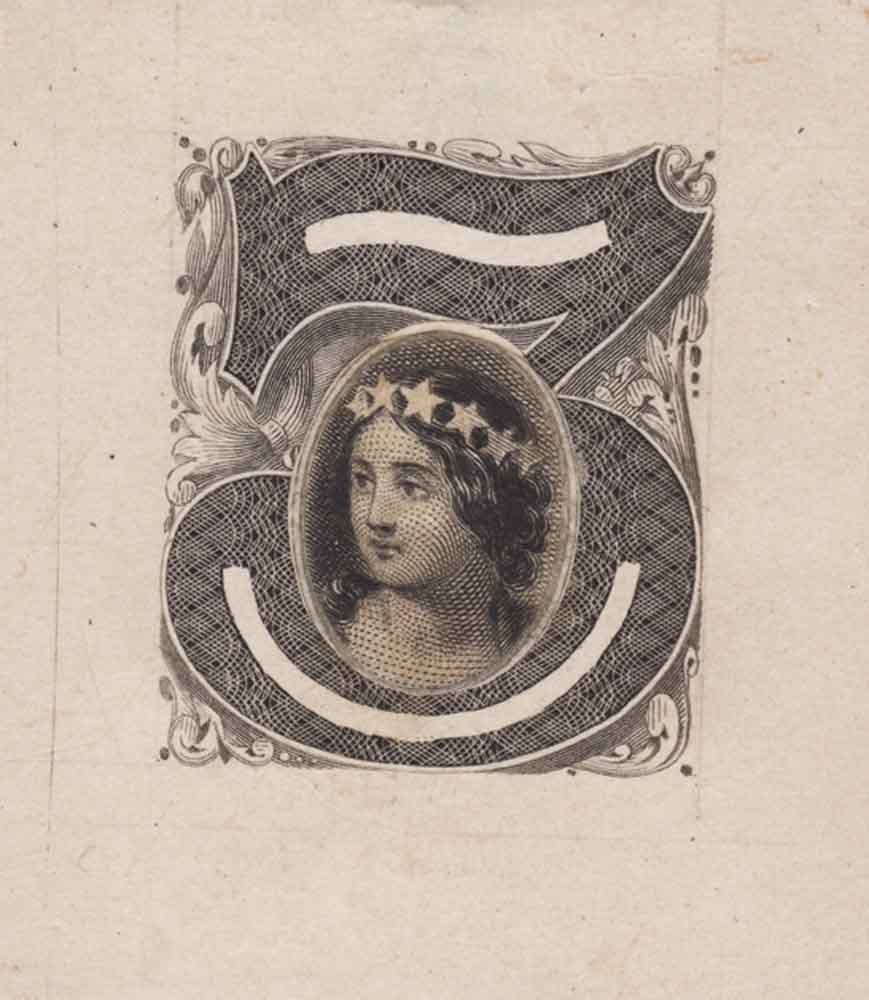
As you can see, this numeral was meant to surround a vignette, so a composite model of this essay was prepared in which a vignette engraving of Columbia has been added. The original frame print for this model was not cut as close as for the frame-only essays, and may still be die sunk on its original card backing.


(This model is what I chose as my avatar and spoke about earlier.)
Send note to Staff  Go to Top of Page
Edited by essayk - 07/26/2013 11:19 am
Pillar Of The Community
United States
1942 Posts
Posted 07/24/2013   6:03 pm  Show Profile Bookmark this reply Add essayk to your friends list  Get a Link to this Reply
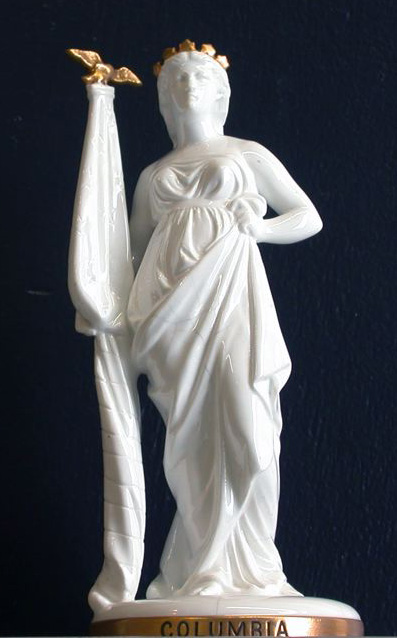
Let me momentarily turn the discussion to the figure of Columbia and the representation here. Already in the late 18th century "Columbia" was imagined as an allegorical representation of the emerging nation United States of America. Here is a porcelain statuette of the figure, so labeled at the base, which was crafted by the British firm Mintons Ltd. in about 1800. Today this is housed in the Art Institute of Chicago. A couple of its distinguishing features are the association with the American flag, an American eagle, here atop a flagstaff as an emblem of authority, and a distinctive headband of stars.


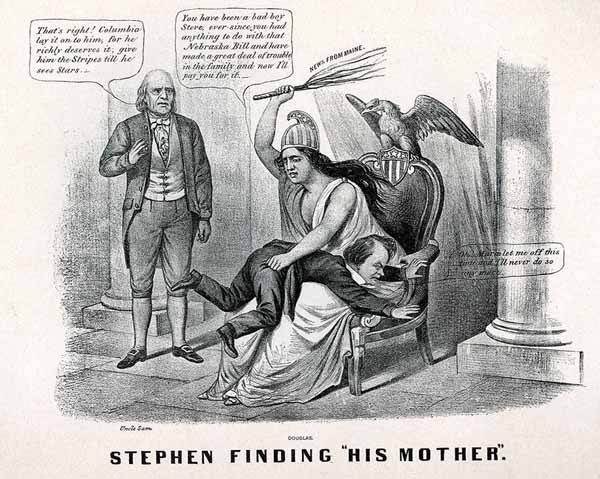
By mid-19th century, the figure was becoming ubiquitous in American culture. In this Currier & Ives political cartoon from 1860, "Uncle Sam" on the left addresses the figure of Columbia by name and encourages her to discipline her "wayward son" Stephen Douglas over the Kansas-Nebraska Act. Here she is seated wearing a Corinthian helmet replacing the crown of stars, but the eagle is perched behind her, and the figure of the flag not only appears as a shield, but is also alluded to in the expression by Uncle Sam, "...give him stripes until he sees stars...." Her emblem of authority is not a flagstaff nor a peace branch, but she wields it with great conviction.


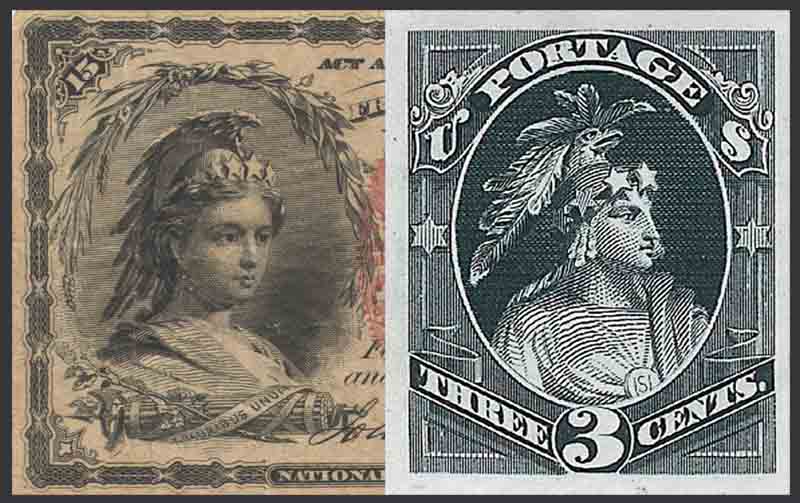
With the creation of fractional currency in 1862, a designer at the National Bank Note Company used a figure for Columbia on the 15c note. Here the Corinthian helmet has been altered so that the eagle is perched atop as a crest in the manner of an Attic helmet. Below are the fasces and olive branch authority emblems, and a crown of stars prominently rests upon her head. In 1876, when fractional currency was discontinued, Joseph Claxton of the Continental Bank Note Company suggested the use of this figure in a similar form for a postage stamp proposal. Scott erroneously refers to the figure in 184-E15 as an "Indian maiden." But the eagle and star emblems of Columbia are unmistakable, as is the US monogram in the medallion she wears.


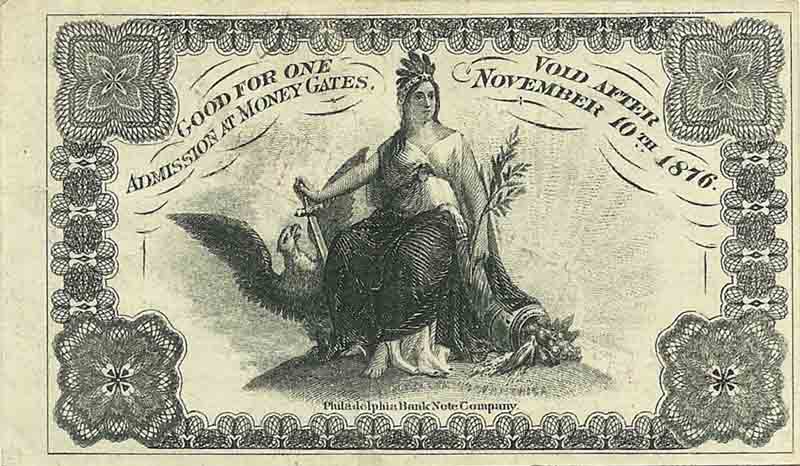
Finally I will refer you to this image of Columbia on the reverse of the tickets the Philadelphia Bank Note Company prepared for the US Centennial Exhibition in 1876. Columbia is seated with the eagle to her right, with a sword and olive branch on either side, and a darkly colored flag draped across her lap. She wears a feathered headdress, with a band of stars at its base.


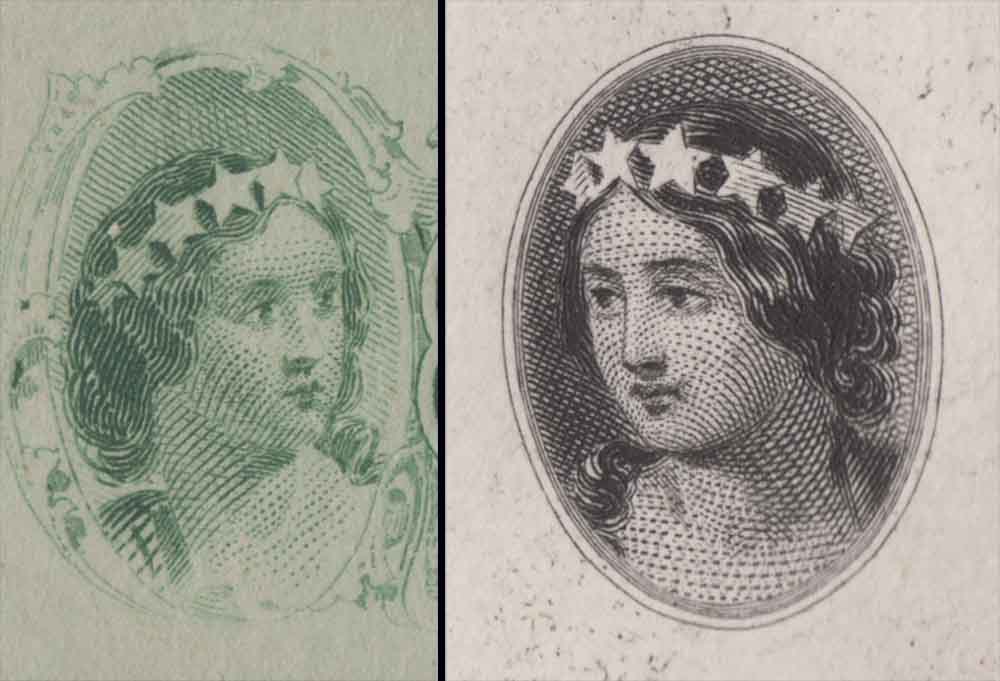
Returning to 1869, the Continental Bank Note company had prepared a tax paid strip stamp for the tax on four ounces of tobacco, which made use of a figure of Columbia for the vignette at the extreme left end.


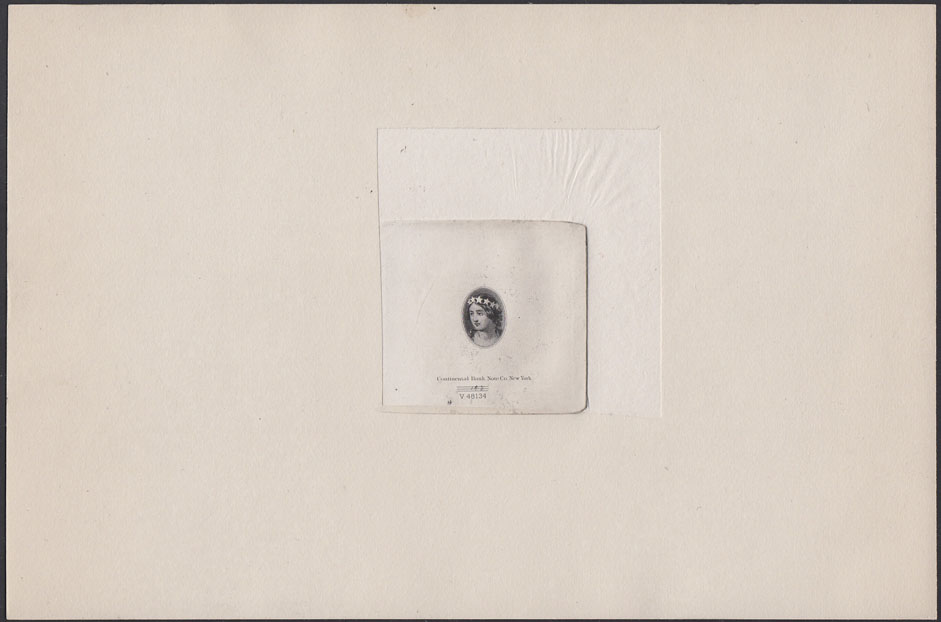
In this tiny sensitive portrait (on the left), the figure has the bearing of a woman in her mid-to-late teens, faces to the right and is wearing a simple crown of stars. The other emblems of the Columbia figure are not present. The vignette on the right has reversed direction and has a decidedly child-like appearance, but is otherwise very similar in style to the version on the tax paid revenue stamp. This is the Columbia vignette modeled with the second series of three cent postage stamp designs.


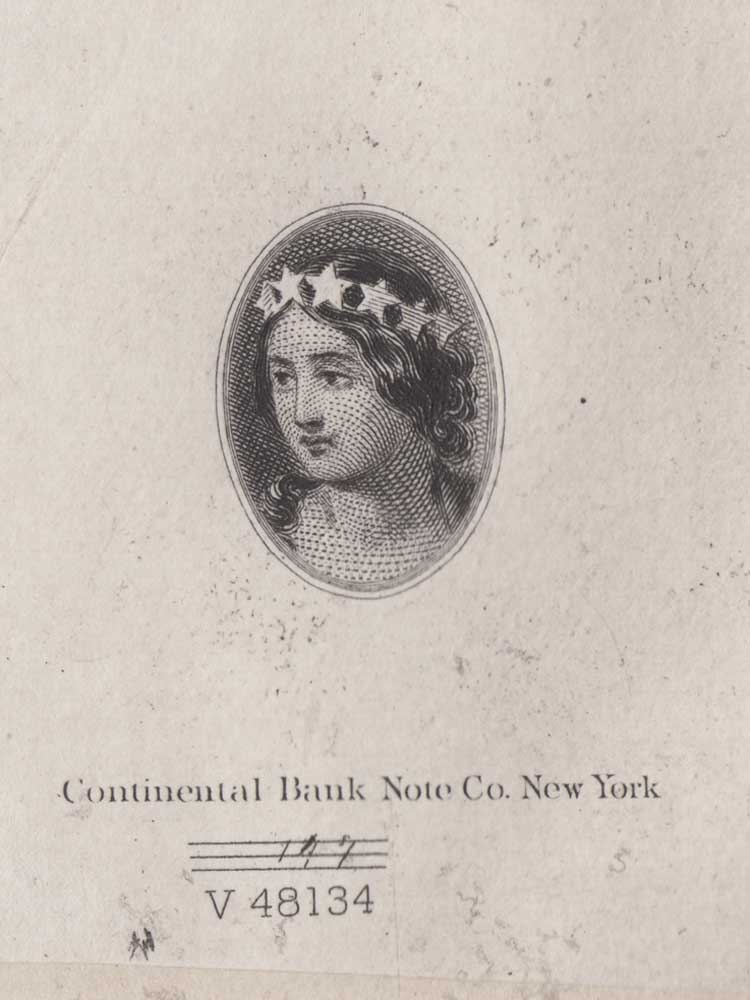
Continental engraved this vignette as a stock die independently of any particular frame. Die prints on India die sunk on card are known in full size and reduced, and bear the die number and the inscription of the Continental Bank Note Company. However, it is probable that none of the examples so far known is original to CBNCo in 1869.


On close examination the company inscription is clear, but the original die number has been effaced with three parallel lines of engraving, and a new number has been engraved below it. This treatment and the style of the number are typical of the stock die renumbering that the American Bank Note Company did at the time of the consolidation with Continental in 1879 and later. While the die is original to Continental, it is clear that the vignette-only die prints are not. Nonetheless, as the only surviving full die prints from this die they deserve a place in the listings with the 1868-69 essays, perhaps with a notation on the later dating of the prints.


SECOND SERIES, DIE STATE I (summary)

So then the first state of the die for the new style three cent is represented by die prints of the frame only and by paste-up models of this frame and the Columbia vignette. At present Scott lists these as distinct stages in the design progression, which they may be, but they are both subtypes of die state 1.


Send note to Staff  Go to Top of Page
Edited by essayk - 07/25/2013 10:31 am
Page: of 3 Previous TopicReplies: 39 / Views: 7,617Next Topic  
Previous Page | Next Page
 
To participate in the forum you must log in or register.

Go to Top of Page

Disclaimer: While a tremendous amount of effort goes into ensuring the accuracy of the information contained in this site, Stamp Community assumes no liability for errors. Copyright 2005 - 2026 Stamp Community Family - All rights reserved worldwide. Use of any images or content on this website without prior written permission of Stamp Community or the original lender is strictly prohibited.
Privacy Policy / Terms of Use    Advertise Here
Stamp Community Forum © 2007 - 2026 Stamp Community Forums
It took 0.38 seconds to lick this stamp. Powered By: Snitz Forums 2000 Version 3.4.05