|
This page may contain links that result in small commissions to keep this free site up and running.

Welcome Guest! Registering and/or logging in will remove the anchor (bottom) ads. It's Free!
To participate in the forum you must log in or register.
| Author |
 Replies: 91 / Views: 23,241 Replies: 91 / Views: 23,241 |
|
|
|
Pillar Of The Community
United States
1946 Posts |
|
|
This is excellent. Good linearity without convergence, and clarity to the focus throughout. Good job! Interestingly enough it also changed the sense of Jackson's expression from uncomfortable to determined. It reminds us that we are working with 2 dimensional images.
I have another project demanding my time just at the moment, and will get back to this later today. But I did want to comment on what you achieved with the pic. |
Send note to Staff 
|
|
|
Valued Member
42 Posts |
|
|
Thanks. I used the camera's tungsten setting to achieve the distinct coloring. The spider tripod actually works well. It just takes practice and patience. Here is the original watercolor painting of the $50 Canal Note 'Moneta' central vignette, as designed by Casilear. Alonzo's relative gave me permission to use it. From this Alonzo did the steel vignette engraving. The steel die can also be shown to the forum, as necessary. 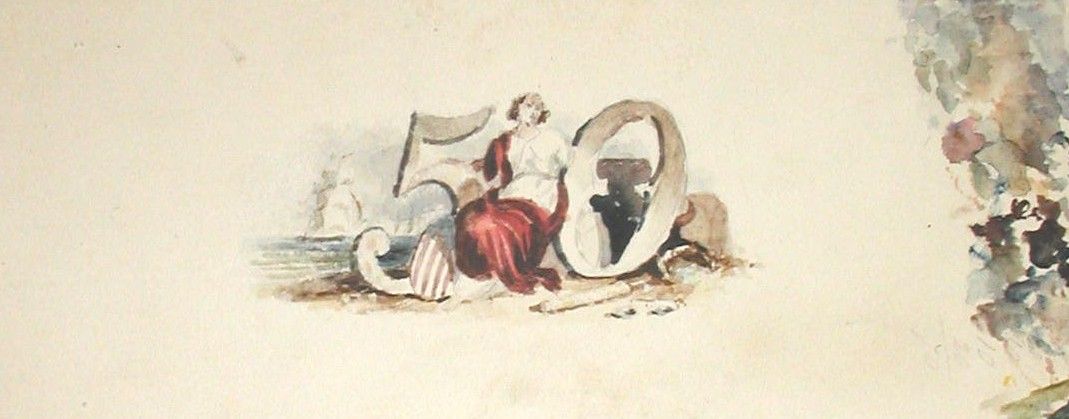 I am presently doing a systematic review of Haxby to see if I can find anything related to the two profile busts under discussion. The CD of Haxby that I have allows a search function - although it is far from perfect - and I am looking up anything recorded for all the Toppan engraving companies. It will take some time, as I have to repeat the search for each state and each company separately. So far, New York and Pennsylvania, two of the larger issuing states, and logical Toppan market candidates, have turned up nothing. The Poughkeepsie NY Bank proof with the two profile heads was said to have been done in the 1840's, but I have my doubts about that. |
|
Send note to Staff
|
|
|
Valued Member
42 Posts |
|
|
Here are two reasonably sharp images of the Wasington profile bust under discussion. The first is an 185110a type 2 that will be auctioned on Tuesday by Kelleher in NYC, and represents about as clean and sharp unused version that can be found. 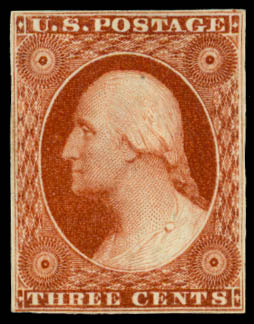 The second image is from the NH $10 Piscataqua Exchange Bank issue of ca1845, which was previously posted by Essayk, and is taken from the Heritage website. 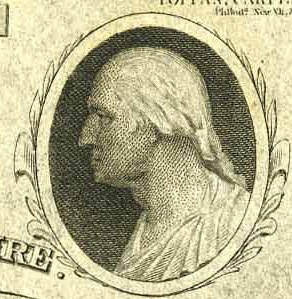 These two images of an issued stamp and bank note containing the die paper imprints of the profile Washington retaining "near new" characteristics, will allow the forum to closely compare the engraving style used on both. Any distortion is caused by blowing up the examples. I have to thank my son for helping me put these images up on the screen, as he is far more skilled in these matters than I am. |
|
Send note to Staff
|
|
|
Pillar Of The Community
United States
1946 Posts |
|
|
With this last post I think we are going around in circles, repeating the same material I sent up in the first two pages of this thread. So let me summarize my thoughts on what I think we have so far.
1. We have conclusive evidence that John Casilear was known to Charles Toppan before 1848, and some circumstantial evidence to indicate that he may have known of Casilear as early as 1835 (1832?).
2. We have conclusive stylistic evidence that the Washington and Franklin vignettes used on the 1c and 3c stamps were derived from two bank note vignettes which were engraved by TCCo not later than 1845. The stock die for these two bank note vignette designs is a single block bearing both vignettes, which was subsequently found in the archives of the American Bank Note Co. Therefore, this stock die was classed with bank note dies and not postage stamp dies, inasmuch as the TCCCo stamp dies were kept in Philadelphia and did not go to New York after the stamp production contract came to an end.
3. We have seen design work for bank note pictorial vignettes by Casilear, and one pictorial vignette engraved by him.
4. So far we do not have any conclusive examples of a bank note or stamp portrait vignette we can state positively was engraved by Casilear. We have an example of a portrait engraved by Casilear as a magazine illustration. Before I could attribute a bank note vignette to Casilear based on style, I would need to see a vignette that could securely be attributed to him. It is a question of dimension, inasmuch as many artists used a different style of engraving for their larger work and their bank note work. For example, John Sartain was noted for his mezzotint engraving in large format and magazine work, but for bank note engraving I understand he used the typical line engraving style that type of work required.
5. We have testimony attributed by other students of the issue to Thomas Morris that the vignettes for the 1851 stamp series were engraved by Joseph Ives Pease, but we have not found any corroborating evidence which proves or disproves that claim.
Based on the evidence presented here so far, I am inclined to agree with Brazer that insofar as bank note engraving is concerned, Casilear was particularly focused on pictorial designing and engraving more than portraits. As for his relation to the essay which has been attributed to him by the unknown hand, there is a feature about it and the one cent stamp design that sets them both apart from the other vignette designs in the 1851-57 series. I will share more about that when I have prepared some images.
|
|
Send note to Staff
|
|
|
Valued Member
42 Posts |
|
|
Here is an example of a signed vignette from Casilear, as taken from a Julian Blanchard article from EPJ, "The Durand Engraving Companies", either Vol 7 or 8, April or July, 1850 or January, 1851, p.14. Credit to American Antiquarian Society. It was engraved for the Bank of Sandusky, OH, ca. 1834-35. The proof note shown has not surfaced in many decades and can't be found elsewhere. The issued notes of this do not show the signed initials. 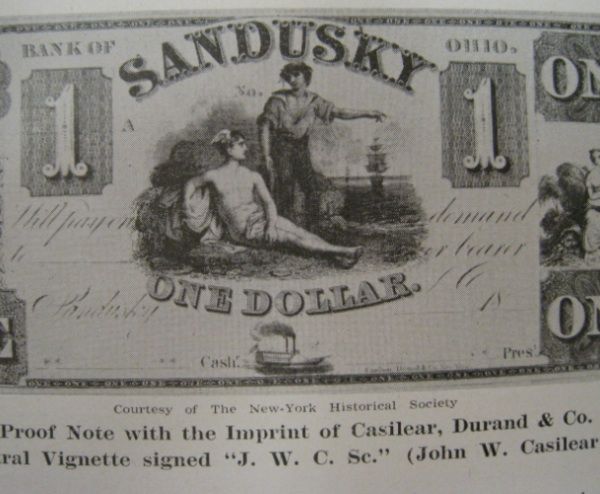 As to the duplication of previous effort, my only intention was to try and post a sharper image of the Washington profile stamp and bank note vignette, nothing more. As to the other points: 1. 1832. I can tie Casilear to the other TC & Co. partners as well, but don't want to take up time or space that detracts from central focus. 2. The Piscataqua Exchange Bank $10 bank note had to be engraved sometime between March and June, 1845, because President Polk (engraving at lower right of "X") did not take office until early March, 1845, and the $10 was issued in June, 1845. As to the rest of what is described in this point, I have lost the thread that indicates where this information was taken from. 3. I can show many more Casilear pictorial engraved vignettes that can be attributed to him by a then contemporary source, Waterman Ormsby, but since there is one posted here, it doesn't seem necessary. The Jackson banknote portrait done by Casilear for the magazine does show up as a bank note portrait vignette in a few issues later on (which will have to be tracked down, but have seen them), but can't tell whether it was reengraved for these by someone else. 4. The image from Blanchard is shown. 5. Still in the air. In the systematic review of Haxby for images of the two profile portraits of Franklin-Washington and for bank notes engraved by all Toppan related firms, I have covered about 10 states so far, and found one more bank note with the two vignettes, from the Citizen's Bank of Waterbury, CT, ca 1853. That bank note has a completely different design than the other 7 seen to date. |
|
Send note to Staff
|
|
|
Pillar Of The Community
United States
1946 Posts |
|
|
The photo image you reproduced is actually in EPJ 7 (1950, no. 3) 151 whole number 27. Number 1: Until it is nailed down explicitly with solid evidence, we must admit that before 1848 we only are working with circumstantial evidence for the connections. I think we can agree there must have been some kind of connection, since some of Casilear's work does appear on product associated with Charles Toppan. Getting specific about just what that connection amounted to or even was, is less clear, especially before he relocates to Philadelphia from 1848-50. Yet after he is made partner, he and Saulnier work out of the New York office again, while the others hold things down in Philadelphia. Telling me that you have more evidence that I have not seen does not give me a basis to agree or disagree with its interpretation, so I have to discount it in my analysis. I'm sure you understand. Number 2: While I recognize that you wish to narrow down the date of origin to March-June 1845, your statement refines but does not contradict mine. I'm cool with that. As to the evidence for the period March to June: Does Polk appear on the note because he was elected president (Nov 1844) or inaugurated (March 1845)? He could have been included in an engraving made any time prior to the June release of the note. But my real point is that it is enough for our purposes here to have established that the note first came along in 1845 with those two vignettes on it - or anytime prior to 1850. As to the part you could not find in the thread before, this is actually new info for this thread, based in part on this item from the ABNCo archives: 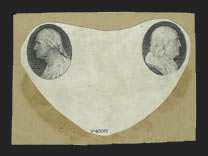 BN I am working on finding a larger version of this, for I have seen one, but for now you can mull this over. The important thing about this is the fact that it was in the ABNCo archives, for that means this stock die was associated with bank notes and other security paper, but not postage stamps. The stamp related rolls, dies, and plates did not go to New York with the other engraved metal, and was not delivered to the ABNCo after the failure of TCCo to get the stamp contract in 1861. Whatever of all that was not turned over to the government, was passed on to Joseph Carpenter and did not go to American. It may be that American ended up with some material as a result of the liquidation of the Philadelphia Bank Note Co engraved stock in 1900, but that is another unknown. The usual report is that Ernest Schernikow bought all that on behalf of the Hamilton Bank Note Co., and used it for his own purposes. what he produced reveals at least something of what he had to work with. Number 3: With your response to number 3 we now have been shown two PICTORIAL vignettes that can be attributed to Casilear as designer and engraver, and you are quite right that one was enough to lay that to rest. However, when you say Quote:
The Jackson banknote portrait done by Casilear for the magazine does show up as a bank note portrait vignette in a few issues later on (which will have to be tracked down, but have seen them), but can't tell whether it was re-engraved for these by someone else. I think you meant to say that a bank note "portrait vignette" version of Casilear's Jackson portrait for the New York Mirror has appeared on some bank notes, but you are not sure that Casilear did the reduction himself or that the bank note version was by another hand. If I have correctly inferred your meaning, then it merely serves to underscore the point I was making. Namely, we do not yet have any evidence we can point at of Casilear's hand having done the die for a "portrait vignette" on a bank note. Number 4: The point of number 4 is that we have no "PORTRAIT vignette" on a note that we can positively attribute to him as the engraver. " Portrait vignette" as distinct from " pictorial vignette." These are vignettes of different types that appear on obsolete bank notes. The Blanchard illustration does not change this, for this is a pictorial vignette, not a portrait vignette. Let us be clear about the distinction, for it is also intrinsic to the way that Brazer classified Casilear in his great work in the CCP on the 19th century US security engraving companies. |
|
Send note to Staff
|
|
|
Valued Member
42 Posts |
|
|
Essayk,
I don't know where you conclude that Casilear relocated to Philadelphia in 1848-50, but that didn't happen. He lived in New York City the whole time, although he probably travelled to Philadelphia at some point (no evidence to back this). TC & Co. had an address at 29 Wall Street from 1848-1851. Casilear had several New York addresses during this period, one of which was 29 Wall Street during 1850-51. J.H.(sic) and G.W. Casilear "Portrait, historical and landscape engravers", are listed in the New York city directory in 1847-1848 at 18 Wall Street, whereas TC & Co. had a business address at 31 Wall Street from 1845-1847. After his nephew George left the partnership to go to gold rush California, Casilear lists his address as "engraver" at 62 Rivington St in 1848-49, and 101 W. 11th Street in 1849-1850. The directories those days were updated in May of each year, so we know Casilear (or TC & Co.) could have moved from their listed addresses any time after May of the previous year up to the point in May of the following year when the directory was updated.
On the dates given for the engraving of the $10 Piscataqua Exchange Bank note, you are right in saying Polk was elected in November, 1844. However, it would be surprising if the engraving was done before he assumed office. I say this because not only did he take office only several years after W.H. Harrison died a month into office and was succeeded by Tyler, but also because it would be a little risky to assume Polk actually taking office before he did so, what with the expense of re-engraving if something happened to him. Did you notice that Tyler doesn't appear in the Presidential group? The bank note cataloguers of today assume it was because he was a slave holder, but that can't be right because Polk and most of the other previous Presidents (the Adams father and son excepted) were also slaveholders. I don't know the reason for sure, but I believe he was excluded for two reasons: First, 11 Presidents was an odd number; and second, Tyler was never "elected" as President but took office on Harrison's death, the first one in our nations history to assume the office on that basis. BTW, I have not seen Polk on any other bank note vignette as engraved for the Piscataqua $10 bank note. In fact, I believe the entire bank note is unique to that bank although I am still searching (98% confidence at this point)
The way I have been attributing vignettes to Casilear is threefold: 1) Anything done under the Casilear, Durand & Co. partnership is given JWC, since his partner was a script engraver, and I have seen no evidence that any of these vignettes appear on any bank note prior to the formation of his first partnership (I will give myself an out, if one or two should happen to show up later, but his style is very distinctive). In the same manner, almost all, if not all the vignettes engraved in the following Casilear, Durand, Burton & Edmonds partnership were probably also by Casilear, although Edmonds is listed as an engraver and did do some attributed pictorial engraving work at a later date. Burton was primarily a copper plate printer, but may have done some engraving. Again, style of the vignettes is what leads me to believe they were done by Casilear. A number of these vignettes kept showing up on bank notes that are legitimate and counterfeit over the next 25 years, and can be thus shown, but would take a lot of time to do so; 2) attributions of bank note vignettes done by Casilear, as attested to by his contemporary Waterman Ormsby. There are many, and they can be mostly tied to TC & Co. and other Toppan related firms, and many trace back to his two partnership firms. Again, some of these showed up on much later bank note engravings (including some done by Ormsby himself). To put all these in this forum would also take me a lot of time; 3) bank note vignettes that are tied to Casilear by watercolor or pen and wash, or pencil drawings that have surfaced and can be attributed to JWC. These can be also shown, and the style of these is much closer to the 1849 vignette previously posted that is securely tied to Casilear, and tend to appear on mostly later TC & Co. and TCC & Co. note designs in the 1840's and 1850's, although a few show up in other firms bank notes. And, to back up Brazer, these are pictorial vignettes in the main, but there are also a fair number of portrait vignettes, particularly in the earlier Casilear partnership. There are no profile portrait engravings that I know of. Still, it can't be excluded since the small portrait engravings are almost never attributed by bank note cataloguers, rather my attribution comes from the portrait not having appeared on another bank note vignette prior to its appearance on a Casilear firm bank note. All this sounds very complex and detailed, but that is the way it has been done by me up to now. I hope this is reasonably clear, but will clarify any uncertainties.
I have found two proprietary proof bank notes with the Casilear Jackson portrait engraving on them, as originally done by New England Bank Note Co. Since the proofs were put on paper much later (don't know when), something must have made the bank note company decide not to go ahead with them (maybe Casilear found out?)
So, there is a lot of ground to cover with all these attributions and is the reason I don't want to just start putting vignettes out on the forum without more detailed guidance. Why don't you review this material and tell me what would help you, as long as it doesn't involve a huge amount of my time to respond.
FYI, just to thicken the plot a little more, I recently discovered a pencil drawing of a milkmaid that was earlier attributed to either Kensett or Casilear (but has been rejected by the Kensett Catalogue Raisonne Committee as one of his works), and that has characteristics that appear on the $20 main vignette of the Piscataqua Exchange Bank issue of 1845, and which I have not seen elsewhere. I can put this up on the forum for comparison, if you think it will help, and if I can master the technical transfer. BTW, I just bought a new printer with scanner, but it may take a few days to get working. |
|
Send note to Staff
|
|
|
Pillar Of The Community
United States
1946 Posts |
|
|
Thank you for correcting me on the matter of Casilear living in Philly. From a poor recollection of something Brazer wrote, I had the location of the address wrong, but it was a facility that belonged to TCCo that he had listed in the city directory as his business address. Your list of locations for him not only fills in some blanks for me, it also makes more sense. He stayed in New York for the entire time he was with TCCCo. Given the fact that the stamp end of their business was later confined to Philadelphia, if that was also the tendency at the beginning of the stamp contract period, then it would be a bit of a stretch to have Casilear work very much on the stamps as an engraver. That bears consideration. It also motivates the thought that his main contribution to the stamps, to the extent he worked on them at all, may have been as a designer/modeler. I can see how you came by the question that names this thread. Since the stamp designs consist of three parts (vignette, frame, lettering) in three phases (model, die essay, adopted die), I think we may dispense with further investigation of Casliear's activity as an engraver of pictorial vignettes. I realize that this is the bulk of the material that may be at hand, and that the style comparisons you want to make can be informed by the manner of execution of the pictorials. However, we need to compare apples to apples, and that means bank note portrait vignette engravings - nothing else at the moment, I think. Quote:
there are also a fair number of portrait vignettes, particularly in the earlier Casilear partnership. Can you elaborate on this a bit? Which earlier Casilear partnership? Are these portrait vignettes that you can attribute to Casilear, or merely portraits that appear on notes from his earlier partnerships? Quote:
There are no profile portrait engravings that I know of. Are you adding a layer of distinction between portrait vignettes and now profile portrait vignettes? If not, then why does this not contradict the quote above? Maybe an illustration would help? FWIW the Washington and Franklin vignettes of our ultimate interest are profile portrait (aka "profile bust") vignettes, and the Jackson vignette you had us look at on the Canal Bank $50 is a 3/4 profile portrait vignette. But our quest at the moment needs to be able to identify any portrait vignette attributable to Casilear, so we can make appropriate comparisons to those of others and those on the stamps. Quote:
Still, it can't be excluded since the small portrait engravings are almost never attributed by bank note cataloguers, rather my attribution comes from the portrait not having appeared on another bank note vignette prior to its appearance on a Casilear firm bank note. All this sounds very complex and detailed, but that is the way it has been done by me up to now. I hope this is reasonably clear, but will clarify any uncertainties. The procedure you are describing here is not confusing to me, since it is what I am trying to do as well, albeit without access to Haxby and with far less experience in the syngraphic side of all this. But it's kind of like those puzzles that have lines like, "The green house must be next to the yellow house because the Spaniard owns a dog." Quote:
I recently discovered a pencil drawing of a milkmaid ... that has characteristics that appear on the $20 main vignette of the Piscataqua Exchange Bank issue of 1845, and which I have not seen elsewhere. I can put this up on the forum for comparison... This, I believe, is the note in question? But, even granting the attribution of elements to Casilear, what does this add but another pictorial vignette? I'm missing something. 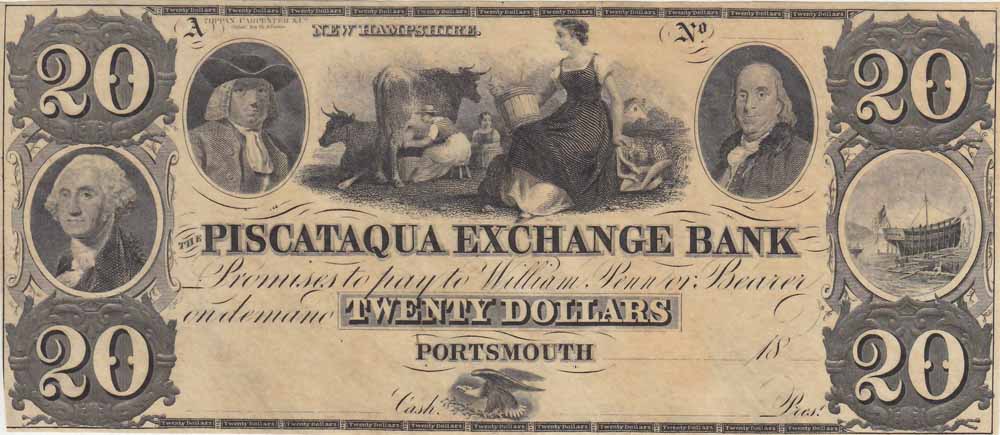 And here's a better look at the pictorial vignette: 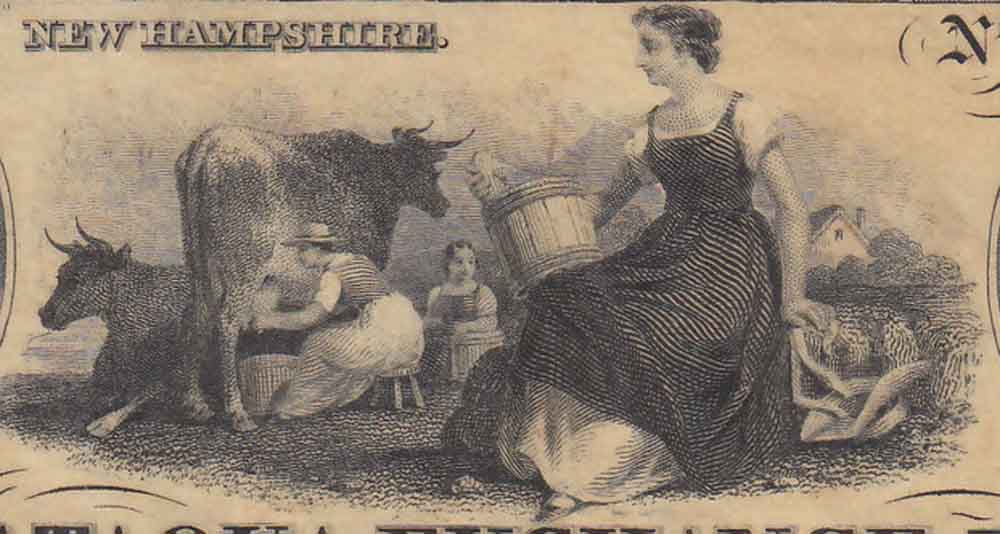 Re: scanner. You get a high five for that. Oh, by the way, I now have an india plate proof of the 1851 3 cent reprint, and a high res scan of an original 1851 3c die (for the purists who will claim that the reprint plate may have altered the design in some way. Either way, we are good to go with tweaking the earlier comparison images. The two you put up are not to scale and do not have as much resolution as we can get now that I can do the scan myself alongside the banknote and stamps. |
|
Send note to Staff
|
| Edited by essayk - 09/19/2013 8:16 pm |
|
|
Valued Member
42 Posts |
|
|
A quick reply to some of your points:
TC & Co. had senior people like Casilear and Smillie working out of New York, not Philadelphia (we know that from the postal contract signed by TCC & Co.). A pictorial or portrait and likely a number engraver basically can work anywhere where there is good northern light, a clean, flat surface to place the turning pad and steel die on top of it, a comfortable seat, and a magnifying glass held in one hand to see what he is doing on the die with the burin or etching tool with his drawing hand, depending on what is being engraved.
See my third paragraph of last post for details on the successive Casilear partnerships.
OK, to get my terminology straight, Casilear did mainly 3/4 profile portrait vignettes. Will work on getting you some examples to see.
The relation to the milkmaid is that it may tie him directly to engraving at least some parts of the Piscataqua Exchange Bank notes. I know from my correspondence with Alonzo's great great grandson, that Alonzo did engrave part of the $5 Piscataqua note. |
|
Send note to Staff
|
|
|
Valued Member
42 Posts |
|
|
Below is a Casilear 3/4 profile portrait engraving of Roger Sherman, as scanned, cropped and enhanced from p.94 of Roger H. Durand's "Interesting Portraits II" publication, originally taken from the Casilear, Durand & Co. banknote engraving of the $2 'The Stamford Bank' (Haxby CT-405 G-6). It is fortunate that Durand had access to the actual bank note to include in his book, since the note is extremely rare and would cost over $1500.00 if it came to auction today, either in proof or issued form. I would not have been able to obtain this level of detail just by saving and editing the bank note image available online. As such, this may be the best image of an attributed (by me) Casilear portrait engraving taken off a bank note from his first partnership that you are likely to receive, as all his earliest notes are very rare, very expensive, and hardly known outside of bank note collector circles. 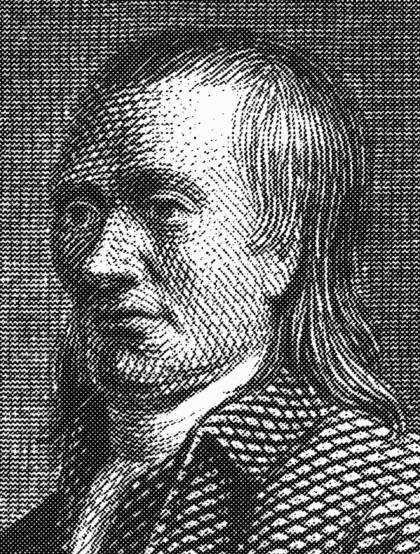 Because of the blowup image and image optimizing requirements, some detail is lost. I looked at the background engraving style around the image shown in the Durand book, and it appears the same as that shown in the Casilear Jackson engraving from the magazine sent you earlier. |
|
Send note to Staff
|
|
|
Valued Member
42 Posts |
|
|
As additional support for my attribution of the Sherman portrait engraving to Casilear posted earlier, thought it helpful to attach the following short blurb from the New York Evening Post review of June 18,1834, pp. 2-3, of works displayed at the exhibition held that year at the National Academy of Design. Casilear had been elected an Associate Member of the Academy the previous year, and he attended the Academy for two years prior to that, learning classical art disciplines that supplemented his apprentice training with Maverick and Durand. 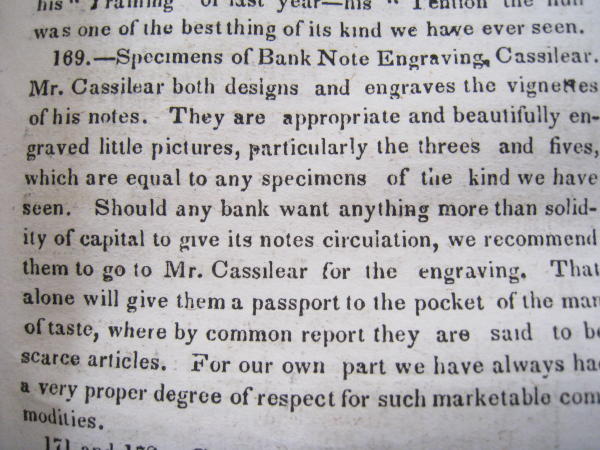 |
|
Send note to Staff
|
|
|
Pillar Of The Community
United States
1946 Posts |
|
|
I'll be back, but I'm tied up right now with two video shoots and 4 edit jobs that came up all at once. Sorry to get personal, but I didn't want you to think I lost interest. |
|
Send note to Staff
|
|
|
Pillar Of The Community
1545 Posts |
|
|
You guys should organize all this information into a book for others. There is a lot of thorough interesting information here, although I can't confess to reading all of it.  -IBFS |
|
Send note to Staff
|
All science is either Physics or Stamp Collecting. -- Ernest Rutherford |
|
|
Pillar Of The Community
United States
1946 Posts |
|
|
Okay, I should be able to attend to this again. I hope we can pick up where we left off.
@IBFS - What you are seeing here is a couple of guys informally comparing notes and trying to discover something. It's more a process than a product, but of course we all hope something good might come of it.
@sojourner After dealing with the video projects I started assembling a batch of obsolete banknotes to study for this and other philatelic projects. Taking a cue from Clarence Brazer I have been attempting to get into the study of "stylistics" and have some examples to look at, if you are still out there and up for it. Not everything I have ordered has arrived yet, but some things are on hand. Enough to lay down the parameters and start, I think.
I would guess by now you have had some time to get acquainted with your scanner, and probably have seen the need for good image editing software. Both of these will become important as we get into the comparison of images. On that score I need to point something out. The scan you posted of a Roger Sherman vignette is of some interest as a matter of record, but it will not be able to play much of a role in doing stylistic comparisons except in a general way. For that we are going to need good scans from actual material, as much as we have of it.
If, or rather, when we are doing direct comparisons of images, particularly if we suspect copying or borrowing of elements, we need to make sure they are both at the same scale. That is neither automatic nor intuitive, but must be carefully plotted out. I will explain it more if the need arises.
For the moment the big question is, are you still following this?
|
|
Send note to Staff
|
|
|
Valued Member
42 Posts |
|
|
Essayk: I have checked in now and then, and am glad you are back to continue this process, since no one else seems to have much more to contribute at this stage.
I also was in the bank note auction market to acquire a JWC bank note group, but lost out at the last second to a phone bidder (hopefully it wasn't you. . .). Incidentally, I am going to use just his initials from now on, since I discovered that our conversation (and images) are ending up in places on the internet that I didn't contemplate. The spiders crawling the internet pick up everything, in case you want to keep some of your material off this forum.
As mentioned, was going through the entire Haxby catalogue to determine how many different notes carried the Washington-Franklin bust profile images used on the 1851 issue and their issue date, and completed this, covering every state in the Union by 1845, and DC. Answer: 10, plus one just carrying Washington, based on images seen (Haxby has many notes with no images). The Piscataqua Exchange Bank $10 remains the first one issued, and it is duplicated by a Frederick MD proof issue of the 1850's that has the 10 Presidents but no profile busts of W/F.
It will be difficult to get genuine, early JWC portrait engravings on bank notes without dropping a fair amount of money, since the cheapest ones will be in the low hundreds in decent condition. I have a local source that has quite a few obsolete bank notes that can be photographed, but not sure about whether relevant portraits are included. Will visit early next week and see what I come up with. Will also troll the auction and dealer sites for doable prices/quality.
The scanner works fine. Let's see where this goes before I invest further.
Over to you. |
|
Send note to Staff
|
|
|
Replies: 91 / Views: 23,241 |
|
|
To participate in the forum you must log in or register. | |
 Help With A 1 Cent Franklin From The Philippines Show Your US 1851-57 Imperforate Stamps Stamps On Stamps Optical Instruments: Microscopes, Binoculars, Sextans, Theodolits, Hand Scopes Cover Calendar For Month And Day -Pics Pushing 330,000 All Different Worldwide Stamps In One Collection . Postmarks.day By Day Experimenting With A Phone As Attached Scanner Turn On The Light! Candles, Lamps, Torches, Candelights, Bedside Lamps. Fan, Éventail, Abanico, Fächer, Leque Linn's To Return To Printed Issues Minkus Supreme Global Albums (The Big Red Thread) Soviet Union Stamp Engravers Czech Stamp Engravers Collecting By Engraver 1851-57 12c Washington Canada 742 Color Shift Error? Stamps Made Of Cloth, Polymer, Metal, Wood Etc Art & Paintings On Stamps Need Help With Swedish Stamp And Postmark Living Persons Portrayed On Stamps If You Have A Design You Like, Might As Well Stick With It! Newfoundland 82 Imperf Cover Please Identify - USSR Stamps US Half Cent Postage Dues On Cover Help With A 1 Cent Franklin From The Philippines Show Your US 1851-57 Imperforate Stamps Stamps On Stamps Optical Instruments: Microscopes, Binoculars, Sextans, Theodolits, Hand Scopes Cover Calendar For Month And Day -Pics Pushing 330,000 All Different Worldwide Stamps In One Collection . Postmarks.day By Day Experimenting With A Phone As Attached Scanner Turn On The Light! Candles, Lamps, Torches, Candelights, Bedside Lamps. Fan, Éventail, Abanico, Fächer, Leque Linn's To Return To Printed Issues Minkus Supreme Global Albums (The Big Red Thread) Soviet Union Stamp Engravers Czech Stamp Engravers Collecting By Engraver 1851-57 12c Washington Canada 742 Color Shift Error? Stamps Made Of Cloth, Polymer, Metal, Wood Etc Art & Paintings On Stamps Need Help With Swedish Stamp And Postmark Living Persons Portrayed On Stamps If You Have A Design You Like, Might As Well Stick With It! Newfoundland 82 Imperf Cover Please Identify - USSR Stamps US Half Cent Postage Dues On Cover
Disclaimer: While a tremendous amount of effort goes into ensuring the accuracy of the information contained in this site, Stamp Community assumes no liability for errors. Copyright 2005 - 2026 Stamp Community Family - All rights reserved worldwide. Use of any images or content on this website without prior written permission of Stamp Community or the original lender is strictly prohibited.
Privacy Policy / Terms of Use Advertise Here |
| Stamp Community Forum |
© 2007 - 2026 Stamp Community Forums |
| It took 0.43 seconds to lick this stamp. |
 |
|
|
|


 Posted 09/13/2013 09:48 am


