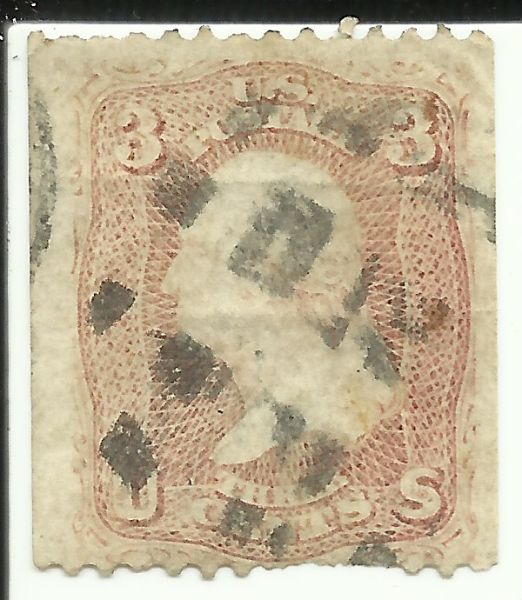
M Jack Reinhard did a study several years ago, in a little Journal called
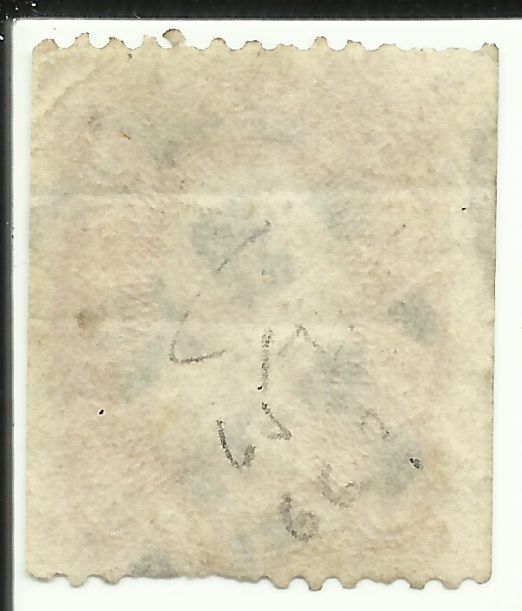
Strictly U.S., in which he discusses the various plate positions and their perforation settings for the stamps produced in the 19th century by the Bank Note companies. All three, including National tended to set the perforators for a bit of extra margin width at the margins of the plate. This is what gives rise to the various types of "jumbo" stamps. If, as was suggested you have a center margin "straddle" then in this case the perfs were set in such a way as to give a bit more margin on the right than usual. For the center gutter on the left side of your stamp there were no perforations, since that is where they cut the panes apart producing a natural straight edge. Sometimes that cut got a little wider than normal. If the original user of your stamp had used scissors to quickly separate the stamps in the pane, then it would have been easy for the right perfs to have been shorn off. Consider this example from what may be the same plate position as your stamp, but on a later issue.
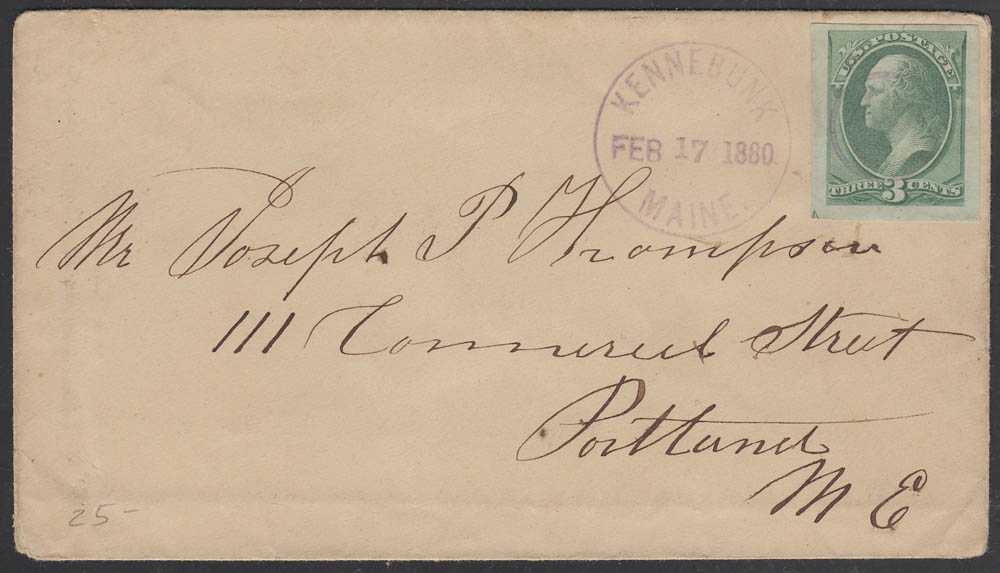
In this case they took off ALL the perfs from what would have been a super jumbo. We may never know the real factors that went into the disappearance of the right perfs on your stamp, but in at least one scenario it may have been done entirely on the up and up, without any fraud involved at all. If the final stamp is at or near normal width, then enjoy the unusual combo. But this isn't about coils, part perfs, or what not.
BTW to qualify as a true straddle pane copy the stamp should have part of the design of an adjacent cross gutter stamp, or an arrow at top or bottom. I don't see an adjacent design, but I think I see a mark that could be a bottom arrow on left. It is too indistinct to be sure. If there is an arrow point there, pointing up, then it is a position N straddle pane stamp, the same as on my cover.





 Posted 09/05/2013 9:12 pm