Stamp Community Family of Web Sites
Thousands of stamps, consistently graded, competitively priced and hundreds of in-depth blog posts to read


Stamp Community Forum
 
Username:
Password:
Save Password
Forgot your Password?

This page may contain links that result in small commissions to keep this free site up and running.

Welcome Guest! Registering and/or logging in will remove the anchor (bottom) ads. It's Free!

Wet Or Dry Printing??.

 
To participate in the forum you must log in or register.
Author Previous TopicReplies: 14 / Views: 5,171Next Topic  
Valued Member
United States
176 Posts
Posted 07/23/2014   08:46 am  Show Profile Bookmark this topic Add Dale Kramer to your friends list Get a Link to this Message
Need help, how can you tell these are dry or wet printing? QE1or QE1a? Do the plate numbers help identify?

Send note to Staff

Pillar Of The Community
3859 Posts
Posted 07/23/2014   08:55 am  Show Profile Bookmark this reply Add jogil to your friends list  Get a Link to this Reply
The best way is to compare the size of the stamp design. Wet printings are narrower/shorter than dry printings. Dry printings are wider/longer than wet printings. There are some stamps that look wet inked that are dry and some stamps that look dry inked that are wet. Design size difference is the best way to tell them apart.
Send note to Staff  Go to Top of Page
Edited by jogil - 07/23/2014 09:40 am
Pillar Of The Community
United States
2948 Posts
Posted 07/23/2014   09:05 am  Show Profile Check Rileysan's eBay Listings Bookmark this reply Add Rileysan to your friends list  Get a Link to this Reply
I don't know if the plate numbers will help identify wet/dry printings, but considering the dates given (1928 for first printings and 1955 for the Dry printings), there is a possibility that a new plate was made at some point during the lifespan of this stamp. Hopefully a specialist in this issue will chime in with more information.

Here's an excerpt from a Linn's article on the differences between wet/dry printings. I hope this helps!

Brian

http://www.linns.com/howto/refreshe...rcourse.aspx


Quote:
Paper was dampened prior to being run through the printing press up until the time of highly mechanized printing. There was good reason to do this. Dampening the paper softened it a bit and made the ink adhere better. But the added moisture made the stamp image not quite as crisp as it could have been.

Additionally, a bigger problem was that as the stamps dried they would shrink. Sometimes the shrinking was negligible, other times it was significant.

When mechanized printing came on to the scene, the dampened paper caused problems. It was softer, and large rolls of paper used in mechanized printing would tear if wet. Wet paper took longer to dry, made less crisp images and shrank. Printing directly on dry paper solved many problems associated with wet printing. The image detail was improved, there was no shrinking and the machinery used for printing was not compromised.

So that tells the how and why of wet versus dry printing, but stamp collectors also need to know the "what" part of the story: what's the difference between the two from a collecting standpoint?

You can both see and feel the difference between wet and dry printing. In wet printing, the ink on the stamp sinks into the moistened paper and even spreads slightly.

You can see that under magnification better than you can see it with the naked eye.
Send note to Staff  Go to Top of Page
Brian Riley
APS 223349
Valued Member
United States
176 Posts
Posted 07/23/2014   09:43 am  Show Profile Bookmark this reply Add Dale Kramer to your friends list  Get a Link to this Reply
Thank you, I knew about moisture in the paper but not the size difference. Thanks again
Send note to Staff  Go to Top of Page
Pillar Of The Community
3859 Posts
Posted 07/23/2014   09:45 am  Show Profile Bookmark this reply Add jogil to your friends list  Get a Link to this Reply
It appears that both wet and dry printings were printed from the same flat plates. It's just that the dry printed stamps were printed on pre-gummed paper where as the wet printed stamps were post-gummed after being printed and dried. Also, the dry printed stamps show embossing on their back side.
Send note to Staff  Go to Top of Page
Edited by jogil - 07/23/2014 11:46 am
Pillar Of The Community
United States
2948 Posts
Posted 07/23/2014   10:54 am  Show Profile Check Rileysan's eBay Listings Bookmark this reply Add Rileysan to your friends list  Get a Link to this Reply

Quote:
It's just that the dry printed stamps were printed on pre-gummed paper where as the wet printed stamps were post-gummed after being printed and dried.


I don't think this is entirely correct. As I understand it, the gumming process for engraved stamps has always been post-printing - even for dry-printed stamps. I would like to hear more from someone who has studied the printing process of stamps ...

As for the size differences, they are fairly minute. Moisture levels in the paper was precise, not exact, so it is possible to measure 10 stamps and get 5 (or more) different results. A difference of +/- .1% in moisture levels will affect how far the ink will bleed into the paper. Therefore, sizes are not necessarily a reliable method for determining wet vs dry printing.

The adage "You will know it when you see it" comes into play here. Simply put: the differences in detail will jump out at you.

Brian
Send note to Staff  Go to Top of Page
Brian Riley
APS 223349
Pillar Of The Community
1849 Posts
Posted 07/23/2014   11:17 am  Show Profile Bookmark this reply Add kevin504 to your friends list  Get a Link to this Reply

Quote:
The adage "You will know it when you see it" comes into play here. Simply put: the differences in detail will jump out at you.

Brian....be careful.
That is what I said that about the Kans/Nebr ovpts....
Send note to Staff  Go to Top of Page
Pillar Of The Community
1849 Posts
Posted 07/23/2014   11:18 am  Show Profile Bookmark this reply Add kevin504 to your friends list  Get a Link to this Reply
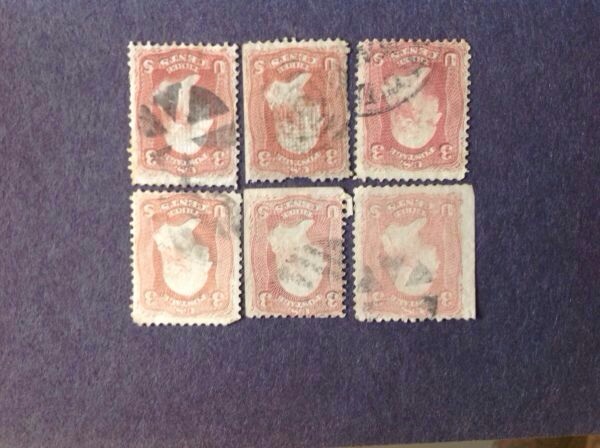
Also...the scan is now showing some 3c Washingtons???
Send note to Staff  Go to Top of Page
Pillar Of The Community
3859 Posts
Posted 07/23/2014   11:36 am  Show Profile Bookmark this reply Add jogil to your friends list  Get a Link to this Reply
See the following article which supports what I have mentioned above: "Size Differences Between Wet and Dry Printings from Flat Plates", Wallace Cleland, THE UNITED STATES SPECIALIST, November 2003, pages 519 to 525.
Send note to Staff  Go to Top of Page
Pillar Of The Community
Learn More...
United States
1270 Posts
Posted 07/23/2014   11:43 am  Show Profile Bookmark this reply Add Al E. Gator to your friends list  Get a Link to this Reply
Excellent article on this subject by Robert Rufe in The United States Specialist, Vol. 78 No. 10, 2007.

(From the article)
Dry Print: Gum side of Mint Stamp: Almost a white, matte-finished gum
Wet Print: Gum Side of Mint Stamp: Yellowish, glassy appearance

Wet Print Design: Wide Side Varying from 35.4mm to 36.2mm; most
common from 35.7mm to 36.0mm
Dry Print Design: Consistent 36.4mm on the Wide side

Wet Print Paper: Literature: 0.0030-0.0034 Thick
Dry Print Paper: Literature: 0.0039-0.0042 Thick
Rufe's test: Av. 0.0037 for wet and Av. 0.0044 for
dry prints (not sure, but I think this was on gummed
mint examples?)
Only the 10-15-20 cents can be dry prints--all 25-cents are wet printings. I didn't see anything in the article regarding height of the design. Examples that I have measure 21.5-21.75 in height and vary from 35.8-36.5mm in width. And, I'm still not sure what I have.
Also, there are no known on-cover examples of wet printing used contemporarily (1955 or after). Same Plates used for both wet and dry printings. Sharpness in appearance of the design, according to Rufe, is not a determining factor. He states that both wet and dry have varying degrees of sharpness. Not sure I buy into that.


Send note to Staff  Go to Top of Page
Edited by Al E. Gator - 07/23/2014 11:49 am
Pillar Of The Community
United States
1414 Posts
Posted 07/23/2014   11:57 am  Show Profile Bookmark this reply Add cfrphoto to your friends list  Get a Link to this Reply
Pre-gummed paper was used for dry printing flat plate stamps and the sheet fed three color Giori press. The same plates were able to be used for later wet and dry printings of the Special Handling stamps as well as some Canal Zone issues and others. Rotary press dry printings were on different plates because the Huck-Cottrell presses used for dry printings differed substantially from the earlier Stickney presses.

Clark
Send note to Staff  Go to Top of Page
Pillar Of The Community
United States
2948 Posts
Posted 07/23/2014   12:03 pm  Show Profile Check Rileysan's eBay Listings Bookmark this reply Add Rileysan to your friends list  Get a Link to this Reply

Quote:
Pre-gummed paper was used for dry printing flat plate stamps and the sheet fed three color Giori press. The same plates were able to be used for later wet and dry printings of the Special Handling stamps as well as some Canal Zone issues and others. Rotary press dry printings were on different plates because the Huck-Cottrell presses used for dry printings differed substantially from the earlier Stickney presses.


Thank you!
Send note to Staff  Go to Top of Page
Brian Riley
APS 223349
Valued Member
United States
176 Posts
Posted 07/23/2014   12:19 pm  Show Profile Bookmark this reply Add Dale Kramer to your friends list  Get a Link to this Reply
Kevin504,
Been trying to post 3 cent Washingtons and the pic keeps coming up the special handling pic I just posted. Something's wrong?
Send note to Staff  Go to Top of Page
Pillar Of The Community
3859 Posts
Posted 07/23/2014   12:40 pm  Show Profile Bookmark this reply Add jogil to your friends list  Get a Link to this Reply
Also, there are some wet printed stamps that are referred to as dry prints when not much of the printing ink has been printed on the paper as usual. This can occur when the paper is less moist than usual so that less printing ink is absorbed by the paper, when less than the usual amount of ink has been used so that the paper looks under inked or when the paper has not been pressed as hard into the printing plate as usual, etc.
Send note to Staff  Go to Top of Page
Edited by jogil - 07/23/2014 12:48 pm
Valued Member
United States
202 Posts
Posted 08/24/2014   3:25 pm  Show Profile Bookmark this reply Add mudhut1000 to your friends list  Get a Link to this Reply


I now believe (note I said believe) that I can tell the differences between wet & dry printing. I will have to compare what I believe are wet or dry printed stamps to the information you all have supplied on this Dale Kramer started thread! Thank you!
Send note to Staff  Go to Top of Page
  Previous TopicReplies: 14 / Views: 5,171Next Topic  
 
To participate in the forum you must log in or register.

Go to Top of Page

Disclaimer: While a tremendous amount of effort goes into ensuring the accuracy of the information contained in this site, Stamp Community assumes no liability for errors. Copyright 2005 - 2026 Stamp Community Family - All rights reserved worldwide. Use of any images or content on this website without prior written permission of Stamp Community or the original lender is strictly prohibited.
Privacy Policy / Terms of Use    Advertise Here
Stamp Community Forum © 2007 - 2026 Stamp Community Forums
It took 0.4 seconds to lick this stamp. Powered By: Snitz Forums 2000 Version 3.4.05