| Author |
 Replies: 37 / Views: 12,344 Replies: 37 / Views: 12,344 |
|
Pillar Of The Community
United States
1756 Posts |
|
|
|
|
Rest in Peace
Netherlands
963 Posts |
|
|
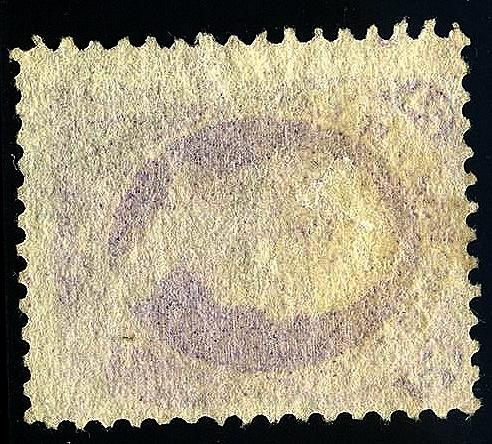
Where ribbed????
This is just a symmetrical wire structure with a horizontal direction of paper... |
Send note to Staff 
|
|
|
Pillar Of The Community
United States
1414 Posts |
|
|
Ribbed paper can be seen in oblique light. Vertical ribbing is more common and easier to see than horizontal ribbing with the exception that the Official Specimen stamps with horizontal ribbing are relatively easy to identify. If any more 24 cent stamps with vertical ribbing are found, the ribbing would be expected to resemble the 3 cent official regular issue with relatively prominent ribbed paper. The 24 cent also exists on silk paper, but is relatively scarce. Whether or not the paper is the Continental silk paper has been the subject of much debate. A couple of copies exist in the Miller collection.
Clark
|
|
Send note to Staff
|
|
|
Pillar Of The Community
United States
1756 Posts |
|
|
Clark... my underlying question in this discussion
is whether the Continentals had both vertical and
horizontal ribbing, or just vertical...
Kindly advise if you have any info the subject...
Randall |
|
Send note to Staff
|
|
|
Pillar Of The Community
United States
1946 Posts |
|
|
Randall,
Short answer, yes they had both types, but not all denominations are known in both. The horizontally ribbed paper is encountered far less often than the vertically ribbed. |
|
Send note to Staff
|
|
|
Pillar Of The Community
United States
1756 Posts |
|
|
essay... thank you kindly for your reply...
In that case, I am going to obtain this
stamp and send it in...
I've always had my doubts there could only
be *ONE* certified 164... and I've looked
at hundreds of them online, and this is the
very first one I've seen with 'suspected'
ribbing... the rest all have nice smooth
backs and no indication of ribbing whatsoever...
Who knows... I may use Jay Tell to promote
it like he did with the first one... LOL
Thanks...
Randall |
|
Send note to Staff
|
| Edited by disi123 - 08/04/2014 11:19 pm |
|
|
Rest in Peace
Netherlands
963 Posts |
|
|
 as I said above: where is the ribbed paper?????? The symmetrical wire is there! See the blue lines! But ribbed??????? |
|
Send note to Staff
|
|
|
Pillar Of The Community
United States
1946 Posts |
|
|
disi123 prepare to be disappointed.
Got your attention? I hope so. Please allow me to speak as a friend. You are not taking a logical approach to this, you are playing the lottery. Why do I say that? Because you are trying to justify the purchase of the stamp on too little information. It is more about hope than knowledge.
May I tell you a story about this? (I'm going to anyway.)
I attended a small stamp bourse recently and got into a chat with one of the dealers about nothing in particular. I had gone to the bourse hoping to find a few dealers with stocks of unpicked inventory for some of the kinds of specialty items I collect - looking for sleepers. I was lamenting to him that such dealers are increasingly rare, and somehow the conversation turned to the quest for ribbed paper, which hadn't been on my list. I pointed out to him the situation with 164, with the observation that there probably are others out there waiting to be found, but that few dealers or collectors know how to look. He was more than a little curious about how that might be done, so with that I headed off for the dealer with a deep stack of the right kind of material and dove in.
After a couple of hours I came back to his booth, and showed him the dozen or so examples I had found, and showed him a 24c paper mesh look-alike that typically throws off many hopefuls. Before we got into that, he pulled out three of the 24c in his own stock and said, "After you left I took these out and held them up to the light and couldn't see anything." I said, "Now you know one of the reasons these are soooo rare. Then we went to work on bringing him up to speed, with bona fide examples of the paper, and after a solid half hour of effort and guidance, he still could not see the ribbing.
It takes a trained eye to recognize true ribbed paper. And trust those of us who know, it is not easy to show to others and almost impossible to photograph well. The pics in this thread won't get that job done. So, if you are buying that stamp in hopes of ribbed paper, then based on what you have shown us so far, you have no more evidence or motivation for buying that stamp than if you were buying it blindly out of a grab bag.
Why is it so hard to photograph? The angle for viewing is so steep that a comprehensive (and recognizable) image lies outside the focal plane limitations of most lenses. You would need a tilt lens with an extreme reach to match that angle, and they aren't available for most cameras today. I have an old 4x5 rail camera that might do it, but I can't process the film any more, and secondarily taking the image off the groundglass has problems of its own.
Anyway, instead of acquiring hopefuls at standard prices and then sending them out, let me suggest that it will be more efficient and less costly for you to learn how to spot ribbed paper for yourself. Then go treasure hunting, if that is your thing.
If you want to tell me to mind my own business, I'll be happy to do that. But as a friend let me say that if you follow your plan you are trusting to luck. Nothing more. |
|
Send note to Staff
|
|
|
Pillar Of The Community
United States
1946 Posts |
|
|
Here is a shot of a 15c on vertically ribbed paper, held the way you need to hold it against diffuse lighting. It is not obvious, even in this photograph, that you are looking at the stamp the long way, with the bottom nearest the lens and the top pointing away. The left and right sides of the stamp appear on the left and right sides of this image. 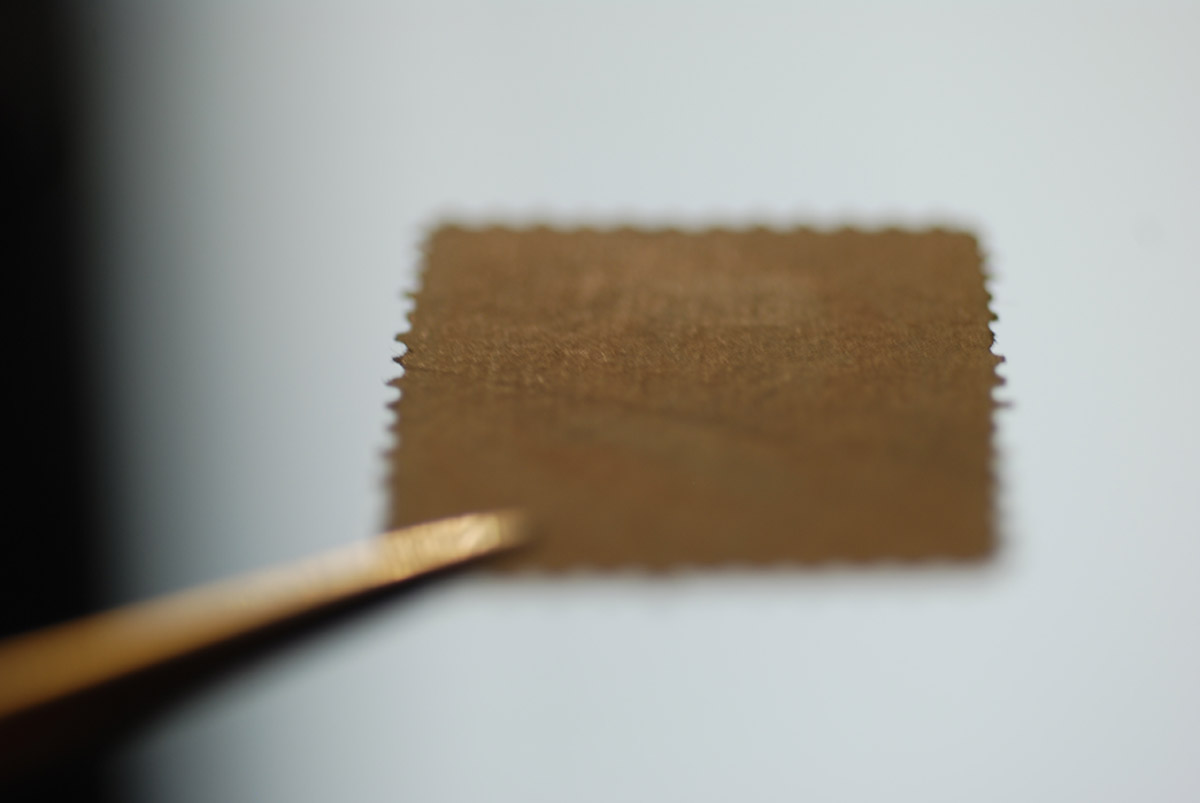 As you can see, only a small part of the paper is in good focus. To correct for this, the front of the lens needs to be as close to parallel to the subject plane as possible and still keep the back illumination. That is a lot of tilt. A view camera can do it, but I don't know about a digital counterpart. I have not tried hooking the electronics of a digital capture system into the optics of a view camera. Has anyone else here tried that? |
|
Send note to Staff
|
| Edited by essayk - 08/05/2014 10:27 am |
|
|
Rest in Peace
Netherlands
963 Posts |
|
|
With a lot of faith I can see an alternation of lighter/darker "bars" that run HORIZONTALLY not vertically! Especially in the image Essayk provided! 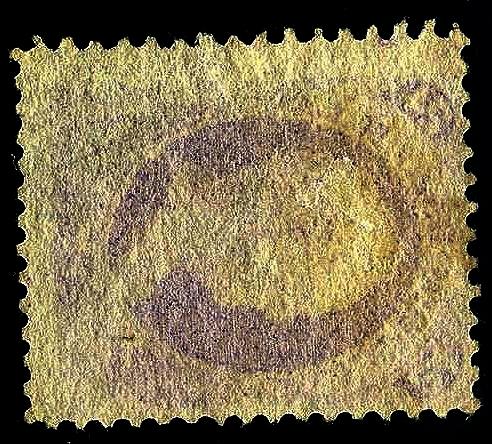 But what has this to do with the paper????? Doesn't it result from the way the sheets were pulled off the press????? |
|
Send note to Staff
|
|
|
Pillar Of The Community
United States
6668 Posts |
|
|
Pillar Of The Community
United States
1946 Posts |
|
|
@Galeoptix
I cannot speak to what you are seeing in the pic of the 24c reverse. as for the item I posted, I tried to explain the stamp's orientation. [I think that you are looking at the perfs on the right thinking they are on the top of the stamp. They are not. The perspective is distorted by the extreme angle. Those perfs are on the left side of the stamp when viewed normally from the front.] The lines that run away from the viewer's point of view are running VERTICALLY on the stamp, despite how the orientation looks to you from the pic. I tried to explain that last time. As for the ribbed paper from the Banknote period, it is not a result of the printing process, it is part of the paper as manufactured. Starting just before 1875 Continental used this stock at least a few times for the runs on various denominations, and only they used it.
Are you familiar with this? |
|
Send note to Staff
|
| Edited by essayk - 08/05/2014 3:19 pm |
|
|
Rest in Peace
Netherlands
963 Posts |
|
|
Essayk, When I look at the 24 cent in an upright position the individual 'bar" or "rib" is HORIZONTAL - IF it is ribbed at all! Which is parallel to the direction of the paper! At least in the stamp where I added the blue lines! In the image you provided - saying the stamp is upright - then the bars are indeed vertical. The paper mesh of the machine-made paper is the result of an imprint of the wire: 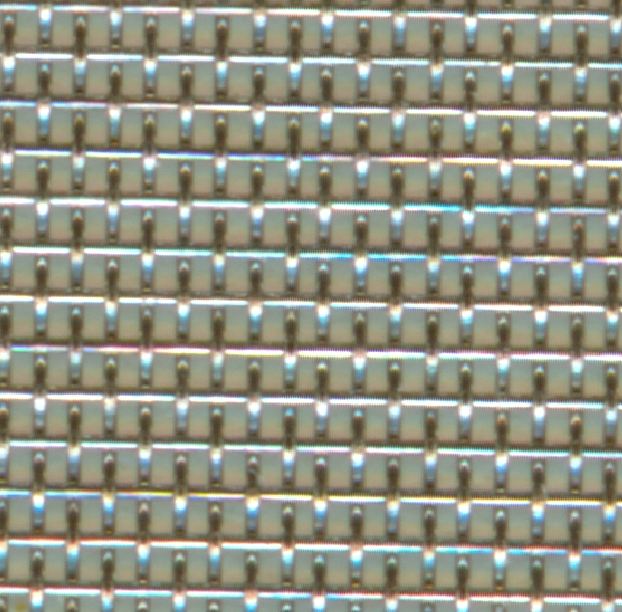 after connecting the cross-overs by a blue line: 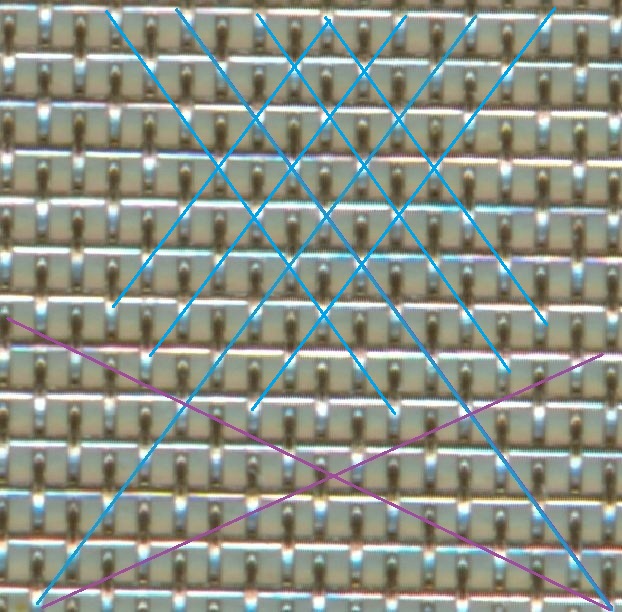 Apart from this wire structure there is NOTHING that would provide us with something ribbed UNLESS in a much later state of handling of the paper! groetjes, Rein |
|
Send note to Staff
|
| Edited by Galeoptix - 08/05/2014 3:33 pm |
|
|
Rest in Peace
Netherlands
963 Posts |
|
|
Essayk,
apart from your 15c stamp showing vertical bars, WHAT is the direction of paper????
What is the density of the ribbing???? How many lines per cm????
How does the stamp curl when in damp environment??? Giving a vertical axis or a horizontal???
groetjes, Rein |
|
Send note to Staff
|
| Edited by Galeoptix - 08/05/2014 3:48 pm |
|
|
Pillar Of The Community
United States
8956 Posts |
|
|
I am very interested in this conversation. Some modern stamps have the same "ribbed" appearance as I can see in Essayk's picture. Some stamps in the Transportation series and printed on the old Cottrell presses are printed on what coil collectors call 'Type II" and 'Type IIa' paper. These two papers show horizontal striations on the gum side of the stamps, but it is not the paper but the gum that is responsible for this.
Is that what is the same on the stamps above?
Peter
|
|
Send note to Staff
|
|
|
Rest in Peace
United States
763 Posts |
|
|
This whole conversation is a little bit out in left field, such that I almost am hesitant to enter it - despite the fact that I am probably the only reader of this board who has actually examined the only certified 24c Continental stamp on multiple occasions. I also was involved for many years, along with Scott Trepel and Ken Lawrence in the study of ribbed paper. I also have personally examined at least several thousand 24c Banknote stamps trying to find another one on ribbed paper - without any luck of course, since if I DID find one, the hobby would sure know about it! I also would be richer by a few hundred thousand dollars.
First of all, not that long ago, Ken Srail showed a very good picture in a thread here of ribbed paper! Where is that thread? Ribbed paper is VERY difficult to photograph, but Ken's picture was quite good. Second, at this point in time, Clark Frazier is the premier expert on ribbed paper and he sometimes posts here, so perhaps he will join the conversation. Clark owns a large amount of reference material on ribbed paper so he can speak to this subject with great authority.
I am leaving to go out for a few hours, but I will write more later tonight, but I agree with Essayk that there is no evidence that the 24c shown in this thread is on ribbed paper. In fact, I can pretty well be near certain that it is not based on the obvious translucent nature of the paper obvious in the photograph. The certified #164 is on solid wove paper (ribbed of course) with virtually no translucency to it. In fact, I do not ever recall seeing a ribbed paper Banknote that was NOT on non-translucent paper, and I've probably handled at minimum, many hundreds of ribbed paper Banknote stamps. So if I see a 24c on this translucent paper, I don't even bother to carefully examine it for possible ribbed paper. However, if a client submits one, I certainly then will examine it very carefully.
Got to run........ |
|
Send note to Staff
|
|
|
Replies: 37 / Views: 12,344 |
|




 Posted 08/03/2014 2:11 pm