| Author |
 Replies: 13 / Views: 3,827 Replies: 13 / Views: 3,827 |
|
|
Pillar Of The Community
United States
937 Posts |
|
|
Anyone want to give their opinion about this one? It appears to be a large 498. I scanned this stamp, a 542 and two 543s at the same time. Perfs measure at about 10.9 x 10.9. Its on a postcard dated 11/30/1919.  Here is its cutout next to the first 543: 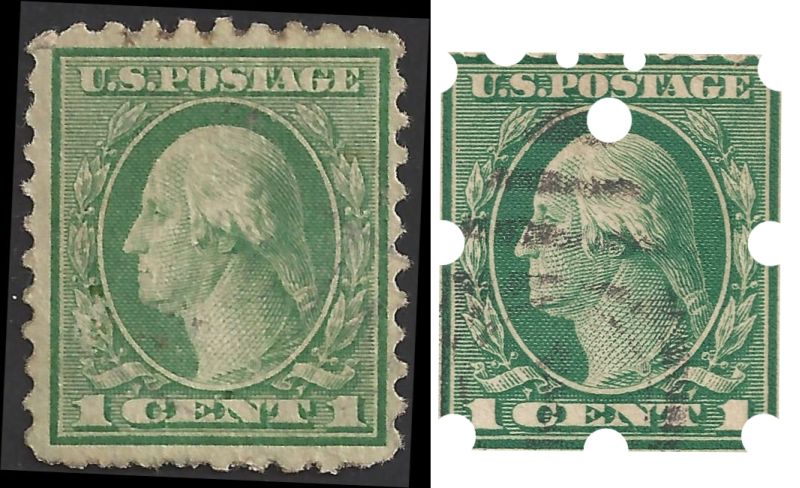 Look at the top frame line: 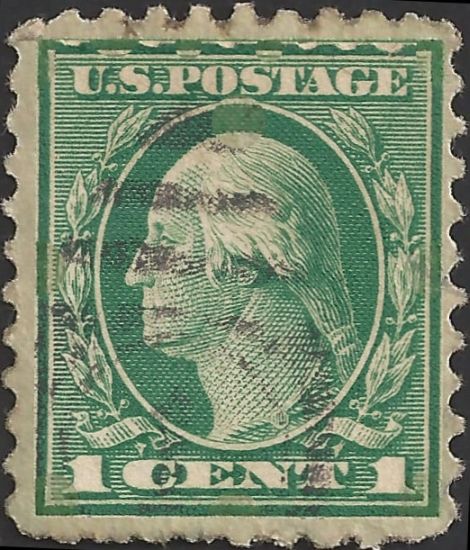 The comparison with the second 543 is nearly identical. Here is its cutout next to the slightly larger 542 (also on postcard): 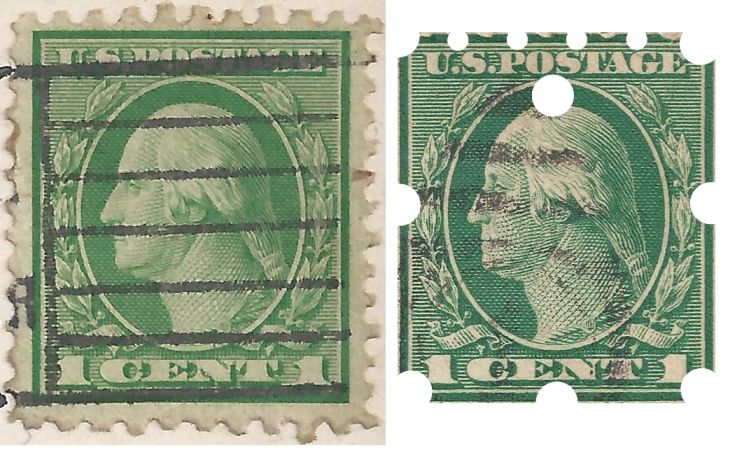 It's narrower than the 542 and even shorter than compared to the 543: 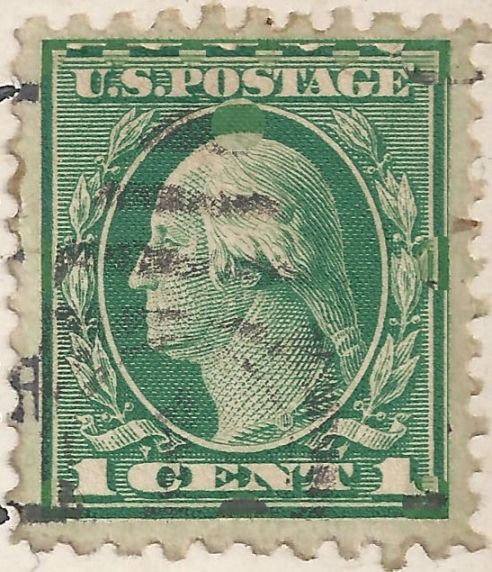 Thanks |
|
Send note to Staff
|
|
|
|
|
Pillar Of The Community
United States
937 Posts |
|
|
Also, it's not offset and the 543 and 542 both completely fill the space inside calipers set to 22.5mm. The 543 measures about 22.58mm. The suspect measures just a bit below 22.5mm. Unfortunately I do not have the go-no go tool. To make it even more confusing, here it's compared to a 544 from the Siegel census that looks like the rest of them there with decent scans: 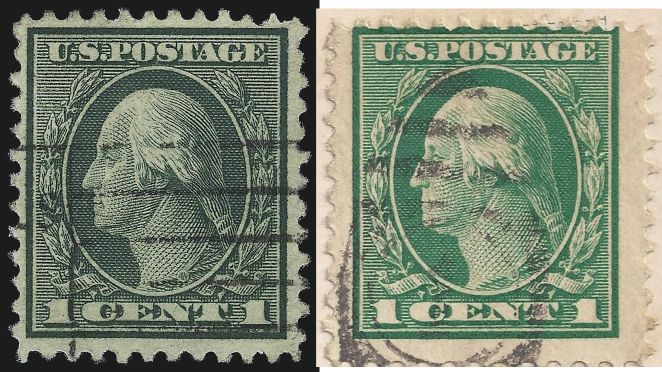 Here it's next to a crappy scan of another 544 from Siegel that has similar margin sizes:  For gits and shiggles, here's an srail test: 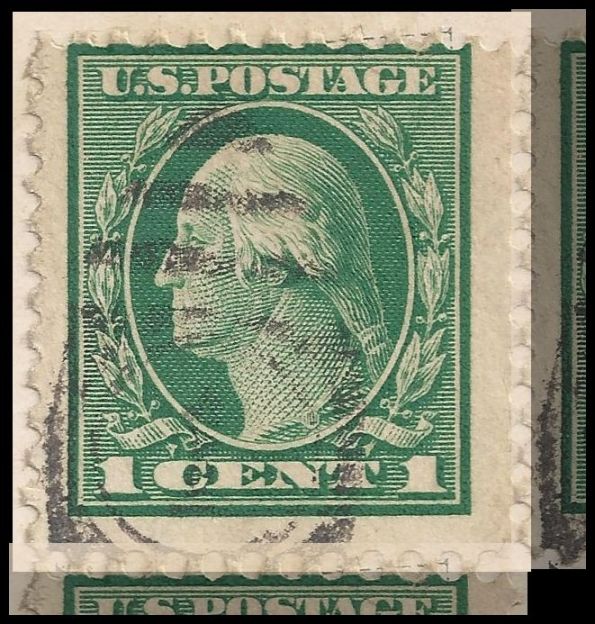 I keep changing my mind every time that I look at it. |
Send note to Staff 
|
|
|
Pillar Of The Community
United States
2948 Posts |
|
|
I can't follow you're trail. Sorry.
If it's perf 11 and flat plate doesn't that mean #498? Why all the fuss? |
|
Send note to Staff
|
|
|
Pillar Of The Community

United States
1273 Posts |
|
|
It looks like a flat plate printing. Look at the back, there should be ink off-set on it. As sheets were printed and stacked, still wet ink from the sheets transferred to the backs of sheets as they were stacked. #544 is a rotary press printing and that process usually had no off-set ink on the back. Very rare for off-set on a rotary. Also, #544 is thought to have been first printed in mid-1921. The EDU for it is 12/17/22. If you stamp is on a post card dated in 1919, then it is a probably #498. Measurements of image size as well as perforation, as stated in catalogues and other reference sources, are not exacts. Actual measurements will vary within the same printing, i.e. #498s, depending upon paper, printing and other factors.  |
|
Send note to Staff
|
|
|
Pillar Of The Community
United States
1414 Posts |
|
|
The stamp is not a 544. If the shade in the scan is close to the actual, it is too bright to be a 544. The best test is to compare the height with a 543. (Alternatively it is possible to use a 542.) The first test is to examine the back of the stamp for setoff commonly seen on flat plate printings. Although some 1 cent flat plate examples look a bit like rotary press printings, most are a brighter green. Under 10 or 15 power magnification fine line detail in flat plate printings will be less distinct than rotary. Please show a laydown test aligning the top or bottom frame line with a known rotary press example in a scan. Attached is a rotary press overlaying a flat plate 610 on the left. Clark  |
|
Send note to Staff
|
|
|
Pillar Of The Community
United States
937 Posts |
|
|
Thank you all for your responses. It is on a postcard so don't want to take it off to check the back unless the chances are nil. I don't think that I made my top post clear. The picture under "Look at the top frame line:" is a cutout of my suspect over a 543. The picture is a cutout of my suspect over a 542. I used photo editing software to create the cutout and to place them above the known rotary stamps. It's a bit hard to see so I included the cutout in the pictures side by side to give a clue of where to look. By bright do you mean the color shade or how the unprinted areas usually have some toning from the ink? It is unlikely to be a 544 because of the postmark date. However, the BEP had been utilizing rotary waste well before. http://www.nwpl.org/documents/BookR..._Feb2013.pdf states that " it is likely that leftover unprocessed material from printing both Scott 542 and 543 was used to create Scott 544. The first plates used to print Scott 542 first went to press August 15, 1919" This puts my postcard in the correct time frame. Since this stamp is 26 months before the postmark established EDU, it's possible that ink on mine could be a different shade of color. It's quite a long shot, but I haven't been able to exclude it from being possible yet. Hence why I'm looking to those more knowledgeable than I. It is a tad short, so that's against the possibility. As for the rotary having finer detail in the lines, I would assume that by the enlargement below, mine would NOT be a rotary print. I can see how the 543 on the left does have finer printing. I don't have the experience to make these distinctions...yet. 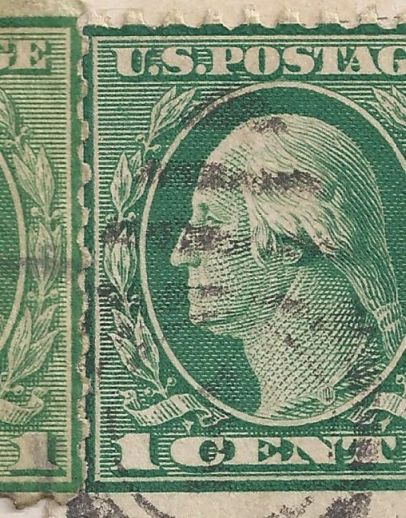 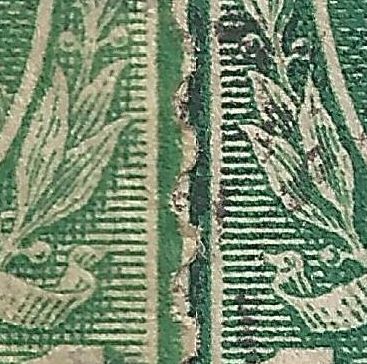 |
|
Send note to Staff
|
|
|
Pillar Of The Community
United States
1414 Posts |
|
|
The 543 to the left is about one frame line width taller than the flat plate 498. This difference is expected and is sufficient to rule out any possibility that the stamp is a rotary press sheet stamp (A rotary horizontal coil would be at least one frame line wider than a flat plate sheet stamps and noticeably wider than a booklet pane single which would also be a bit shorter.)
Thank you for illustrating a close up of the difference between rotary press and flat plate impressions from the same master die.
Clark |
|
Send note to Staff
|
| Edited by cfrphoto - 09/11/2014 9:47 pm |
|
|
Pillar Of The Community
United States
937 Posts |
|
|
Hello cfrphoto, The human eye used as a line up tool seems very inaccurate to me from what I know of psychological studies. That's why I used software to create this picture: 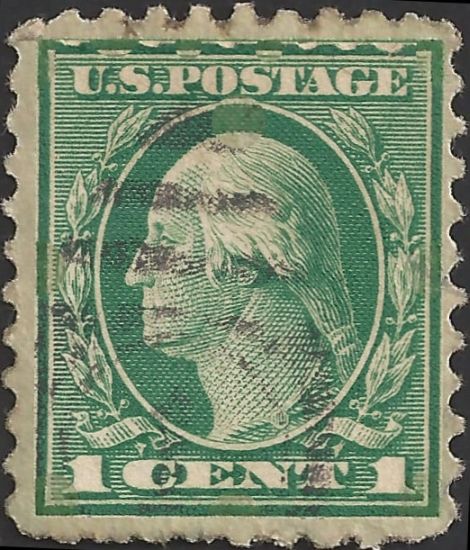 It was created from a scan of both at the same time to minimize minute variations in sizing using a consumer grade scanner. Here is the "cutout" I made of my suspect stamp compared to a 543 that was used to create the overlay above: 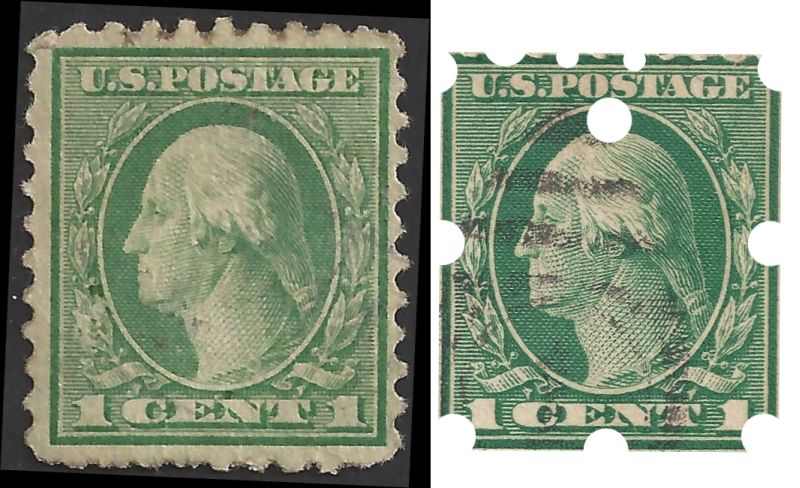 I believe that this is a much better way than lining two stamps up by the human eye. In the picture above the last one, I believe that many factors could lead to the small height difference: paper grain orientation, water content before printing and nearly 100 years of varying storage conditions. The one thing that Al E. Gator pointed out that makes mine a flat plate vs. rotary printing is the line detail. It all makes sense to me now that my "eyes" are better trained to distinguish the two. It seems that aside from print size, very little information differentiating the two types is readily available on line. I'm going to spend tomorrow making a post as a reference to help people who are new to stamp collecting to differentiate the two types. That is assuming that I can get a few more people to confirm the details that were replied to my post. |
|
Send note to Staff
|
|
|
Pillar Of The Community
United States
937 Posts |
|
|
To elaborate, the overlay shows that there is a difference in the "squareness" between the two stamps. However using software to overlay the two makes a much more easily identifiable difference between the two. My 498 is much less than a frame line width less shorter than a true rotary printing. The actual difference depends on many things. However, the distinction in this particular example comparison is the detail difference in the lines of the printings. |
|
Send note to Staff
|
|
|
Pillar Of The Community
United States
1414 Posts |
|
|
I respectfully disagree because of the time involved. To my eye the computer overlays of one stamp covering the other are confusing and seem a bit inconclusive.
It should easily possible to separate flat plate and rotary press stamps by eye. First, look at the color and margins. Most flat plate stamps have a more saturated or richer color because a higher percentage of the paper is covered with ink. Shades are typically different. Certain stamps like 544 or 449 have distinctive shades never seen on flat plate stamps. Second, looking at the stamp, rotary press stamps appear to be taller or wider than flat plate stamps to a trained or experienced eye. Flat plate stamps typically have larger margins than their rotary press counterparts. Paper grain, except for some higher denomination stamps printed on special paper or 200 subject plates should be vertical while booklet pane stamps were on horizontal grain paper.
Booklet pane, special paper, 200 subject plate and the First Bureau watermark error stamps are enough wider to be apparent to a very experienced eye. I reserve the lay down test for cases where I really want to be sure or where real money could be involved. I use high resolution scans and overlays to check coil edges or perf 10 on one side where checking by eye simply won't work or where no reference copies are handy.
Clark
|
|
Send note to Staff
|
| Edited by cfrphoto - 09/12/2014 10:45 am |
|
|
Pillar Of The Community
United States
1946 Posts |
|
|
In making those computer comparisons, make sure that the images being compared have retained the same relative relation to one another even after resizing. Once you break the size relation, your data become invalid. If you can "normalize" the data by some agreed procedure, then you are good to go.
Just something to keep in mind. Call it a lesson I learned the hard way. |
|
Send note to Staff
|
|
|
Pillar Of The Community
United States
937 Posts |
|
|
Clark, I think that we're both arguing for the same things except from different perspectives. You obviously have more experience than I. I am arguing from the perspective of someone who is still learning the details.
It was your comment about line detail between the two types that made the distinction apparent to me. I mistakenly attributed that point to Al E. Gator.
I agree that "It should (be) easily possible to separate flat plate and rotary press stamps by eye." However, that does depend on if the beholder's eye is trained or not and can be difficult to discern in exceptional cases. In my case with this 498, I did not know that the two differed by line quality. Size aspect ratio wise, my stamp varied by less than 1%. Hence the reason for my over examining this stamp when I could have known well before coming to the point of asking for more experienced opinions.
A sentiment to the effect of "every week we get someone who found x rare stamp that obviously isn't, ugh" seems to present in this and many other forums. Count me with in with the lamented group. I truly couldn't determine why my stamp wasn't a 544. I searched this forum and many other sources of information for a few weeks before deciding to create this post. Many don't spend much effort to try to properly identify, but I did try. Other than size differences between rotary and flat plate printings, I didn't find any information that made the distinction apparent.
Now I know. I can also see how many others in similar situations can be confused. I want to create a guide of how to properly identify the minute differences in stamps that beginners can follow. I hope that you and the other experienced members here can help me create and refine such a guide.
The aspect ratio difference of my 498 compared to a true rotary stamp are not discernible by nearly anyone. The color and line quality difference can be easily trained to identify. Quality of scans or photographs, techniques of scanning, differences in monitor calibrations, etc. can make it difficult to accurately use these tools. Especially when many people that are new to the hobby don't have examples to compare to or are not able to meet locally with those that can teach them.
I agree with all of your points from the perspective of an experienced collector of this series. I just want to make the point that the inexperienced (like myself) need a much more simplified explanation. That type of simplified explanation needs to be illustrated such that anyone can understand the differences. Many opinions are given without clarification of why they came to that conclusion. Nobody is required to write out detailed explanations every time that it is needed, but very few so far have made it teachable. Your reply to me did actually detail the specifics.
I don't feel that we're are at contention. I appreciate your input. I just want to illustrate the difference in perspectives and the need for educating those like myself with the minutia of the hobby.
Ryan
essayk: That is certainly one of the many ways that the process from scanning all the way to software comparison can go wrong. It is one of the things that I'm going to address in my "newbie" guide. I've also been tricked by it. Very good point. |
|
Send note to Staff
|
| Edited by Historical DNA Collector - 09/13/2014 10:14 pm |
|
|
Rest in Peace
United States
7097 Posts |
|
|
Pillar Of The Community
United States
937 Posts |
|
|
No, it's the private perforation used by the International Laudanum Vending Machine Co. |
|
Send note to Staff
|
|
| |
Replies: 13 / Views: 3,827 |
|




 Posted 09/11/2014 2:59 pm


