| Author |
 Replies: 12 / Views: 2,286 Replies: 12 / Views: 2,286 |
|
|
Valued Member
United States
485 Posts |
|
|
Hello. What are your thoughts on these? I'm having a tough time distinguishing color varieties. Thank you for helping. 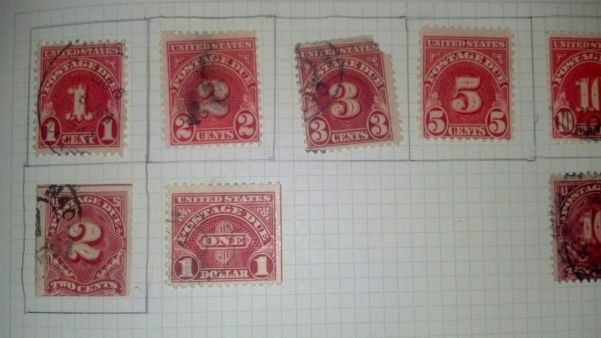 |
|
Send note to Staff
|
|
|
|
|
Pillar Of The Community
United States
6668 Posts |
|
|
Pillar Of The Community
United States
845 Posts |
|
|
Don't assume anything. Even though your stamps are common, learn to prove that to yourself. Learn to distinguish color varieties by examining stamps, reading, etc. Its hard to see color varieties when you don't have good examples of the different colors. Try searching auction sites for examples of each color or other sites stamp-related sites that might show examples of the different varieties. For example look at this site: http://www.1847usa.com/On the left, there are a number of links under "BACK OF THE BOOK IDENTIFIERS" in the sub-section "POSTAGE DUE STAMPS" which give you an idea of the shades of the various issues. |
Send note to Staff 
|
|
|
Valued Member
United States
485 Posts |
|
|
Thank you very much for your polite, patient response. I'm 35 and just started stamps 2 months ago. I'm trying to read and soak in as much as I can. |
|
Send note to Staff
|
|
|
Pillar Of The Community
United States
937 Posts |
|
|
HungaryForStamps seems very compassionate and seems to want to help educate you. It's not easy to learn how to identify certain stamps. Please follow his advice and learn as much as you can. Personally, I love learning about the various details that distinguish stamps. I like it more than building a collection. We all engage in this hobby for our own reasons.
Regardless, I do appreciate that you appreciate when people put forth effort to help you. I am also new to this hobby. All I can say is that it takes time and a lot of learning. Let me know if I can help you with your learning process. |
|
Send note to Staff
|
|
|
Moderator

United States
12330 Posts |
|
|
I concur with Hungary and Historical. At times it is not easy to break into this hobby; while there might be a wealth of information available online finding it, sorting through it, and separating the good from the bad information can be quire daunting. That is why I highly recommend this forum to so may new hobbyists, generally it is quite 'new user' friendly.
But also understand that patience is helpful on all sides. And if I might make one recommendation that might help. Rather than make separate threads for each question you might consider making a single thread with a title of something like 'new hobbyist questions' and combine many of the questions there. Of course you still want to adhere to the forum topic categories and organization; so US stamp questions would need one thread and world wide another but starting a new thread for every stamp you have a question on can cause reader fatigue.
But otherwise, keep the questions coming!
Don |
|
Send note to Staff
|
| Edited by 51studebaker - 09/16/2014 07:30 am |
|
|
Valued Member
United States
364 Posts |
|
|
Properly ID'ing stamps is one of the must frustrating, yet rewarding experiences in the hobby. Many instances of sitting at my desk and picking out that one stamp that I've been setting aside because it is difficult to determine what it is. After putting in the effort and research, when you are able to finally determine what the item is, it feels pretty darn good. Most of the time the stamp is worth less than a dollar, but that isn't the point as others have mentioned. |
|
Send note to Staff
|
|
|
Pillar Of The Community
United States
8956 Posts |
|
|
Hi Maverickx. It is great to read your post above! Wished I was still 35, but in three weeks I will be double your age!
I have been a stamp collector since I can remember. I had a neighbor who started collecting around 1900 (!) and who remembered going through thrash cans of the estates in the town where he lived in the Netherlands. His collection showed it also!
Anyway, in those 60 plus years I have learned a bunch about stamps, but there is one thing that I never understood. It is the color nomenclature. If you go to the Scott catalogue and look up a stamp like J38. It comes in three listed shades: claret, carmine and lake. There is also a deep claret, but that one should be easy if you know what claret is!
But Scott fails to show what these names mean. And asking someone gets you nowhere, most folks would call them all 'red'.
A color chart would be the answer for your own use. Talking to other collectors about particular colors is most of the time useless; everybody tends to see colors different!
Keep collecting those different shades though!
Peter |
|
Send note to Staff
|
|
|
Pillar Of The Community
United States
2055 Posts |
|
|
Regarding the color shades, it just occurred to me that Scott doesn't publish a color key, or at least I don't think they do. Stanely Gibbons and Michel both do. Since the color names in Scott don't necessarily match Gibbons or Michel, you'd think they'd make one so people can see exactly what they mean by bister brown or deep olive, etc. |
|
Send note to Staff
|
|
|
Valued Member
United States
485 Posts |
|
|
Rest in Peace
7742 Posts |
|
|
maverickx...Welcome to the world of stamps...You will drive yourself crazy the odd time, but you will learn to love it..Enjoy |
|
Send note to Staff
|
|
|
Valued Member
United States
485 Posts |
|
|
Pillar Of The Community
United States
845 Posts |
|
|
Actually Scott does publish a color guide, but its specialized towards a handful of issues. That is, its not a general guide and is of limited use (and its expensive).
"Scott Specialized Color Guides for U.S. Stamps"
I have this guide, the Michel and the SG guide. The problem is that even with these guides I feel I still need experience with the particular stamp issue I am identifying. Granted I have not used them as much as I should. But I think the usefulness of a guide, versus looking at actual examples of stamps or even online images, is limited, so I can understand why Scott hasn't published a general guide.
On the other hand, if Scott personnel are NOT working with some internal guide, then I have less confidence they have a handle on the issue. It could just be that Scott recognizes that color varieties differ so much by the particular issue, that a general guide is not a real benefit to the collector. |
|
Send note to Staff
|
|
| |
Replies: 12 / Views: 2,286 |
|



 Posted 09/15/2014 01:12 am


