|
This page may contain links that result in small commissions to keep this free site up and running.

Welcome Guest! Registering and/or logging in will remove the anchor (bottom) ads. It's Free!
To participate in the forum you must log in or register.
| Author |
 Replies: 17 / Views: 7,514 Replies: 17 / Views: 7,514 |
|
Valued Member
United States
23 Posts |
|
|
can someone explain what stamp proofs are. I see them on ebay and some sellers ask very high prices. are these in as high demand as stamps? |
|
Send note to Staff
|
|
|
|
|
Pillar Of The Community
United States
6668 Posts |
|
|
Depending on what type of proof they can be good alternatives to the high dollar stamps because you can get the plate proofs for less than some of the big buck stamps. Die proofs are a different story and there are 2 types of the die proofs, Large & small on India paper. There are also 2 types of die proofs, India paper and card proofs and the card proofs are the affordable ones for the most part. These are listed in Scott specialized back of book and usually have nice razor sharp images. Example of plate proof on card; This is known as a trail color proof (Forgot to mention that one)  Others here know far more than I do and they will chime in, hopefully :) |
Send note to Staff 
|
|
|
Pillar Of The Community
United States
1946 Posts |
|
|
This topic is very large, but until I get a sense of how much you want to know, I am going to cut corners in discussing what proofs are. For the stamps of the US, proofs are printings of finished stamp designs as issued, but may appear on special papers, sometimes in special colors, and may have been pulled from a stamp plate or from the original die. A common, but inaccurate, shorthand way of thinking of proofs is to say they are trial impressions of a stamp die or plate, pulled on special papers, in order to check for the quality of the engraving or the entering of a plate. That way of thinking assumes that proofs come into being before the stamps. Some do, but there are many types of proofs that came into being after the stamp has been issued, and sometimes even after it has been withdrawn from sale to the public. So some proofs are production test samples for the archives of the stamp production companies, but some are officially authorized reprints intended for public distribution. The Scott US Specialized Catalog has sections late in its listings for essays, proofs, and specimen stamps, and at the head of each section gives much more detail about what kinds of material may be found there. However, the catalog has never been complete in the listings for this philatelic byway. There was a time when collectors looked down on the collecting of proofs. While that attitude has changed, only a small portion of philatelists actively collect proofs. That is actually a good thing, because the numbers of proofs in existance is very small in comparison to the numbers of stamps. Generally speaking, people with a specialized interest in a particular stamp or set of stamps will assemble a set of its proofs, while those who collect by the album will only seek out isolated examples. How rare are they? If the total distribution of an issued stamp amounted to 1500 copies, it would be classed as very rare, and would command thousands of dollars in good condition. But for proofs, 1500 examples would make it one of the more common proofs, commanding only a few dollars. Many US plate proofs exist in numbers like that, but as you get back to the early classics, the plate proofs on India paper become very rare and command high prices. Edit: Correction on some misinformation in another response: Quote:
Die proofs are a different story and there are 2 types of the die proofs, Large & small on India paper. There are also 2 types of die proofs, India paper and card proofs and the card proofs are the affordable ones for the most part. It looks like die proofs might be a bit of a mystery here. Small die proofs start out as large die proofs, but were intended to be delivered in a significantly reduced size, and most were NOT printed on India paper. The catalog classes two types of small die proofs for stamps up to 1903, and both appear on wove paper. After 1903 there are other types of small die proof, but also on wove paper. The inexpensive proofs on cardstock are not die proofs, but plate proofs. However, there are a few examples of large die proofs printed directly on card, at least as trial colors, which in most cases command about as much as their die sunk India paper counterparts. |
|
Send note to Staff
|
| Edited by essayk - 12/01/2014 1:54 pm |
|
|
Valued Member
United States
23 Posts |
|
|
thank you stallzer and essayk, for your knowledge on this topic, I was in total ignorance of the subject. essayk you have answered well enough all I want to know at this time about proofs.
|
|
Send note to Staff
|
|
|
Pillar Of The Community
United States
1869 Posts |
|
|
I've always found this an interesting topic and was aware of the comparative rarity of proofs. This also applies for things like specimen stocks and bonds, which are far rarer than issued examples, but are in less demand due to the smaller collector population.
Regarding proofs on India paper as opposed to card stock, I think I've seen examples of India (tissue) paper impressed *into* card stock (i.e., the plate was stamped on both at the same time). Any info on this practice? |
|
Send note to Staff
|
|
|
Pillar Of The Community
United States
1946 Posts |
|
|
India paper by itself would not respond well to the pressure of printing. The normal practice for pulling proofs on India, for both die and plate, is to back the India paper with cardstock. Sometimes a bit of powder adhesive is used to help the India cling to the card inside the sinkage area. After printing in this way, the India is often, but not always, trimmed to the dimensions of the die sinkage. Plate proofs on India are usually cut while still on the card backing and often removed from the card later. However, this can leave the India thinned, depending on how strongly it adheres to the card. Since it is also more fragile off card, it is not uncommon for India off card to have creases and thins. Because of the protection the card offers, it is preferable to buy India proofs on their original card backing whenever possible.
|
|
Send note to Staff
|
| Edited by essayk - 12/02/2014 8:58 pm |
|
|
Bedrock Of The Community
United States
10859 Posts |
|
|
There was a time when there was a serious group interested in proofs. They were members of the Essay-Proof Society, and in it's heyday proofs often brought big bucks. When most the members of the society passed on there was no real influx to fill the vacuum and it ended. So did the prices to a large degree. Many rare and beautiful items go for relatively low prices since. I don't want to imply that they are all cheap, but many should bring a lot more than they do. Especially die proofs. |
|
Send note to Staff
|
|
|
Pillar Of The Community
United States
1946 Posts |
|
|
Quote:
When most the members of the society passed on there was no real influx to fill the vacuum and it ended. revcollector, how do you account for that turn of events? Why did a vacuum develop? Was it about age dying off, or was something else happening? BTW were you once a member of the EPS? |
|
Send note to Staff
|
| Edited by essayk - 12/02/2014 11:26 pm |
|
|
Rest in Peace
United States
763 Posts |
|
|
I totally disagree with the premise that once the E-P Society disbanded, that the prices went south. In fact, if you check just the Siegel website of past sales in recent years that feature essays and proofs, I think you will find that scarce material brings relatively good prices. Don't misunderstand me......as a general rule, since essays and proofs aren't "stamps" they are undercollected and generally undervalued based on rarity alone. But "rarity" alone does not determine the monetary or "market" value, demand does. And while things like die proofs DO seem undervalued, they stay that way because there isn't more demand for them.
There will always be a demand for good E-P material, not only from those who collect only that material, but also from specialists who desire E-P material for their collections, as no specialized collection of any stamp or issue of stamps can be complete without E-P material.
If you think there is no market for E-P material, consider that the two dominant dealers in that material - Bill Langs and Jim Lee, both make a very nice living specializing in that material.
I was a longtime member of the E-P Society, until the very end. In fact, the very first articles I wrote in philately were for the E-P Journal and the great Editor Barbara Mueller (apology if I missspelled her name) mentored me during the process. They were on the subject of the E-Ps of the 1c 1861 and the 3c 1861, but were really not much more than a compilation of the existing material (at that time, c.1971 and available to me for study) into one article. So they were useful, but not enduringly important.
It is a wonderful specialty area with lots of beautiful material available. I highly recommend it. And even just a collection of plate proofs on card or india between 1847-1900 can be a rewarding persuit. Many plate proofs can be bought very inexpensively, yet look gorgeous in the spaces in the album where stamps you can't afford would go! |
|
Send note to Staff
|
|
|
Pillar Of The Community
United States
1946 Posts |
|
|
I think revcollector is just trying to make sense out of some phenomena he is seeing. But I don't think his analysis is quite right. I think the death of the E-PS was a symptom, not a cause.
I don't think the market for proofs and essays has tanked any worse than for stamps in general. Some things are up, some things are down. But on the whole I have to admit that I am able to buy more things today than I could before. It's not just about price, it is about availability and less competition at the sales (or so it seems). On the other hand, it only takes two interested parties at a sale of essay-proof material to make prices move unexpectedly, so the more who tend to other things, well, selfishly, the better for me as a buyer. Not so good as a seller.
But I find it curious that revcollector sees the death of the E-PS as a benchmark of sorts. I'd like to hear more about that. I joined the Essay-Proof Society in 1973 and stayed with them past the end. I even wrote an article for the final issue of the Journal. So I'd like to hear his thoughts on the subject. Market or not, what died with the E-PS? RC, how about it? |
|
Send note to Staff
|
|
|
Pillar Of The Community
United Kingdom
1361 Posts |
|
|
Proofs for French stamps (and French printed stamps) are major items for most issues which are pretty much always engraved. The two main types are Deluxe proofs (Epreuve de luxe) and artist proofs (Epreuve D'Artiste). These are usually available in the issued colours, single colour or black.
I have a few but these are more recent issues and these were not cheap but for engraved issues, beautiful items to own.
Off the top of my head I can't think of a single item where the proof cost less than the actual stamp. |
|
Send note to Staff
|
| Edited by AnthonyUK - 12/03/2014 1:25 pm |
|
|
Pillar Of The Community
United States
770 Posts |
|
|
Moderator
1589 Posts |
|
|
Very interesting thread, and thanks to those sharing their knowledge.
Was this market ever an attractive target for forgeries? |
|
Send note to Staff
|
|
|
Pillar Of The Community
United States
1946 Posts |
|
|
Quote:
Was this market ever an attractive target for forgeries? Wouldn't it be great to have a portion of the hobby free from that? Alas, this isn't it. However, most of the faking involving proofs has to do with altering them to fraudulently represent their corresponding stamps. Let me illustrate: 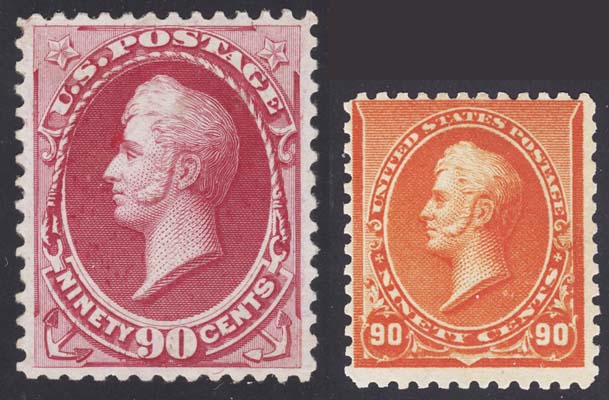 These look like reasonable examples of 166 and 229, but no, they are both fakes from proofs. The item on the left is a plate proof on India which has been augmented with a sizing agent to make it stiffer, and then was privately perforated. Unfortunately the faker seems to have used a polyvinyl resin to do that, and in the process made a paper that bends but does not snap back. No need to even check the perfs on this one. The item on the right has a somewhat opposite problem. It looks like stamp paper, but in fact is a plate proof on cardboard which has been shaved down to stamp thickness, gummed, and perforated. It too fails the snap test. Worst yet, it is just barely Fine in terms of centering. But even so, the market value of a 229 stamp in this grade exceeds the value of an intact card proof. This next example ups the ante a bit: 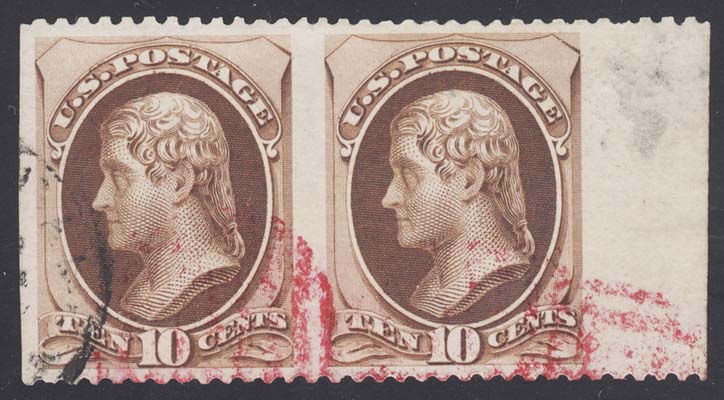 Here we are supposed to think that we have a #150 pair imperf vertically. But here the faker has broken one of the cardinal rules of the game, "Don't fake an unlisted variety." It invites close scrutiny. And on close examination, everything about this screams "fake." It is in fact a plate proof pair on India, privately perforated with a couple of fake cancels added. What a waste of a good right margin proof pair! If we consider the situation with essays, things can get tricky. By their very nature, essays are not supposed to be identical with issued stamps. What better opportunity to create something new and pawn it off as a "hitherto unknown essay." Look at this next example. Both items in this pic are the same "essay." On the left is how it looked in a Siegel auction in 2007, where it was sold without any disclaimer of fakery. Just the note that it is "unusual" and not listed in Scott. It sold for $400. On the right is how it appears in a listing by an ebay seller today, priced at $1995. Note that in the present day image the tear running through the T of "Postage" is not so prominent. But that is only the tip of the iceberg. 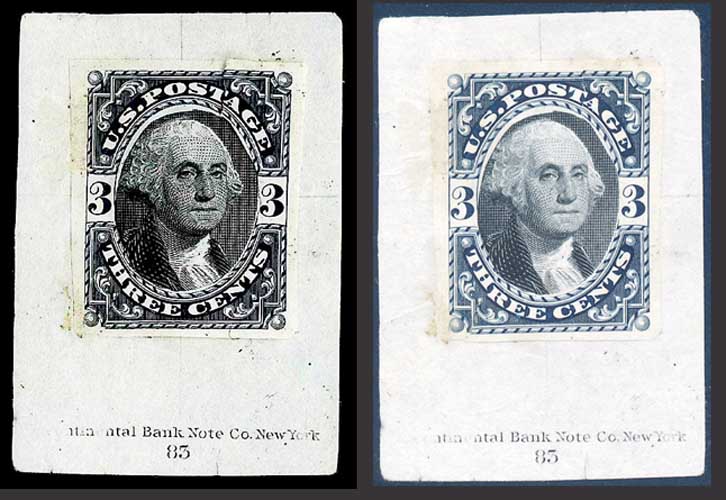 Note that this "essay" is composite, consisting of a frame essay cut out and pasted over a vignette essay. From the inscription the vignette was produced by the Continental Bank Note Co., from master die #83. So far, so good. The frame essay was cut to about stamp size and pasted over the vignette. Its center was crudely cut out so the vignette could show through. The cutting tool was inserted into the uncut frame essay about at the point where the tear proceeds up from the center, and follows the curve of the frame. Initially the cutting was way off, but about halfway down on the left it becomes stable and follows the curve very well until it reaches the final ascent by the right numeral "3." It then carefully runs straight to the tear. This then is mounted down and the job is finished. Well, sort of. What the faker has overlooked is the fact that this particular frame was designed by Augustine Helm while he was working for the Philadelphia Bank Note Co. Helm never worked for the Continental Bank Note Co., and Continental never came into possession of the die for this frame essay. So there is no reason these two design parts would have ever come together. Add to that the poor quality of the workmanship, and we can be quite sure that this was done privately after the fact by someone attempting to fabricate a fantasy piece. Although I have not personally handled this particular item yet, I expect that we will find that the frame essay is engraved and was printed on proof paper. Which would mean it was done some time after the Schernikow reprints were made in 1903. Maybe a long time later. In my estimation, this item is not worthy of catalog listing, and I am communicating that to the editor. However, there is a listing that has a similar origin, and it is included in the catalog with knowledge and intention. This is the item listed and illustrated as "184-E2a variety." The warning note applies directly to that item and any like it. That type of fake combines an engraved frame like this one with a lithographed vignette - thereby combining a 1903 reprint with a lithographed original. That item I have seen. So, in answer to your question, yes fraudulent material exists among the proofs and essays. |
|
Send note to Staff
|
| Edited by essayk - 12/03/2014 5:50 pm |
|
|
Pillar Of The Community
United States
937 Posts |
|
|
Pillar Of The Community
United States
1869 Posts |
|
|
Essayk, there's a member of another forum I'm on who is seeking information about the engraver Agustine Helm, particularly while he was with the Bureau of Engraving & Printing (1885-1893). May I ask where you found your info in him as frame engraver of the proof above? |
|
Send note to Staff
|
|
|
Replies: 17 / Views: 7,514 |
|
|
To participate in the forum you must log in or register. | |
Disclaimer: While a tremendous amount of effort goes into ensuring the accuracy of the information contained in this site, Stamp Community assumes no liability for errors. Copyright 2005 - 2026 Stamp Community Family - All rights reserved worldwide. Use of any images or content on this website without prior written permission of Stamp Community or the original lender is strictly prohibited.
Privacy Policy / Terms of Use Advertise Here |
| Stamp Community Forum |
© 2007 - 2026 Stamp Community Forums |
| It took 0.36 seconds to lick this stamp. |
 |
|
|
|


 Posted 11/30/2014 5:21 pm


