| Author |
 Replies: 32 / Views: 5,141 Replies: 32 / Views: 5,141 |
|
|
|
Pillar Of The Community
United States
2943 Posts |
|
|
Quote:
When the first one came up, it immediately shot up to almost three times catalog, which was already beyond my budget. By that time it was obvious that for stamps without flaws, there were not going to be any bargains. I realized that my hopes of winning some of these stamps could be a naïve pipe dream. rustyc, that is one reason I don't go to "major" auctions. Also, I'm still in the accumulation stage of collecting so it would be foolish of me to buy a single high end piece. I attended a large stamp auction at Fuscos Auctions near Cleveland. It wasn't an elite type auction though. So I'm not sure it fits your criteria. What they had was an overwhelming amount of stamps. But not the thousand dollar plus, items that a high end auction would. I won a group of mint, hinged on pages, airmails, sans the zeppelins. lol If I go there again, I will go the night before to preview the lots. If you're buying single stamp lots it's easier and quicker to preview. I like the box lots full of hidden gems. That takes time and digging. Live auctions are a blast. Great way to meet people and people watchin'. Bidding gets the blood going no matter what level of bidding. If you only have 80 bucks in your pocket and the item your bidding on is up $60, 65, 70...SOLD, "yes got it"...that's fun. |
Send note to Staff 
|
| Edited by stampcrow - 12/17/2014 10:59 pm |
|
|
Rest in Peace
United States
763 Posts |
|
|
Eric Jackson and Richard Friedberg are the two most important dealers in U.S. Revenues and both are generally strong supporters of that market, including public auctions. Both also act as agents for clients, so it's not really possible to know during the sale if an item was bought for a client or for stock. But obviously, if the same item shows up in the near future in their stock, then they likely bought it for stock.
Both are great guys and I admire and repect them both. Know them both for 35+ years. Actually once oubid them both for a nice M&M collection sold by private auction. Still am amazed! |
|
Send note to Staff
|
|
|
Rest in Peace
United States
4052 Posts |
|
|
When bidding on collections & accumulations, I see three choices:
1) Inspect the lot, in person, taking notes; or,
2) Bid only by the description & the photos, and be prepared for a wide range of outcomes <=== understatement
Choice #1 is, of course, a bit of an investment. You need to be spending enough money to warrant the time & expense of that visit, and you are 'out' that time & cash whether/not you bid, and whether/not you are successful. OTOH, if you like shopping, this can be the best part of the auction experience, regardless of how you bid (mail, net, etc).
Choice #2 is not a really bad choice if the sums involved are the sort of money you can lose, especially if you can happily rationalize that you saved yourself all that time travelling & shopping.
In short, for any lot, I have two target highest bids: what I would pay if I really knew what was in there, and what I would pay knowing that I don't.
3) Ask the auctioneer for a more detailed description of a lot or two. You need to be fair to them, so let them know what matters to you: the degree of duplication, for example, or a better idea (better than '1910-1990') of how much of the lot is from which decades.
The more I know, the more likely I am to press my bid past what I thought was my limit for that lot; I get invested, so to speak, and know more about what I'll be missing.
When bidding 'blind', I tend to drop-out earlier, mostly because I know that what is driving someone else to bid strong might be a segment of the collection/accumulation which matters much more to TOG (The Other Guy) than it would ever matter to me. The corollary is that I never tell myself "gee, maybe he knows something I don't", preferring "gee, maybe he wants something I don't".
Cheers,
/s/ ikeyPikey |
|
Send note to Staff
|
|
|
Valued Member
United States
79 Posts |
|
|
Its great to hear all your views/insights on the bigger auctions, I've been thinking about joining Stamp Auction Network to have more options than just ebay. Looking through the realized prices of the perf singles I'm surprised I might have had a fighting chance for some of the ones I would've went for. Thats a great piece rustyc, I'm sure once you get that mounted on a page you won't have any second thoughts. |
|
Send note to Staff
|
|
|
Pillar Of The Community
United States
1125 Posts |
|
|
Quote:
Q/ Is there *anything* in any of your albums for which you would really rather have back the cash you paid? 1 - I have never regretted anything I bought. On the other hand, I have greatly regretted not buying some things. 2 - I have never paid too much for an item. On the other hand, I have paid too soon - as in: I paid the 2018 price for an item in a 2014 auction. In some cases, I may have paid the 2024 price. As long as I can justify the price to myself that way, I've never overpaid for anything at auction. |
|
Send note to Staff
|
|
|
Pillar Of The Community
United States
913 Posts |
|
|
I wonder how many of the Curtis Collection multiples will still exist six months from now? There is going to be a strong financial incentive to break-up anything that didn't bring a premium as a multiple. |
|
Send note to Staff
|
|
|
Bedrock Of The Community
United States
10670 Posts |
|
|
I have already heard of that possibility on one item, although hopefully it won't happen.. |
|
Send note to Staff
|
|
|
Pillar Of The Community

United States
856 Posts |
|
|
Speaking of breaking up the multiples (which I also hope doesn't happen), I noticed that more than a few of the Curtis multiples had been "reconstructed" by rejoining smaller pieces that used to be attached to each other. Is a reconstructed multiple considered to be flawed? I'm wondering how they are viewed by experienced revenue specialists. |
|
Send note to Staff
|
|
|
Pillar Of The Community
United States
6447 Posts |
|
|
You see that a lot. I'm not a multiples collector (although I own a few), but personally I do not consider them "real" multiples and do not value them nearly as much as I would an intact multiple. Many ebay sellers and other dealers *COUGH*Aldrich*COUGH* try to get full multiple prices for reconstructed multiples, but I avoid them. |
|
Send note to Staff
|
|
|
|
Pillar Of The Community
United States
856 Posts |
|
|
I bought the pair below from Eric Jackson at a show last summer. Of course, it was openly disclosed and sold as reconstructed. I paid a premium, but I'm sure it was as much for the imprint and plate number as it was for it being a pair, and I know Eric's prices can be high anyway. In any event, I think the price was fair and I'm happy with the item. But I was curious about how others view reconstructed multiples. 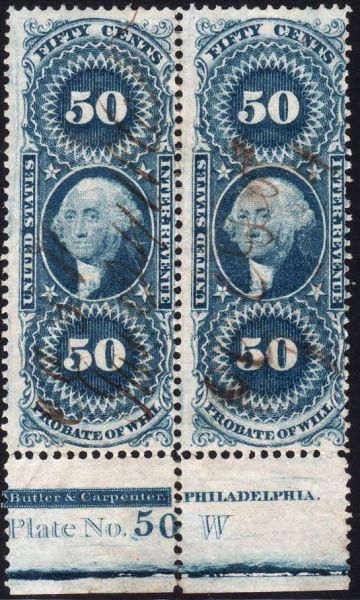 |
|
Send note to Staff
|
|
|
Pillar Of The Community
United States
1855 Posts |
|
|
My experience is that auctions have the benefit of usually offering highest-quality material, with good assurance of genuineness. The auctions I have attended have been dominated by dealer buyers. But they don't buy everything, and I've been pleased to pick up many good-quality items at what I consider reasonable prices. On some I was the only bidder against a single online or email bid.
I've met nice people, and picked up tips on new dealers to try, in the auction room.
I also think it's pretty cool to sit there while a rare item, beautifully illustrated in the auction catalog, is bid up to multiples of the catalog estimate. It's a form of entertainment, especially when the item has absolutely no interest for me. "Someone bid $25,000 for that?"
Live auctions are a useful component of a diversified collecting strategy and I feel all collectors should try them at least once to see how they fit in to their strategy.
I recommend carefully reading the auction house's terms and conditions, noting especially the "buyer's premium," if any, and markup for using credit cards. Bring your checkbook. Review the terms and go through any required credit/reference checking at least two weeks in advance. Have fun.
|
|
Send note to Staff
|
|
|
Rest in Peace
United States
82 Posts |
|
|
Chip -
Your #1 and #2 are right on target. I concur 100%. That is how it works.
My self-interrogation while considering buying something also has a one and two:
#1 - "what is the most I can lose on this?"
#2 - "when will I ever see it again?"
After answering myself, I know what to do.
Bill |
|
Send note to Staff
|
|
|
Bedrock Of The Community
United States
10670 Posts |
|
|
The first issue specialists that I know generally look down upon reconstructed multiples as being less than the sum of it's parts, as do I. It's really only done so that some collector can flex his ego with the "largest multiple" idea, even though it really isn't. |
|
Send note to Staff
|
|
|
Rest in Peace
United States
763 Posts |
|
|
Revcollector;
I do not totally agree with your view that a reconstructed multiple "really isn't". I **DO** agree that they are (or should be) worth substantially less than if they were intact - which addresses the "condition" aspect of the multiple. But I also think that even though reconstructed, they absolutely ARE legitimately the size they originally were. I don't see where just because two stamps become separated that disqualifies them from being recognized as originally an intact pair. For the purposes of value, we agree. For the purposes of a definition, we do not. |
|
Send note to Staff
|
|
|
Bedrock Of The Community
United States
10670 Posts |
|
|
A multiple by definition is two or more ATTACHED stamps. Not two or more PREVIOUSLY ATTACHED stamps. The only real value to a reconstructed block is possibly to someone trying to plate the stamp. Otherwise they are simply two blocks or three blocks or however many blocks that at one time were part of the same multiple but no longer are. Obviously they were separated for a document, or for successive documents and if they were still on the documents they would not be considered the largest multiple, so why should they now, just because someone had a few hinges laying around. |
|
Send note to Staff
|
|
|
Replies: 32 / Views: 5,141 |
|




 Posted 12/17/2014 9:50 pm





