| Author |
 Replies: 9 / Views: 3,847 Replies: 9 / Views: 3,847 |
|
|
Valued Member
United States
5 Posts |
|
|
|
|
Pillar Of The Community
United States
1820 Posts |
|
|
Pillar Of The Community
1849 Posts |
|
|
Pillar Of The Community
United States
1946 Posts |
|
|
I agree with Kevin. The printing and color in relation to the 1c suggest this is an American print on soft paper - 189. Color-wise the 1c looks like a 182, but few monitors are reliable for color. |
Send note to Staff 
|
|
|
Pillar Of The Community
United States
1414 Posts |
|
|
It is possible to identify hard or soft paper stamps using long wave UV light. Hard paper will appear to be bright while soft paper which will appear to be "dead" in comparison. Some practice is needed but the technique is reliable. Some stamps printed on so called intermediate paper will appear to be on thin hard paper but will have a visible basket weave pattern in back light and will not fluoresce under long wave UV. Although intermediate and some soft paper stamps were printed by the Continental Bank Note Company, they are grouped with the American Bank Note Company stamps because faulty classification criteria in the Scott catalog.
Soft paper stamps with postmarks before the February 4, 1879 consolidation have to be considered Continental products. Some 1 and 3 cent hard paper stamps also exist with the American Bank Note Company logo, likely on left over hard paper purchased by American Bank Note for an experimental printing.
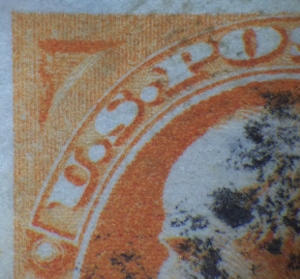
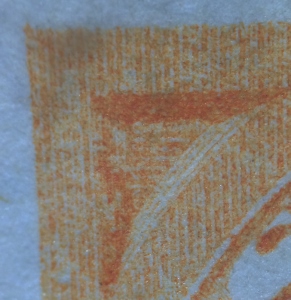
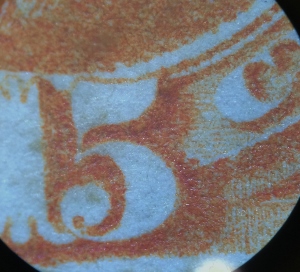
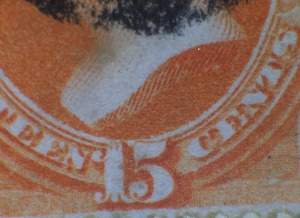
If the 15 cent stamp is on hard paper, it is most likely the Continental product. Again, identification information in the Scott catalog is not particularly helpful. The so called secret mark in the upper left corner is more likely to be an artifact of lesser printing quality of the Continental products. Except for some ribbed paper examples, Continental stamps lack complete fine lines in the upper and lower triangles, a characteristic of the National printings. Also, National Bank Note printings seem to have brighter and clearer color than the muddier Continental printings.
Clark |
|
Send note to Staff
|
| Edited by cfrphoto - 01/06/2015 10:05 am |
|
|
Valued Member
72 Posts |
|
|
Quote:
Again, identification information in the Scott catalog is not particularly helpful. The so called secret mark in the upper left corner is more likely to be an artifact of lesser printing quality of the Continental products. The fact that Scott continues to claim that the "V" is a secret mark on these stamps doesn't make any sense to me (though at least they mention that it's not always present on CBN and ABN issues). The 1967/1989 edition of Brookman's books devotes no less than 13 pages to the issue of identification of these stamps, including the falsehood of the "V" mark, in his discussion of the 15c Continental, most of which appears to have come verbatim from the 1947 edition. And he mentions that Pat Paragraphs (which I have not read) wrote as early as 1932 that the "V" is not a true secret mark. You'd think that 82 years later, Scott wouldn't still be reporting it as such. One thing I'm curious about, Clark - you mention the weakness of the fine lines in the triangles as identifiers of the Continental issues. However, Brookman also notes that the fine horizontal line at top center is broken or missing in the Continental issues. Is this still considered to be true, or has it since been disproved? |
|
Send note to Staff
|
|
|
Rest in Peace
United States
763 Posts |
|
|
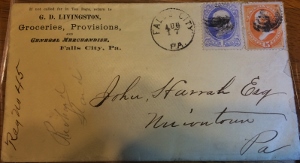
With Brother Clark around, you don't need me to give an opinion on this one, but one thing that may be of help is to understand the rate on the cover. It appears to be a 10c registry + 2x3c = 16c which did not occur (the 10c registry rate) until July of 1875. So that fact alone would make me lean toward it being either a 163 or 189, but as essayk pointed out, exact colors are tough to discern on computer monitors. Also, since #189 comes in every different orange shade (including those of the earlier 15c issues), we would not be able to go by stamp color either. But one thing could help us even more - is there a backstamp of any kind on the cover? If that backstamp (or an enclosure) would be dated prior to #189 being issued, than it pretty well screams out that it's a 163. If after the issue date, then it leans strongly to being a 189. And if push comes to shove, send it to me, and for $10. I will lift the stamp off the cover to see if it's hard or soft paper and if soft, it must be a 189 and if hard, it is then surely a 163. |
|
Send note to Staff
|
|
|
Pillar Of The Community
United States
1414 Posts |
|
|
Quote:
However, Brookman also notes that the fine horizontal line at top center is broken or missing in the Continental issues. Is this still considered to be true, or has it since been disproved? Since the initial Continental printings of the 15 cent stamp were printed using the National Bank Note plates, the only thing that likely to have changed was the ink formulation. What I wrote above in no way rules out having the top center line broken or missing. Unfortunately, as Bill Weiss points out, the color may end up being the deciding factor. Continental printings on ribbed paper and possible later soft paper printings may not have the fine line detail missing, so a more nuanced approach s needed. I believe that the 30 cent can also be distinguished by print quality, although the National printings always seem to be blacker, possibly because of finer line quality, not the actual shade of the ink. Also, the 90 cent stamps are also separated by shade which can be confusing since the shade variations within the National and Continental printings may overlap. I was at an auction a couple of years ago when a stamp with a certificate was offered as a 152. Although the certificate, from one of the major services, stated that the stamp was a 152 it was clearly a Continental Bank Note 163 ribbed paper variety. The color should have provided enough of a clue that the stamp was not a National printing. So even expert committees get it wrong sometimes. Clark |
|
Send note to Staff
|
| Edited by cfrphoto - 01/07/2015 12:48 am |
|
|
Valued Member
United States
5 Posts |
|
|
Thanks to everyone for the discussion and contribution to my question; I see that I'm not alone in getting confused on trying to ID the variations of this stamp! There is no other postmark/backstamp on the envelope so an actual year date cannot be determined. I went back and looked at the sellers description (this was an ebay find) and forgot that they had added the following description that talks about the postmark location and timing: "An attractive registered cover sent from a general store proprietor in Falls City, Pennsylvania to Uniontown, Pennsylvania. The Falls City post office, in Fayette County, was in existence from 1871 to 1886. The Falls City, PA postmark is dated August 17 with no year date which is unfortunate. The year date would help determine which stamps were used to frank this envelope. Prior to 1879, Continental Bank Note Co. was the printer and used a different type of paper than that used by The American Bank Note Co., which took over the CBN in 1879 and changed papers. On cover, I cannot differentiate between Scott #163 and #189, both 15¢ Daniel Webster stamps (the first is yellow orange and the second red orange – this looks like yellow orange to me) and Scott #156 and #182, both 1¢ Benjamin Franklin stamps. In any case, it is a nice registered cover from a discontinued post office. This cover measures 153mm x 86mm. See scans for condition - roughly opened on the right end. Based on this information and the discussion above it probably falls in the 163 or 189 category. Mr Weiss is spot on with his reccomendation to lift the stamp to gain certainty on the paper type and corresponding Scott #. I have a few items that I've been meaning to send in for expertizing and I may include this one (mostly for curiousity purposes). Thanks again for the help and interesting discussion. I haven't cracked open the Brookman book recently to study this stamp and I intend to do that tonight; this stuff can be confusing but also a lot of fun! |
|
Send note to Staff
|
|
|
Pillar Of The Community
United States
1414 Posts |
|
|
Quote:
lift the stamp to gain certainty on the paper type and corresponding Scott #. It should be possible to examine the stamp under long wave UV light without removing it from the cover. Hard paper will be relatively bright compared to soft paper. Compare with examples where the paper type is known. Use a stamp like a common Scott 3 cent 65 or 114 as the hard paper example and a 2 cent 210 or 213 as a soft paper example. Also, the seller is incorrect when he stated that the American Bank Note Company changed from hard to soft paper. Continental changed the paper before the consolidation. Clark |
|
Send note to Staff
|
|
| |
Replies: 9 / Views: 3,847 |
|



 Posted 01/06/2015 01:37 am