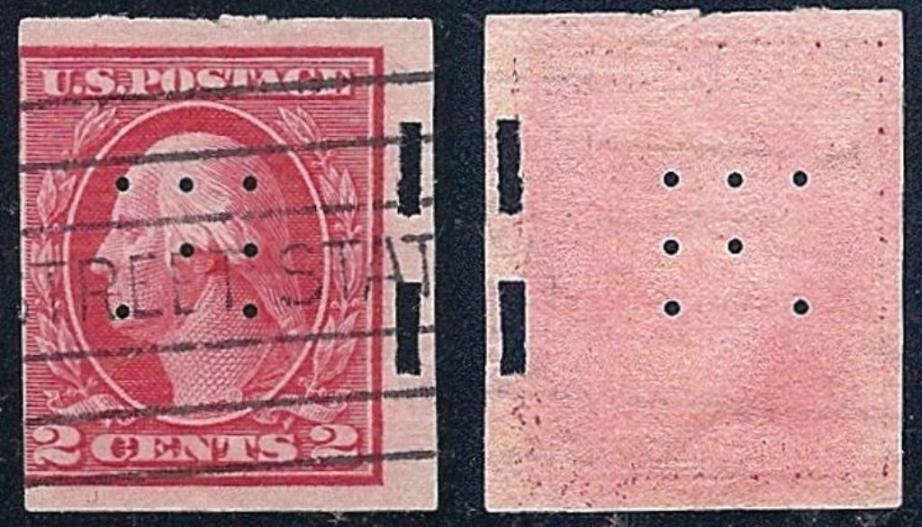
| Author |
 Replies: 36 / Views: 8,507 Replies: 36 / Views: 8,507 |
|
Pillar Of The Community
United States
672 Posts |
|
|
I came across this stamp in my collection recently and am wondering if this is a "pink back" Scott shows pink backs occurred on a few Washington Franklins near the start of World War I. Germany was the dominant supplier of synthetic dyes at that time. Chemical plants were converted to explosive factories and the British blockade curtailed imports. The Bureau of Engraving and Printing was forced to get dyes where ever they count find them. A poor quality batch of aniline ink resulted in the dye bleeding through the paper creating a pink back. What do you think, pink back ?? 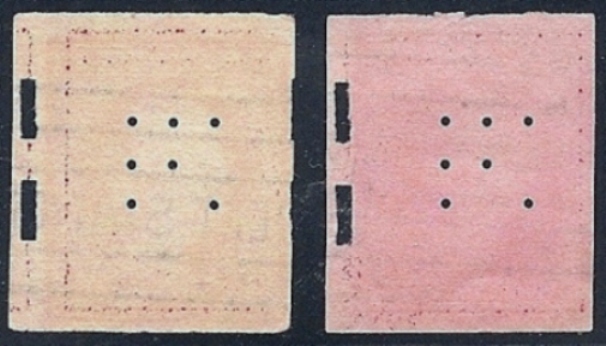 |
|
Send note to Staff
|
| Edited by kcaramat - 03/07/2015 10:27 am |
|
|
|
|
Pillar Of The Community
United States
1946 Posts |
|
|
Mind if we see the front? An aniline bleed is visible on both sides of the stamp. |
Send note to Staff 
|
|
|
Pillar Of The Community
United States
672 Posts |
|
|
Pillar Of The Community
United States
611 Posts |
|
|
It is hard to say. The Schermack type III perfs look fake. If they are then, it certainly makes figuring out which stamp and when it was made very difficult. |
|
Send note to Staff
|
|
|
Pillar Of The Community
United States
1946 Posts |
|
|
This for sure is an aniline bleed and not the result of soaking a stamp off of pink/red colored paper. The color intensity on the reverse is not uniform all the way to the edges, but tends to be more dense in the middle and feathers off at the edges. The lines of printing on the obverse also feather out from their defining lines.
If that is what you mean by calling it a "pink back" then that is what it is.
BTW sometimes the color will transfer to a piece of paper making contact with the obverse, such as in a closed album. With these devils you don't want to mount stamps on a facing page without interleaving, unless this one is in a mount. |
|
Send note to Staff
|
| Edited by essayk - 03/07/2015 11:52 am |
|
|
Pillar Of The Community
1849 Posts |
|
|
Quote:
This for sure is an aniline bleed and not the result of soaking a stamp off of pink/red colored paper I respectfully disagree. |
|
Send note to Staff
|
|
|
Pillar Of The Community
United States
672 Posts |
|
|
Pillar Of The Community
United States
611 Posts |
|
|
Scott notes that the only 2 cent stamp with the pink back is a 425 perf 10 with sl watermark. Have you checked the watermark out yet? |
|
Send note to Staff
|
|
|
Pillar Of The Community
United States
672 Posts |
|
|
It's a single line watermark. Imperforate stock was simply pulled from regular BEP production prior to perforating. Pink backs are known on Scott #409 both with and without Schermack type III perfs. What makes this stamp interesting is that it has control identification marks too.
The timing of when companies stopped using control identification marks and when the "pink backs" were thought to have been created is what is confusing to me. There seems to be a gap of a few months here. Either control perforations were used slightly longer than previously thought or the Bureau experimented with aniline ink a couple months earlier than thought.
Or of course the possibility this isn't a "pink back" at all.
|
|
Send note to Staff
|
| Edited by kcaramat - 03/07/2015 4:57 pm |
|
|
Pillar Of The Community
1849 Posts |
|
|
Pillar Of The Community
United States
672 Posts |
|
|
That's given, Scott only references pink backs on Washington/Franklin 425, 426 and 435. It's also a known fact that they do exist on Scott #409 as they were pulled from production runs and have been certified as such.
The actual stamp design or the paper printed on is no different than the 1912 Scott #406. The change in Scott numbers only reflects a perforation change. It does however give a clue as to the timing of the ink formulation change.
In 1914 Germany was producing 90% of the world's synthetic dyes. The start of World War I forced the BEP to find dyes where ever they could. Formulations were in a constant state of change. That's the reason for as many as 15 color shades of the 2 cent Washingtons. |
|
Send note to Staff
|
| Edited by kcaramat - 03/07/2015 5:09 pm |
|
|
Pillar Of The Community
United States
1946 Posts |
|
|
Kevin, we're still waiting for you to account for what you are seeing. I know nothing about any special class of stamps being called "pink backs" but I do know aniline bleed when I see it, and I have pointed out some of the markers.
So what do you make of these data? Telling us about what the catalog lists is only part of what is needed.
|
|
Send note to Staff
|
|
|
Pillar Of The Community
United States
2555 Posts |
|
|
I have to agree with Kevin on this one. The entire stamp should not be discolored on a "pink back". |
|
Send note to Staff
|
|
|
Pillar Of The Community
United States
2555 Posts |
|
|
I also question whether you will see ink setoff on a genuine "pink back" |
|
Send note to Staff
|
|
|
Pillar Of The Community
1849 Posts |
|
|
essayk.....as per Scott:
The aniline ink caused a pink tinge
to permeate the paper and appear on
the back.
My take....
Made the paper translucent and the design
shown thru with a pink tinge.
It does not make the paper "pink".
The example shown is NOT pink....
it is a red bleed ....from soaking??
It is NOT a bleed thru. |
|
Send note to Staff
|
|
|
Pillar Of The Community
United States
672 Posts |
|
|
So this is more of what you would expect to see as a pink back ? 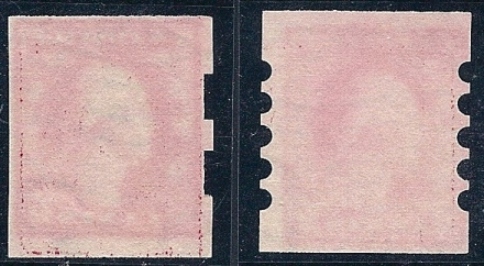 |
|
Send note to Staff
|
| Edited by kcaramat - 03/07/2015 8:16 pm |
|
|
Replies: 36 / Views: 8,507 |
|




 Posted 03/07/2015 10:26 am