| Author |
 Replies: 36 / Views: 8,505 Replies: 36 / Views: 8,505 |
|
|
|
Pillar Of The Community
United States
672 Posts |
|
|
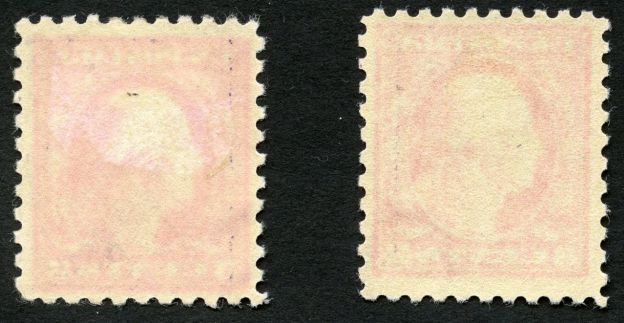
Makes sense to me. I couldn't come to terms with the date descrepency between a Schermack with control mark and a Schermack with a pink back.
Appeciate all of the responses. |
Send note to Staff 
|
|
|
Pillar Of The Community
United States
2555 Posts |
|
|
The last two you posted look good. I see that they both have ink setoff on the back... |
|
Send note to Staff
|
|
|
Pillar Of The Community
1849 Posts |
|
|
Pillar Of The Community

United States
1273 Posts |
|
|
Moderator

United States
12330 Posts |
|
|
Pillar Of The Community
1849 Posts |
|
|
Quote:
I thought it to be a control perfin.
Don You thought the Control perfin (patterened holes) was considered a "pink back"" Your comment is confusing??? |
|
Send note to Staff
|
|
|
Rest in Peace
United States
763 Posts |
|
|
We need to get some of the confusion here explained. The control number perfin (which is #48 - these are identified by the MISSING holes) was a function of the private vending company (Schermack). The control perfin has absolutely nothing to do with whether or not the stamp is a "pink back" (I do not believe it is, I think it is just (as others have pointed out) ink bleed probably caused by soaking it in water that was too hot). |
|
Send note to Staff
|
| Edited by Bill Weiss - 03/08/2015 8:49 pm |
|
|
Pillar Of The Community
United States
672 Posts |
|
|
Thank you all for weighing in.
The control perfin is pattern 48 of the Kabo Corset Company of Chicago. They were one of the last users of control perfins, with LKU dates of Feb/Mar 1914.
The only date info I could find on "pink backs" was a certified Schermack block of 6 with plate# 7390. That plate# went to the press in June of 1915. That in itself surprised me, as I had believed "pink backs" were produced sometime in 1914.
I feel confident with the conclusions the group has arrived at. |
|
Send note to Staff
|
| Edited by kcaramat - 03/08/2015 05:37 am |
|
|
Pillar Of The Community
United States
1946 Posts |
|
|
Sorry I had to disappear yesterday as this discussion was starting. I had a shoot that took me until midnight, and then I had services to conduct earlier today. I'm sure I missed a bunch, but I did want to show you this. One of the complaints that was lodged against the new 2c lake in 1890 was lodged by the New York Sun, "...an ink which is not only to florid, it is also too gummy. It rubs off. It won't wash. It isn't a fast color." American sought an alternative, trying to avoid the use of aniline ink which was expressly forbidden by the contract. However, though it is not widely known and not mentioned in Scott, they did use an aniline formulation for some stamps printed in carmine. Here are a couple of examples, on the left both sides of an uncancelled stamps, and on right a cancelled stamp. Neither has gum and presumably both have been soaked in water. 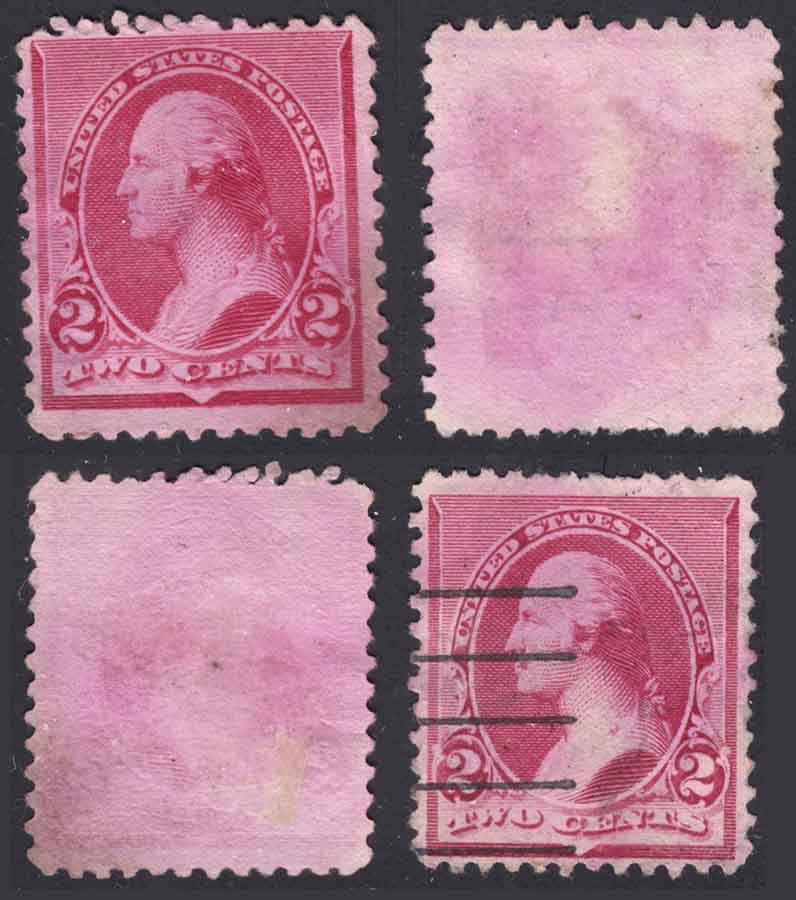 The characteristic pink bleed-through is not limited to stamps printed in shades of red. This is the phenomenon I was referring to as "aniline bleed." How this compares to the so-called "pink backs" you are discussing remains to be seen. But the fact that these exist and are not listed in Scott invites comparison with your later variety which appears to me to be more of the same. |
|
Send note to Staff
|
|
|
Rest in Peace
United States
763 Posts |
|
|
essayk;
I am confused. The "pink backs" listed by Scott were created because of the use of aniline ink used to print the stamp, which permeated the paper, causing the "pink back". Whereas the examples you show were (correct me if I'm wrong....) created by exposure to WATER, causing the ink to "bleed" through the paper. In my mind, this is a big difference. Now if you can show an unused/OG copy with a "pink back", then I think we would be talking about the same thing. |
|
Send note to Staff
|
|
|
Pillar Of The Community
United States
4194 Posts |
|
|
Here is the back of a ultramarine front/ 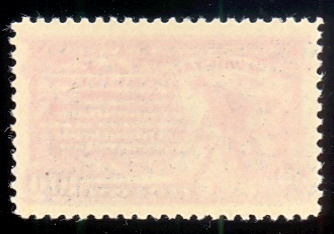 pink back E11 (which is listed as such in the Scott Specialized). It is MNH, so not from water soaking. |
|
Send note to Staff
|
|
|
Pillar Of The Community
United States
1946 Posts |
|
|
Bill, the water only changes the degree of the migration, but not the source. The use of aniline ink is the source of the problem, because it is what is migrating, and generally speaking that is not a spontaneous migration. It may happen when a force is applied directly to the ink (as in the contact pressure of an album page which will cause a transfer of ink to the page) or when it is in sustained contact with moisture and begins to migrate into unprinted parts of the paper upon which the design is printed. It can be documented that at least since the 1870s, and probably earlier, the summer and winter fomulations of gum differ in viscosity. Summer heat and humidity, plus the contact pressure of sheets lying atop one another in a drawer or whatever, can cause the sheets to stick together in places. Summer gum was thinner, in depth and in viscosity. So depending on the season, the gum itself can act as a catalyst for the migration of aniline. That is what produces what you are calling a "pink back" on stamps which are MNH. (See the Special Deliver example and the link that Kevin first put up.) But it is the same phenomenon of aniline migration ("aniline bleed") as you will see with soaking; just a matter of degree.
As I believe you know, not all examples of #220 show this migration of colorant even after soaking. Why some and not others? You associated that with the temperature of the water used. But in point of fact if the ink used does not have any aniline in it, then no amount of water at any temperature will produce an aniline migration. Something other color migration? Maybe, but most other inks are pretty stable that way. So if you see this migration, it is a strong indication that aniline ink was most likely used. Hot water merely increases the activity of the molecules and makes it easier for migration to take place. And any ink subject to breaking down will respond to that too, it is true. But different substances can be expected to have different migration patterns. Since the problem is ubiquitous for aniline inks, it is the most familiar.
Last point, do you know why the use of aniline was supposed to be forbidden in stamp production? It is not merely an aesthetic issue. Aniline dyes allow color to stand out with their full saturation, which is aesthetically desirable for stamps. But those dyes are toxic, and lots of people put stamps into their mouths to lick them to make them stick. Do that long enough or often enough and you won't have a ripe old age. Can you imagine trying that today?
BTW your point is well taken about finding this phenomenon on stamps with og. To tell the truth I have never pursued that and don't know the track record for it, but we should expect to see something. I'm going to look into it to see what I can learn about it. Whatever I find out I will let you know. |
|
Send note to Staff
|
| Edited by essayk - 03/09/2015 09:31 am |
|
|
Pillar Of The Community
United States
1414 Posts |
|
|
A couple of observations:
1. The paper was damp when the stamps were printed.
2. The "bleed through" will be seen under the gum.
3. No one is going to classify a "pink back" variety unless it has been seen on the back of stamps with original gum.
My guess is that the "bleed through" occurred during printing as a consequence of dampening the paper during the printing process. It does not seem likely that interaction with moisture in the gum could have been provided enough moisture to pull any dye away from the surface of the stamp into the paper.
Clark |
|
Send note to Staff
|
| Edited by cfrphoto - 03/09/2015 11:43 am |
|
|
Pillar Of The Community
United States
1946 Posts |
|
|
Clark, you haven't addressed what for me is the basic question and the limit of my personal interest in the subject:
Is the "bleed through" we see in a "pink back" the same kind of aniline bleed that we can see in grand style after certain stamps are soaked in water?
If so, then I can see how moistening the paper prior to printing could account for at least some migration of the colorant. The second point about it being under the gum seems intuitive unless we ask about how much of the effect has gone into the gum itself. Not sure how one would make that distinction without sacrificing a bunch of examples.
The distinction everyone seems to be making about "pink backs" seems to me a matter of degree and definition. But it does raise the question, if this kind of bleed was possible in the late 19th century, what was different that we only see true "pink backs" in limited times and issues? In that regard, maybe there is more to it than a matter of degree. But what?
|
|
Send note to Staff
|
| Edited by essayk - 03/09/2015 12:49 pm |
|
|
Pillar Of The Community
United States
1414 Posts |
|
|
essayk,
See the article "World War I Printing Dye Shortages: Submarine Shipment of Printing Dyes?" by Larry S. Weiss in the March 1987 issue of The United States Specialist.
"Effect of Dye Shortages on Stamp Colors
Collectors of Washington-Franklin head stamps of the period, however,
do observe the many color varieties. The perforated 10 stamps, particularly the
2¢ issues of 1914 and 1916 (Scott #425 and 463) show various shades that are
generally lighter than that on earlier stamps of the same denomination. Scott
#425 is reported in Johl (1937) and Scott Specialized as having the colors of rose
red, dark rose red, carmine rose, carmine, dark carmine, scarlet, and red and
#463 has carmine, dark carmine, and rose red. In another source (Powers, 1917)
the colors are reported as running from pink to deep carmine. Meanwhile, the
earlier issue of the 2¢ from 1912 (Scott #406) is reported by Johl and Scott in
carmine, bright carmine, dark carmine, and lake, all more intensely colored reds.
In March, 1916, the color of the 12¢ (Scott #435) was reported (Scott 's Circular)
to have noticeably changed from the normal claret brown to copper red and was
so significantly different that even today it retains a sub-number, Scott #435a.
The most extensive description of the color variations of these stamps and
others, such as postage dues and special deliveries, affected by the dye problems
is given by Miers (1961).
In addition, present-day collectors should be familiar with what are
termed the "pink back" varieties of the 2, 3, and 12¢ perf 10 stamps, Scott #425,
426, and 435, which show a bleeding of the dye through the paper to give a
distinctive pink tinge in the form of the printed design on the reverse. These
were recognized when current and promptly catalogued (e.g. Goodwin, 1919).
Scott Specialized (1987, pg. 157) attributes the pink backs to the use of
aniline inks. However, inks with aniline dyes were in use from at least 1894
without such effects. The term "aniline dyes" in philately is generally
acknowledged (Kimble, Konweiser, Poole, Sutton) to denote brilliant colors
which are soluble in water and show fluorescence under ultraviolet light, an
erroneous use of the term. White (1979, pg. 15) similarly notes the misuse of the
term "aniline dye" in philatelic writing. It would be better in the case of the pink
backs for the Scott catalogue to simply acknowledge that changes in the ink formulation
resulted in the dye bleeding through the paper to a greater extent than
usual, without specific mention of the use of aniline dye in the ink."
From the above, it should be clear that the "pink back" was a one-off situation unrelated to ink running after the fact while soaking stamps. It should be noted that the perf 11 Special Delivery, Scott E11 "pink back" variety also exists. I have handled at least one really nice example.
Clark |
|
Send note to Staff
|
|
|
Replies: 36 / Views: 8,505 |
|




 Posted 03/07/2015 8:20 pm