| Author |
 Replies: 17 / Views: 5,441 Replies: 17 / Views: 5,441 |
|
Pillar Of The Community
United States
670 Posts |
|
|
I found these two stamps in a big US collection I just got today. They are marked as 491, next to a strip of 3 also marked as 491 that were really 492. The first image below seems be type II, but the possible three dash line in the ribbon just to the right of the first fold is very hard to see. After another look, the first image is type I. Not sure how I missed that toga rope. No setoff. W/Fs making me crazy again. The second image does have the characteristics of a type II. They are both perf 10. I checked for watermark and couldn't see any, but I can't always see them when I know they are there. Not sure about the edges, but both measure the same side to side. Opinions?  |
|
Send note to Staff
|
| Edited by raymodj - 03/09/2015 4:41 pm |
|
|
|
|
Pillar Of The Community
1545 Posts |
|
|
Quote:
W/Fs making me crazy again Know the feeling. Here's a good procedure for identifying Washington/Franklins... 1. Determine the printing method (Flat Plate, Rotary or Offset). 2. Determine the perforations. 3. Determine the type. If you have these three things, you will actually know in many cases whether the stamp has a watermark or not. The only times when you absolutely need to check the watermark is on... 1. Flat Plate imperfs. 2. Perf 11 Flat Plates. 3. All perf 10's (except for Type I coils). -IBFS |
Send note to Staff 
|
All science is either Physics or Stamp Collecting. -- Ernest Rutherford |
|
|
Pillar Of The Community
1545 Posts |
|
|
Also...The perfs on the right side of the stamp on the right look funny to me.   Now that I look closer, the perfs on the left stamp look funny also. -IBFS |
|
Send note to Staff
|
All science is either Physics or Stamp Collecting. -- Ernest Rutherford |
| Edited by I Brake For Stamps - 03/09/2015 5:58 pm |
|
|
Pillar Of The Community
United States
937 Posts |
|
|
I think you're right on. The left is Type I and the right is Type II. Presence or not of a watermark is the only thing left to determine. For $5 Bill Weiss will take a look and he's very good at spotting watermarks.
As for the perfs, the left and right have to be original. The top and bottom perfs could have been cut off of a #539 coil waste 11x10, but that stamp catalogs at around $4500 higher. I can't see anyone deciding to turn a #539 into a #491 no matter how bad the top and bottom perfs could be. The odd shape of the right hand perfs could be due to how the user removed the stamp from a vending machine. |
|
Send note to Staff
|
Ryan = HDNAC = DNA = HDC = Hysterical DNA Collector = Historical DNA Collector = me who just loves stamps :) |
| Edited by Historical DNA Collector - 03/09/2015 6:54 pm |
|
|
Pillar Of The Community
United States
937 Posts |
|
|
I just noticed some peculiarities of the Type I (left hand) stamp. It almost seems like it has some recuts. There's an odd break in the hair at the yellow arrow. The green arrows point to noticeable darkening of the eyebrow and some lines in the hair. None of these differences are noticeable on the few Type I rotary print coils that I have. 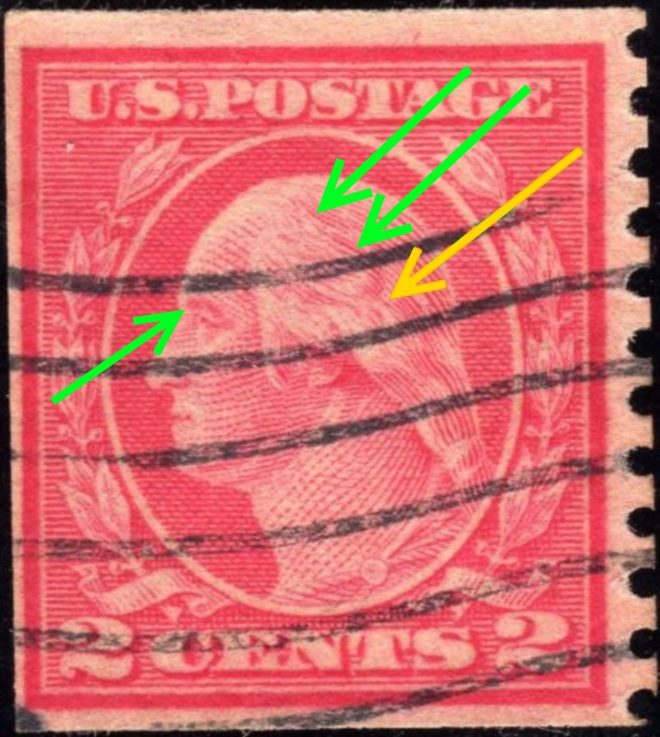 |
|
Send note to Staff
|
Ryan = HDNAC = DNA = HDC = Hysterical DNA Collector = Historical DNA Collector = me who just loves stamps :) |
| Edited by Historical DNA Collector - 03/09/2015 7:39 pm |
|
|
Pillar Of The Community
United States
670 Posts |
|
|
Good eye, DNA. I don't see what you pointed out on the only other rotary coil I have handy.
The type I stamp is a 453, and should have a watermark. I didn't see a watermark on either of these stamps, so I'm going to try a few more times. If I can't find anything, I'm sending the type II to Bill Weiss with something else I've been meaning to send him. It will most likely come back as a 454, but worth $5. |
|
Send note to Staff
|
|
|
Pillar Of The Community
United States
578 Posts |
|
|
The left stamp looks like a type III to me (either Scott 455 or 492.) The right stamp looks like a type II, and my guess is that it's watermarked (i.e. Scott 454, not 491.) |
|
Send note to Staff
|
|
|
Valued Member
United States
56 Posts |
|
|
IBFS
I hate to break in here, but being new to this game I have a question for you. I like you approach, I think I can determine the difference between Flat plate and rotary, but offset printing? From what I can see Type IV, V, Va VI and VII are offset printing, but short of these identifications, is there another way of telling the difference between Flat Plate and Offset Printing? |
|
Send note to Staff
|
|
|
Pillar Of The Community
United States
578 Posts |
|
|
With experience, you'll be able to tell offset vs. engraved by "look." (I think that's what you're really asking about.) Short of that, the best way IMO is to just drag the edge/tip of your tongs lightly across the design (e.g. perpendicular to a frame line.) If the stamp is engraved (raised design,) the tongs will "catch" on the ink. If the stamp is offset, you'll encounter no resistance and the tongs will slide smoothly over all printed areas. |
|
Send note to Staff
|
|
|
Valued Member
United States
56 Posts |
|
|
Pillar Of The Community
United States
670 Posts |
|
|
Thanks srail, I can see possible faint type III lines on the ribbons. Is that what led you to type III? I thought type I because the top line of the toga rope is not very defined, and the rope lines don't seem consistent top to bottom. I read (probably on 1847usa) that the toga rope isn't a defining characteristic of type III, but it usually looks more like type II.
Joe, another good trick for telling flat plate and rotary stamps from offset stamps is the tinfoil test. If you can't get the hang of feeling the engraving, just put some tinfoil on the stamp and gently rub with your finger. If it's flat plate or rotary, you'll see an image of the stamp on the tinfoil, caused by the engraved lines. |
|
Send note to Staff
|
|
|
Pillar Of The Community
United States
578 Posts |
|
|
Pillar Of The Community
United States
937 Posts |
|
|
Pillar Of The Community
United States
670 Posts |
|
|
Well, no luck finding the watermark on the type II on the right. I took a few pictures but it's much easier for me to scan. I'm a little shaky and was born wearing glasses. I tried to get one in fluid and the second while flashing.   |
|
Send note to Staff
|
|
|
Pillar Of The Community
United States
611 Posts |
|
|
It seems to me the right stamp is a type II. I don't see the watermark either. That means it's time to send it off. The left one is type III.
The way I look at these is to find stamps that have all of the markers clearly show. Since the 491 is the most expensive, it has to show all markers clearly. Otherwise it is a type III. |
|
Send note to Staff
|
|
|
Pillar Of The Community

United States
1273 Posts |
|
|
Some additional information that helps identify Types I-II-III rotary press issues. The first two images were taken from a 2011 post from another site that were posted by a friend on mine. The comments under the images are his, although I had to re-type them to fit under the images. 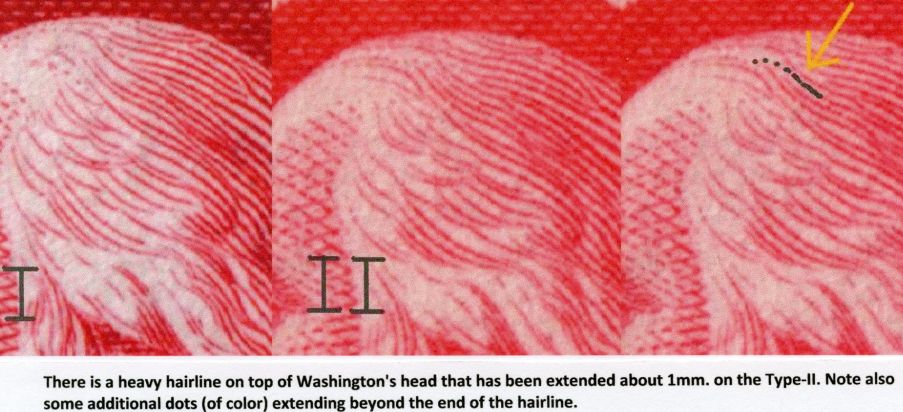 Its a little harder to see what he's talking about in this second post. But the lines can be seen. 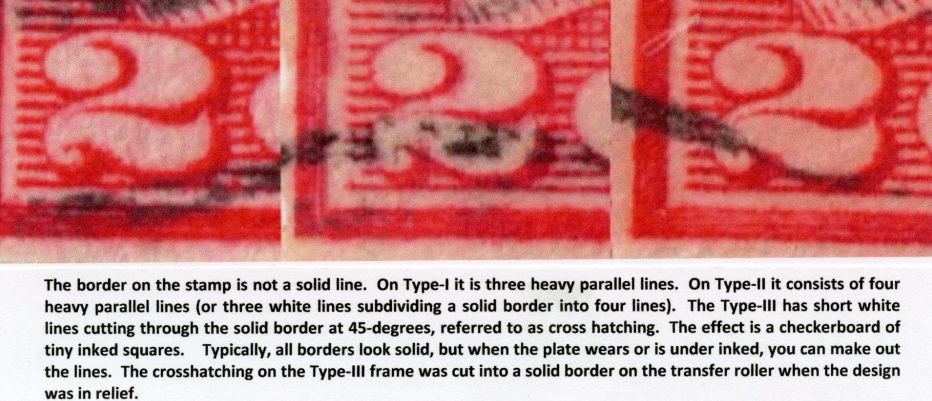 This image (below)is an example of a #454 that I have on a cover. Its the best example I have that can show the lines in the border (type-II). I don't have an example of a type-I that I could post. 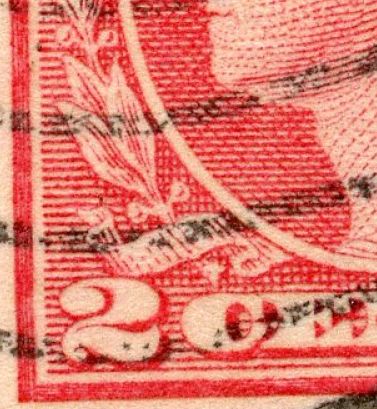 The image (below) is an example of a #492 that I have on a cover. Its the best example I have that can show the cross hatching in the border. As Tipzi stated in his original post, most examples will show a solid border, so the border distinction used as an identifier will not work in every case. The difference in the hair line between a type-I and type-II should be fairly consistent to identify. All this having been said, the first image in the original post is a type-I and the second is either a type-II or III. Most likely a type II but would need a better image to be sure. I am not seeing a watermark, but single lines are difficult to see. Ray Mac. sent in one he thought was a #491 and it was cert'ed. as a #454--a portion of a watermark was found on a single perf. tip. Go figure.  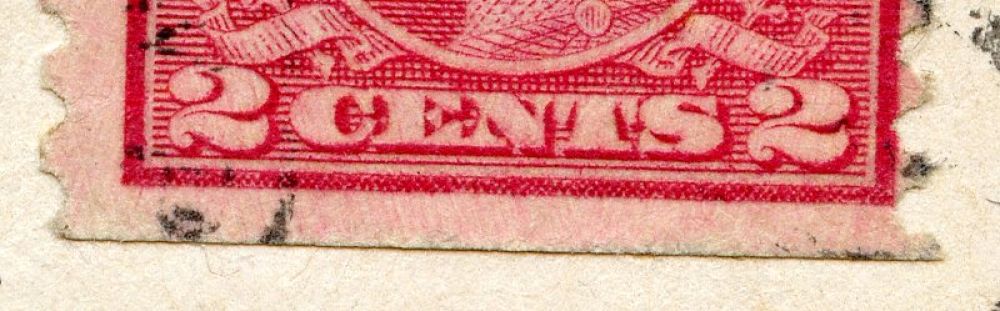 |
|
Send note to Staff
|
|
|
Replies: 17 / Views: 5,441 |
|




 Posted 03/09/2015 4:36 pm


