| Author |
 Replies: 44 / Views: 5,958 Replies: 44 / Views: 5,958 |
|
|
|
Pillar Of The Community
United States
1946 Posts |
|
|
Not to muddy the waters, Bill, but I am not clear about the plate situation. US #17 was printed entirely from plate I. US #36 was printed from plate I for part of its run, and then plate III for the rest (#36B). US #44 was printed from a new plate in 1875, which was made from a new die. I am intrigued by your observation that the Roosevelt die proofs were pulled from what appears to be the original die. (And I am even more intrigued by the fact that Bill Langs is offering the very one you pointed us to). Odd that it would show the same lines and dots as the original die. Could it be that Langs got the pictures switched around? [edit: No, it's not a switch, because the PF gave the Langs piece cert #471033, and it so appears on the PF web site.] I think we should all take a look at the item which received PF cert #463402 http://pfsearch.org/pfsearch//image...3/463402.jpg (or use their serach page to hunt for anything that "begins with" 44P) This item has the same hokey left frame line as the Langs 17P1 offering, and has the notation "PROOF ON INDIA. / AND WE ARE OF THE OPINION THAT / IT IS NOT SCOTT 17 VARIETY, RATHER IT IS A SCOTT 44P VARIETY, ON PROOF PAPER OF INDETERMINATE COMPOSITION; THE PROOF WITH IMPROVED FRAME LINE AT LEFT." This is so close to what Langs is offering, right down to the paper, that I think this settles what a new PF cert request would determine. |
Send note to Staff 
|
| Edited by essayk - 04/04/2015 10:54 am |
|
|
Pillar Of The Community
United States
937 Posts |
|
|
Bill, something like this? I've sent you an email so we don't clutter the thread. I'll replace the image with progressing revisions. 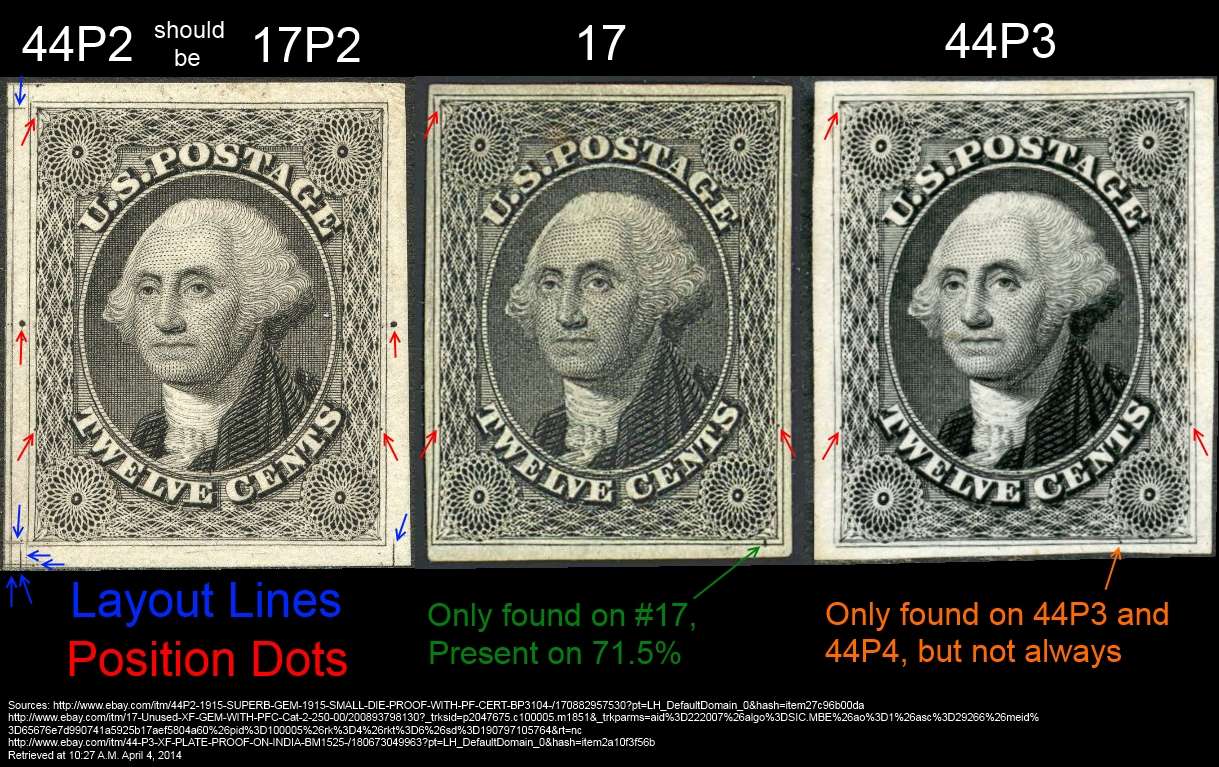 |
|
Send note to Staff
|
Ryan = HDNAC = DNA = HDC = Hysterical DNA Collector = Historical DNA Collector = me who just loves stamps :) |
| Edited by Historical DNA Collector - 04/04/2015 3:11 pm |
|
|
Rest in Peace
United States
763 Posts |
|
|
Quote:I think we should all take a look at the item which received PF cert #463402 http://pfsearch.org/pfsearch//image...3/463402.jpg (or use their serach page to hunt for anything that "begins with" 44P) This item has the same hokey left frame line as the Langs 17P1 offering, and has the notation "PROOF ON INDIA. / AND WE ARE OF THE OPINION THAT / IT IS NOT SCOTT 17 VARIETY, RATHER IT IS A SCOTT 44P VARIETY, ON PROOF PAPER OF INDETERMINATE COMPOSITION; THE PROOF WITH IMPROVED FRAME LINE AT LEFT." Interesting indeed. But the first thing I noticed is that it does NOT have the constant position dots below either bottom rosette. But it also doesn't have the #17 constant plate scratch/line below the right bottom rosette. So they must have reached their conclusions based on either the color/impression or the framelines. I believe there are other small differences between the dies/plates used for the 12c 1851, 1857+ and Special Printings. Jim Allen is the premier student/collector of this stamp and he has been writing a series of articles on them in the Chronicle - which can be accessed for free on their website (U.S. Philatelic Classics Society) so perhaps re-reading those articles might tell us what these differences are. |
|
Send note to Staff
|
|
|
Pillar Of The Community
United States
1946 Posts |
|
|
The Neinken study of the 12c of 1851 is available for pdf download at the USPCS website. try this link: http://d2jf3tgwe889fp.cloudfront.ne...kmarked2.pdf or follow these directions To get there from the home page I did a search on the name neinken and it brought up a page for the electronic library. Scroll down for a link to the book by author and title. p.72 ff - Neinken had advanced an interesting theory with respect to the imperforates associated with plate 3. Citing a receipt from the gov't for plates in 1861, which reported three plates for the 12c, Neinken concluded that plate 3 was not produced in 1860 as reported in Scott. He asserts that it was created in 1851 as the second of two plates made that year, but which remained unused during the time #17 was in regular issue to the public. He then asserts that in 1860 plate 2 was resurrected and altered to fashion plate 3. He makes no comment about trial impressions from plate 2 prior to alteration. I suspect that the present generation of experts at the PF do not subscribe to this theory, but it may be worth noting in the event we are not able to cover all bases for these stamps. Most of what the PF has certified for the past couple of decades seems to be coming up as versions of #44. My main reason for turning to Neinken was to see whether or not he/it has plating info for plate 1. The subject is discussed, but is focused primarily on the right pane only, since discernible left pane material did not allow for much plate reconstruction back then. I don't know how much that has changed. However, for plate 1R the placement of position dots is of major interest. How closely anything there corresponds to what we are seeing here I do not yet know. BTW I noticed that Langs is offering a 44P3 with the two dot combination ( http://www.ebay.com/itm/180673049963 ) and those dots line up well with two dots on his "17P1." But one of this dots, the uppermost of the two, appears on a #17 he is offering ( http://www.ebay.com/itm/200893798130 ). However, the left frame line on his "P1" is treated differently from the other two. |
|
Send note to Staff
|
| Edited by essayk - 04/04/2015 1:39 pm |
|
|
Pillar Of The Community
United States
937 Posts |
|
|
Neinken changed his mind about plate 3 in 1969, 4 years after the book was published: The 12 Cent Plate 3 - When Was the Plate Made? http://chronicle.uspcs.org/PDF/Chro...63/17165.pdfHe quotes portions of a letter from Mr. Elliott Perry that influenced him: "'What does all this mean? It would indicate that my theory that both 12 cent plates were made in 1851 is incorrect, and that Plate 3 was made at a later date and that when it was made, it was intended that this plate be used for perforated stamp.'" |
|
Send note to Staff
|
Ryan = HDNAC = DNA = HDC = Hysterical DNA Collector = Historical DNA Collector = me who just loves stamps :) |
| Edited by Historical DNA Collector - 04/04/2015 1:58 pm |
|
|
Pillar Of The Community
United States
937 Posts |
|
|
From Neinken's 12c book: "One hundred and forty-three positions of Plate 1 have guide dots on or near the right end of the bottom outer frameline under the right lower rosette." With 200 positions on the plate, that works out to 71.5% of them having the mark pointed to in green on Bill's image that I posted above. Neinken illustrates most of the 200 positions and none show Plate 1 having the guide dot pointed to in orange. |
|
Send note to Staff
|
Ryan = HDNAC = DNA = HDC = Hysterical DNA Collector = Historical DNA Collector = me who just loves stamps :) |
|
|
Rest in Peace
United States
763 Posts |
|
|
Yes, it seems pretty obvious that before Plate 1 was made many of the position/layout dots/lines were burnished out. But even though Neinken calls that constant line in the frame below the right edge of the right rosette "guide dots", I'm not so sure as many of the copies that show it look like more than a "dot". It looks more like a short scratch than a "dot".
Another interesting question is why do 71% of the positions of Plate 1 show the "dot" or "line" - why don't all 200 positions show it if it was on the transfer roll and /or the die? Yet it was not on the die proofs we've seen, so it must have been on the transfer roll? |
|
Send note to Staff
|
|
|
Pillar Of The Community
United States
2555 Posts |
|
|
The guide dots, and yes, some look more like dashes, were put on the plate to position the transfer roll. TCC&Co made no effort to remove the dots once the plate was finished. Most of the stamps that are missing guide dots are the 10th column of stamps in each pane. That is because it was actually the dot above and to the left that controlled the placement of each transfer roll setting. That is why you will find dots in the left margins of the TCC&Co plates and none on the bottom row stamps at all. |
|
Send note to Staff
|
|
|
Pillar Of The Community
United States
1946 Posts |
|
|
The "layout lines" on the die are not the lines on the plate. They were shaved off the transfer roll reliefs before the clichés on the plate were entered. I'm with Sinclair in understanding that "guide lines" were scribed onto the plate before anything was entered from the transfer roll. So when we look for lines on the stamps we must think in terms of the positions on the plate that typically had guidelines and dots nearby, such as the bottom row, and things on all the edges, the central entries in each pane (row and column), and so on. That's where your 71% mostly comes from. The rest didn't need them.
Edit: Sinclair said that TCC&Co did not use dots or lines in the bottom row, and I would trust him on that. My experience is with later companies, such as National, which did mark the bottom row, as we know for stamps like the 90c that has them in bottom plate blocks and many individual stamps.
Burnishing out the lines was part of plate "finishing" prior to hardening and the process was not as radical as pounding out an errant entry from the reverse of the plate. They used a tool called a "burnisher" (how original). |
|
Send note to Staff
|
| Edited by essayk - 04/05/2015 08:03 am |
|
|
Pillar Of The Community
United States
937 Posts |
|
|
Sinclair's statement about the guide dots and the 10th column are supported by Neinken in his 12c book on page 67:
"Plate 3...While the reconstruction of the plate is not complete, the distribution of the guide dost seems to be as follows: Dots are found in or near the lower right hand corner of nearly all positions, except the 10th vertical rows of each pane.** This confirms our theory that Plate 1 was rocked from top to bottom and Plate 3 from bottom to top, as dots in the top row of Plate 1 are above the upper right and left corners of the designs, with no dots below the positions in the bottom row and also in the top row, but no dots are found above the designs in the latter row. The dots on Plate 3 are not consistent in size, shape or position, but vary greatly. Another point confirming our theory regarding how the two plates were rocked is as follows: Plate One has the greatest number of shifts in the top row, wheras Plate Three has the greatest number in the bottom row."
"**There are no guide dots on the designs fo the tenth vertical row of the right pane but in the author's collection are four singles from the tenth row of the left pane, each showing a guide dot. Therefore, it can be assumed that nearly all of the designs in the tenth vertical row of the left pane had a guide dot. (M.L.N.)"
Elsewhere in the book he notes that Plate One was meticulously made whereas Plate 3 didn't show great craftsmanship.
Edit: Sinclair alerted me to the lack of reference for the start of the first part of the quote. |
|
Send note to Staff
|
Ryan = HDNAC = DNA = HDC = Hysterical DNA Collector = Historical DNA Collector = me who just loves stamps :) |
| Edited by Historical DNA Collector - 04/05/2015 4:18 pm |
|
|
Pillar Of The Community
United States
2555 Posts |
|
|
The footnote regarding guide dots in the 10th row of the left pane apply only to Plate 3. |
|
Send note to Staff
|
|
|
Valued Member
United States
131 Posts |
|
|
Wow, great discussion. Now I am Seeing Dots! Pulled out my poor mans version of Scott 17 and was looking at it. I noticed the line at the bottom right under the Rosetta. This isn't a cracked plate by any chance? 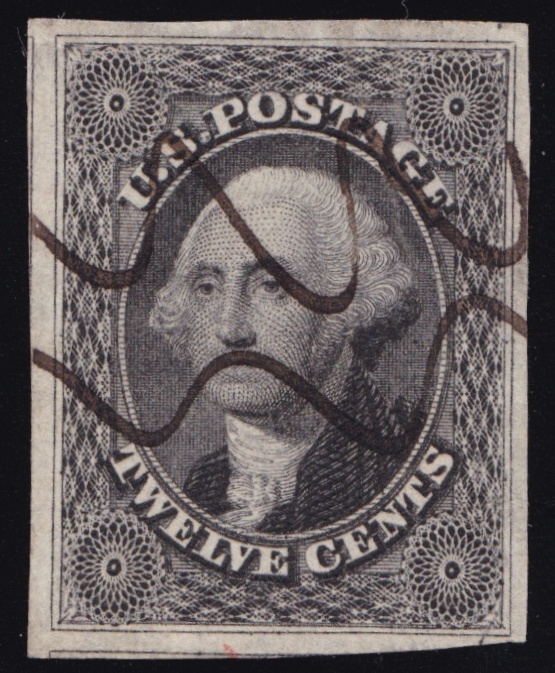 |
|
Send note to Staff
|
|
|
Pillar Of The Community
United States
2555 Posts |
|
|
Poor mans version? I think even with the pen cancel your stamp would sell for a pretty good price considering the large margins. Your stamp matches position 47R1 very closely which shows a scratch emanating from the guide dot. |
|
Send note to Staff
|
|
|
Rest in Peace
United States
763 Posts |
|
|
Yes, I would agree that is a plate scratch extending out from the guide dot. And wow(!) what terrific margins for this! |
|
Send note to Staff
|
|
|
Replies: 44 / Views: 5,958 |
|




 Posted 04/04/2015 10:49 am


