How far do you take this? Here's a pretty little set, wouldn't you agree? Does it do anything for you if I tell you these are not regular Banknote Issue stamps, these are all hard paper Special Printings of the Continental Bank Note Company?
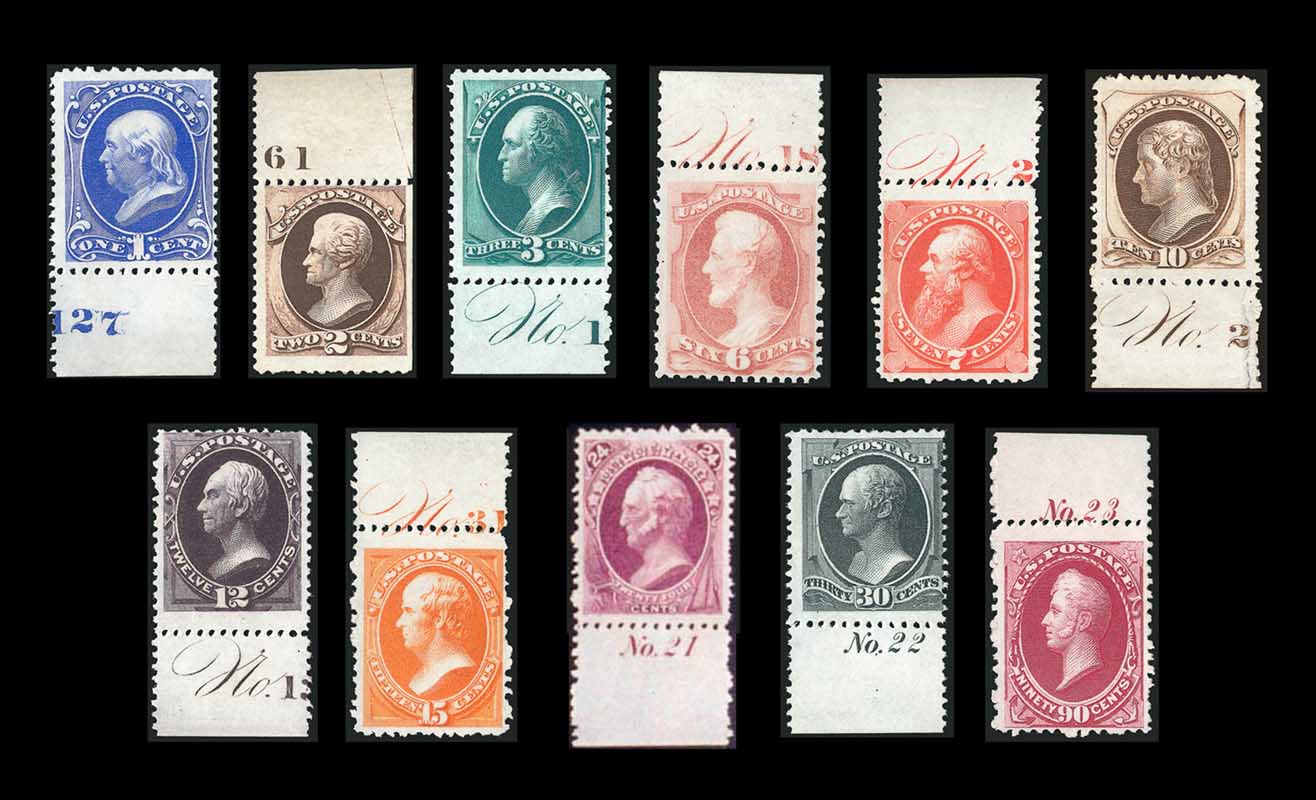
Significant items, I'm sure you would agree. So, how does it make you feel when I tell you that every one of these stamps came from the unique plate number and imprint strips of four that had been assembled by the Earl of Crawford late in the 19th century. They were intact when his collection was sold in 1913.
"Col." E.H.R. Green was a multimillionaire stamp collector in the 1930s who took delight in buying and breaking full sheets, large blocks, and strips of rare material. He is the last man to have owned the full pane of C3a, and when he bought it he instructed Eugene Klein to start breaking it up immediately. I don't think they even made a photograph of it intact.
I find myself divided in my feelings about whether or not such items should be broken, but I am not divided in my opposition to the opinion on private ownership expressed here. If all collectors were to adopt this attitude toward their relationship to the material they collect, then I would think it is time for the good of posterity to introduce legislation banning the collection of postage stamps.
This war is raging in the collection of antiquities right now, driven by archaeologists and universities, with the upshot that increasingly it is becoming illegal for US citizens to own them. There are many arguments given, but one of the key underlying assumptions is that private collectors do not know how to preserve, care for, and study antiquities as well as museums and archaeologists.
If rare old postage stamps do indeed preserve a portion of US history, as some of us like to think, then the question of "ownership" needs to be reconsidered or it can be lost. Those who speak about the "rights" of ownership seem to forget two things: 1. not all things are "owned" in the same way, and 2. the only "rights" you effectively have are the ones you can protect.
Those who do not have the ability to collect postage stamps with an eye to posterity, should not be allowed to own anything rare that might be considered part of our cultural heritage. How's that for a radical position?
BTW there are lots of good citizens in Arkansas and North Carolina who regard dogs as personal property they can keep or dispose of any way they see fit. More than a few of them find their way to "no kill" rescue shelters in cities like Chicago. From these shelters one must sign certain "owner agreements" before an animal will be placed, and it is formally recognized as an "adoption." That exists and is another challenge to the question of "ownership" on yet another front.
Stamps aren't dogs, but some of them are cultural icons. How do you like your Special Printings, with or without selvedge? If I buy them, what gives me the right to say the story ends HERE and rip off those tabs? Ownership? How so?





 Posted 04/27/2015 07:12 am


