| Author |
 Replies: 22 / Views: 15,823 Replies: 22 / Views: 15,823 |
|
Moderator
1589 Posts |
|
|
I've seen different cinderella versions of the 1995 Atomic Bomb stamp that was originally planned for the 1995 WWII minisheet. This is supposed to be an image of the stamp as originally planned: 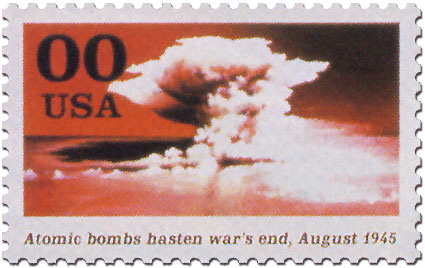 But I haven't been able to determine how this image was ever made public. The 1995 minisheet was announced in the August 3rd 1995 Postal Bulletin, but by then a substitution had been made and the image of the minisheet in the PB reflects the substitution. I'll keep looking, but if anyone could help me trace the origin of this image, I'd be very appreciative. Basil |
|
Send note to Staff
|
|
|
|
|
Pillar Of The Community
United States
6756 Posts |
|
|
As far as I know, the image first appeared publicly in November 1994. But I don't know in which postal bulletin or press release. The design was officially canned publicly on December 8, 1994. The cinderellas appeared in protest afterwards. |
Send note to Staff 
|
|
|
Moderator
1589 Posts |
|
|
It must have been a press release, as I've not found it looking through postal bulletins of that time frame.
It may have been covered by Linn's, but I don't think their online archives go back that far, but google-fu suggests it was covered in Linn's Yearbook for 1995 so I'm trying to run down a copy.
I've seen the cinderellas on covers, and have one on order where it is actually cancelled along with the stamp that replaced it. And covers with the cinderellas signed by Paul Tibbetts are available, but I'm not sure I want to spend the $$$ for one of those. I'm mostly interested in confirming that the image I posted in the original post is of the stamp that was proposed and then withdrawn, rather than the cinderellas. |
|
Send note to Staff
|
|
|
Bedrock Of The Community
United States
12128 Posts |
|
|
The "stamp" design you show in the original post was the intended original design of the stamp in the series. Here's an excerpt from a period document on the subject: 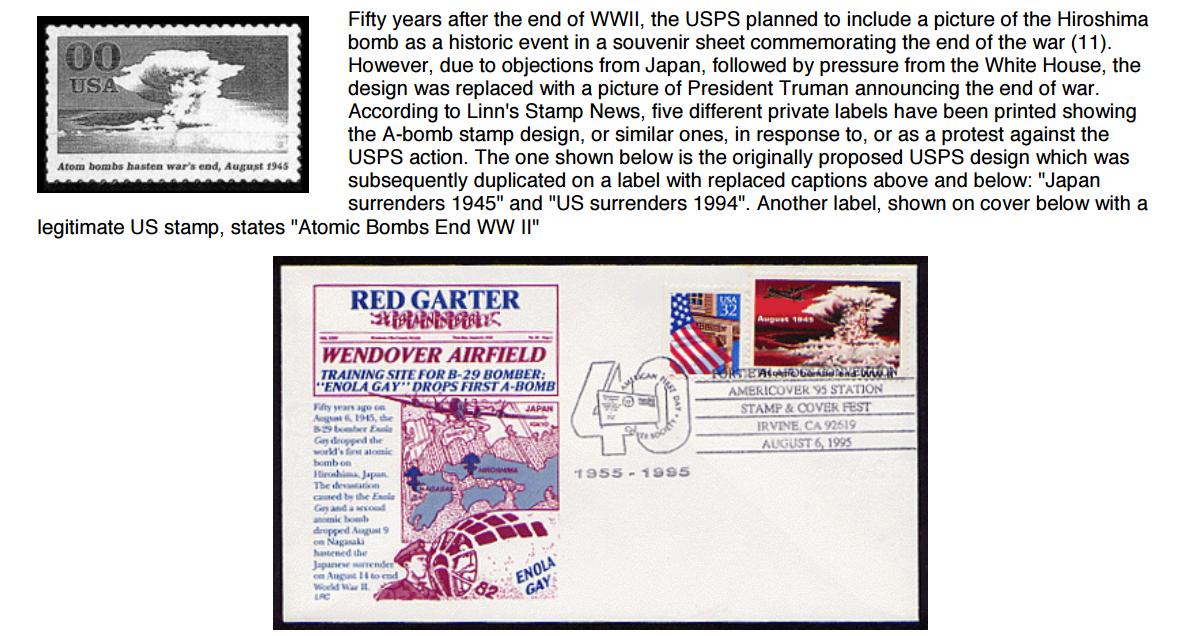 Based on what I could find, it seems President Clinton personally asked the PMG to withdraw the stamps in favor of a different design. This supposedly was printed in a USPS advisory dated December 7, 1994. Curiously, the controversy is documented in this newspaper op-ed article dated December 5, 1994, two days before the stamp was officially withdrawn: 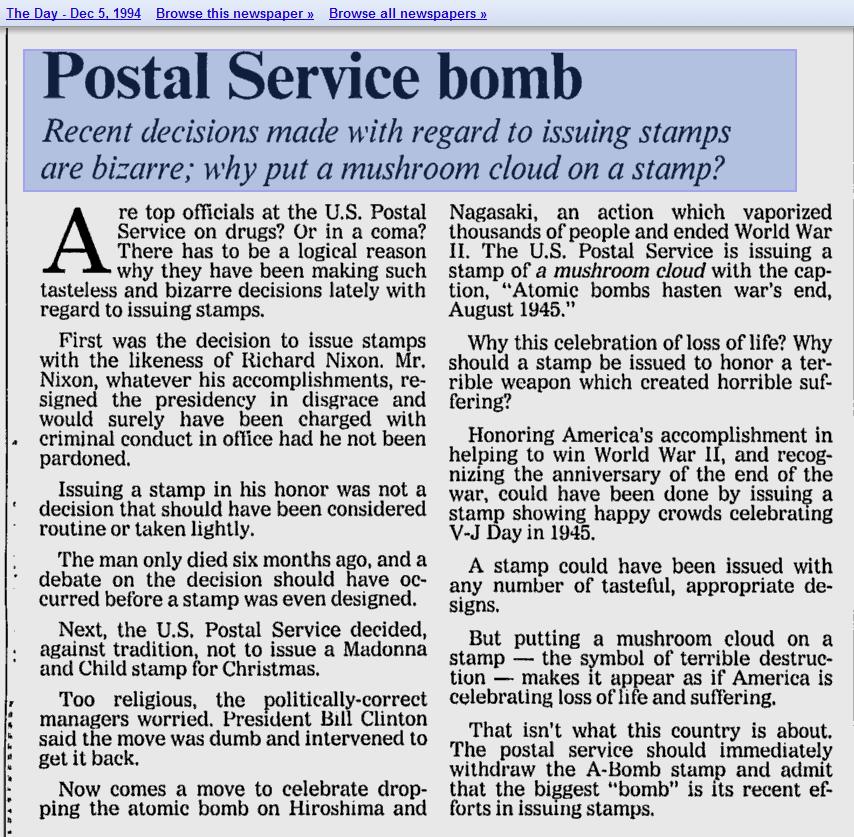 |
|
Send note to Staff
|
|
|
Moderator
1589 Posts |
|
|
wt1, Thanks for the additional information. I'm still in the dark as to how word, or an image, of the proposed stamp got out. I am researching the life of General 'Hap' Arnold for a possible exhibit. He was among those convinced that bombing would end the war with Japan without requiring an invasion. Neither he, nor FDR, nor probably any of the major wartime decision makers had qualms about targeting "civilians," though the matter was discussed at the time. In the case of Japan, much of its industrial capacity, considered legitimate bombing objectives, was dispersed among small shops spread throughout its cities, and thus effectively destroyed only with large scale bombing attacks. In terms of the effect on civilians, there was little difference, if any, between one bomb dropped by a single B-29, and cities destroyed by flights of several hundred B-29's at a time. Very few thought that the bombing would avoid an invasion of the Japanese islands. Arnold, though, was one of them. I think the caption on the proposed stamp, factual as it was, is less offensive than the caption on this cinderella:  The bomb did hasten the end of the war, though at the cost of many Japanese lives. Whether it was the appropriate subject for a stamp is a matter of opinion. |
|
Send note to Staff
|
|
|
Bedrock Of The Community
Australia
38679 Posts |
|
|
The USPS released photographs prior to issue, of the 10 stamps in the WW2 series.
Followed by protests from Japan.
Then followed the re-design.
6.2 With regard to the subjects of postage stamps:
- the 1984 Hamburg Congress adopted recommendation C 27 recommending
that "postal administrations, in choosing themes for their issues of
postage stamps, should:
- make every attempt to avoid topics or designs of an offensive nature
in respect of a person or a country;
- choose themes calculated to contribute to the dissemination of
culture, the strengthening of bonds of friendship among peoples and the
establishment and maintenance of peace in the world";
|
|
Send note to Staff
|
| Edited by rod222 - 05/17/2015 03:44 am |
|
|
Moderator
1589 Posts |
|
|
Quote:
The USPS released photographs prior to issue, of the 10 stamps in the WW2 series. Apparently so. But when and how? Do you know? I am trying to specifically verify that the image I posted is the original image. Every source for it so far is secondary. I'm looking for a primary source. |
|
Send note to Staff
|
|
|
Bedrock Of The Community
Australia
38679 Posts |
|
|
No I do not.
I am quoting from a source, from my database, that itself, fails to give the details of the photographic release. It seemed a minor issue in the report.
The stamp image you posted, is identical to the image in the report I have, and it was co-authored by
T.R Reid in Tokyo, Bill McAlister in Washington, and Les Winick in Chicago.
I am a fan of Les Winick's articles and would respect his report.
|
|
Send note to Staff
|
|
|
Bedrock Of The Community
United States
12128 Posts |
|
|
I don't know if this will help any, but the excerpt below gives some dates related to the stamp unveiling and subsequent change: 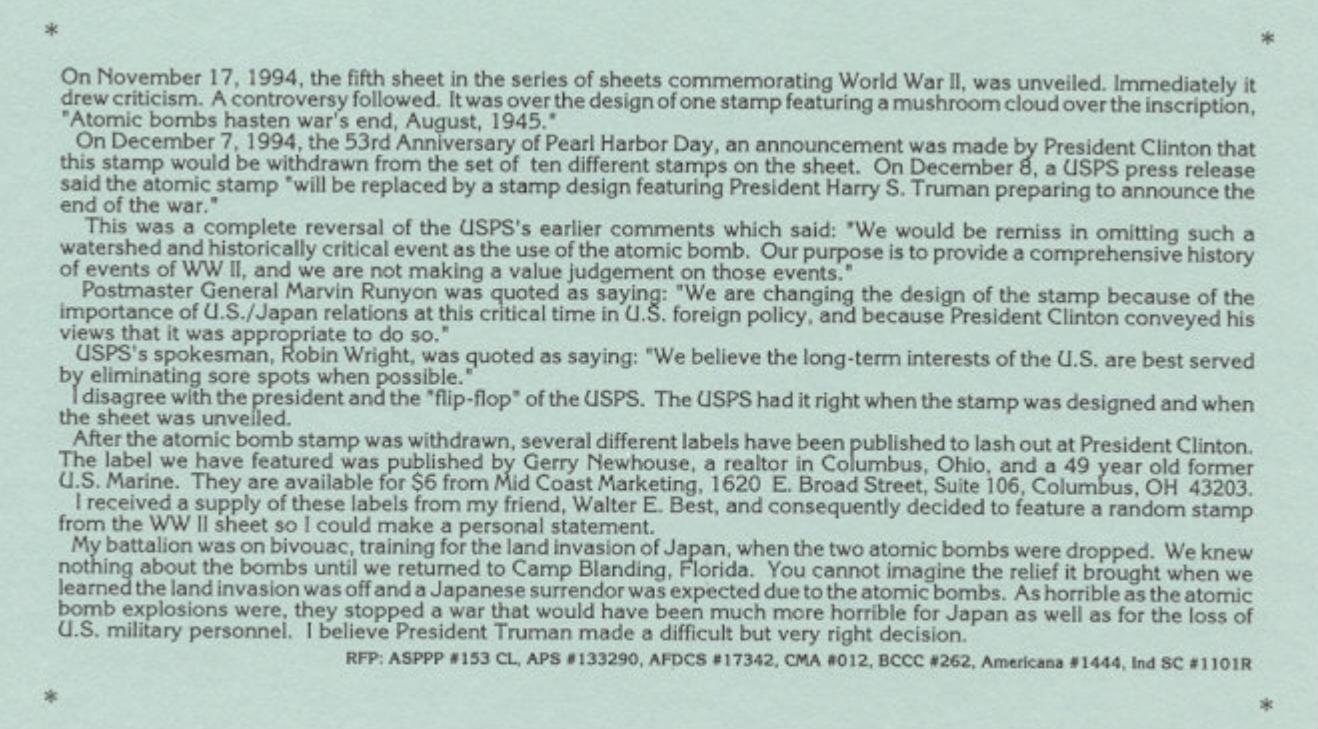 The entire page may be found on page 7 at the link below: http://www.asppp.org/HTMLobj-3437/Vol_21_No_4.pdfOne final note: I just went to the online database of Postal Bulletins and the one for November 24, 1994, No. 21881 (which presumably would have had the stamp announcement) has pages 20 and 21 deleted, suggesting that the stamp had been announced at that time but was deleted from the archived copy of the Postal Bulletin for that date. |
|
Send note to Staff
|
| Edited by wt1 - 05/17/2015 2:48 pm |
|
|
Moderator
1589 Posts |
|
|
wt1, Thanks. If nothing else turns up, that's pretty good confirmation, as it does verify the text on the stamp. The cinderellas typically have a different text (as well as a different image of the mushroom cloud). As usual, your skill and sniffing out online material comes through. It so happens I had checked that PB, and hadn't noted the deleted page. Actually, the source I use, here: http://www.uspostalbulletins.com/PD...df#search=""has a page 21, but it is blank. Interesting! Basil |
|
Send note to Staff
|
|
|
Pillar Of The Community
United States
1947 Posts |
|
|
While I do not condone putting the atomic bomb explosion on a stamp, it seems a little disingenuous to me to base the objection on the fact that a lot of people were killed. Every stamp issued which commemorates a battle or a war is in a way commemorating (or maybe remembering?} the deaths of people. It matters little if 1 or tens of thousands died. The number of deaths is irrelevant. |
|
Send note to Staff
|
| Edited by rohumpy - 05/18/2015 05:20 am |
|
|
Valued Member
United States
135 Posts |
|
|
The USPS published a poster showing the stamps to be issued in 1995; this was sometime in 1994. The 1995 WWII sheetlet was included on that poster showing the atomic bomb stamp. I don't know if it was illustrated in other releases. The August. 1995 issue of Scott's Stamp Monthly has an article on the stamp. There were several "protest labels" privately published/issued in reaction to the withdrawal of the stamp. I'll try to post images later.
|
|
Send note to Staff
|
|
|
Rest in Peace
United States
4052 Posts |
|
|
While I agree with rohumpy - especially on the choice of the word 'disingenuous' - there is a useful distinction to be made between combatants and non-combatants. I can't think of a war/battle stamp that commemorates the deaths of what were primarily non-combatants that is not admonitory, eg, of The Rape Of Nanking.
That having been said, the use of atomic bombs on Hiroshima & Nagasaki was not about the civilians; the primary goal was not to kill civilians, but to destroy the cities; the primary impact on the Japanese leadership turned-on a factor the Americans had never considered for a moment.
I think that the text "hastens war's end" was exactly correct.
I also think that the bomb saved Japanese & American lives. Thanks, Harry.
Cheers,
/s/ ikeyPikey |
|
Send note to Staff
|
|
|
Moderator
1589 Posts |
|
|
Quote:
While I agree with rohumpy - especially on the choice of the word 'disingenuous' - there is a useful distinction to be made between combatants and non-combatants. Non-combatants are legitimate targets in war if they support the war. This certainly applies to those working in industrial production or distribution critical to waging war. Such as non-combatant casualties from bombing factories, refineries, marshaling yards, etc. Perhaps more controversial, some would apply such thinking to any who indirectly support the war effort, whether through efforts to maintain or boost morale, or through indifference or neglect that allows militaristic leaders to control a country's government. In the case of Japan, much of the industrial production was in small shops scattered throughout the major cities. There was no way to target this industrial base short of destroying entire cities. In some instances, American air forces did drop leaflets warning civilians to flee. By Mid-1945, no one paying any attention in Japan, combatant or not, could escape knowing that Allied forces were intent on totally destroying Japan's capacity to wage war. There was no difference, in terms of the moral issues involved, in dropping a single bomb that could destroy a city, and subjecting it to the destructive capacity of hundreds of B-29's dropping HE and incendiary bombs. Some argue that the bombs dropped on Hiroshima and Nagasaki were not necessary because Japan had already determined that the war was lost. But would it have made any difference if, on those days, it had been just another flight of hundreds of B-29's dropping ordinary ordnance? For whatever reason, Japan had not yet surrendered when the atom bombs were dropped. Who can say how much longer it would have been before they formally acknowledged their surrender? The tenacity of the Japanese forces on islands conquered by US forces in refusing to surrender certainly led most to believe that Japan never would surrender without being conquered by an invasion of ground forces. Japan's capitulation after Hiroshima and Nagasaki took almost everyone by surprise, even those few who thought that air power alone would eventually force Japan to surrender. That the bombs hastened the end of the war is the only reasonable conclusion. As to whether it was politically insensitive to recall this on the 50th anniversary of the event, I could see some merit in this if the stamp were being issued as a single commemorative. But as one of 10, that was not the case, and the claim on the stamp was factual. |
|
Send note to Staff
|
|
|
Valued Member
United States
135 Posts |
|
|
Here is an information page I prepared showing the original design, the replacement design, and five of the protest labels. One of the other ironic things related to this story is that, in Japan's equivalent of "Celebrate the Century" series issued in the late 1990s, there was a stamp for Pearl Harbor. 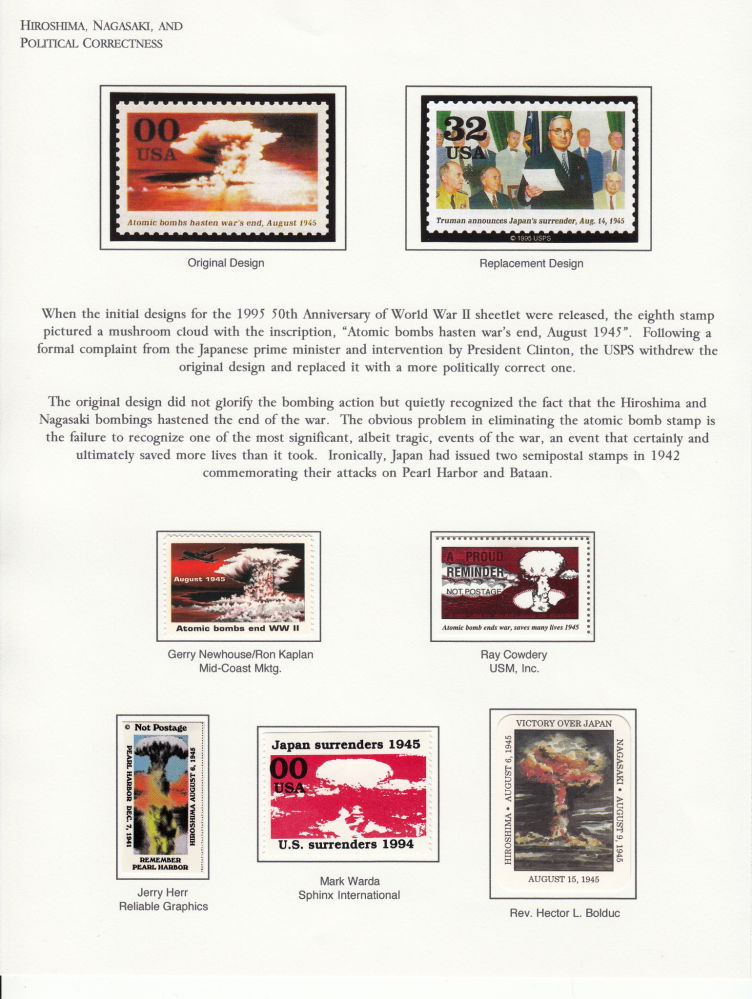 |
|
Send note to Staff
|
|
|
Pillar Of The Community
United Kingdom
8628 Posts |
|
|
Unlike some, I don't have an issue with the use of the bomb itself. My father was all set - armful of injections and all - for deployment to the Far East when the bombs ended the war, and he was extremely grateful. But I find the proposed stamp crass and tasteless (and that's even without considering the low production values of this series). Turn it around: an ISIS stamp of aeroplanes hitting the World Trade Centre with the text "Hastening the return of the Caliphate". Hmm. |
|
Send note to Staff
|
|
|
Replies: 22 / Views: 15,823 |
|




 Posted 05/16/2015 10:44 am


