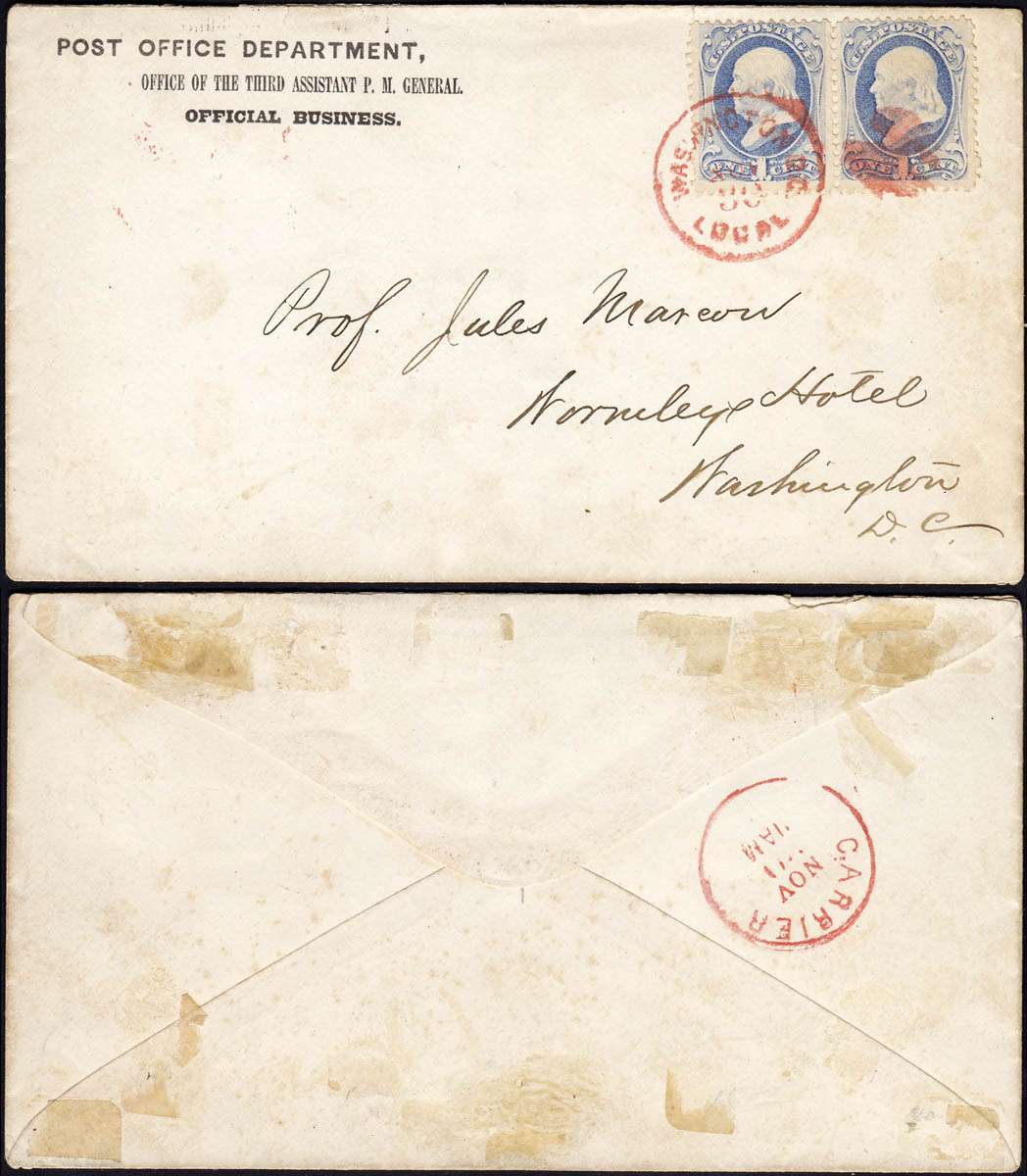
I think as many have answered as intend to, so now I will share with you what I learned from Alan Campbell. Here is the question precisely as I expressed it on the Frajola website:
"Is there anything about the style or color of the markings, the rate, or anything else that would allow us to say whether this usage preceded the usage of officials by the Post Office Department? "
Quote:
DC Local Cover
For this usage to have preceded the introduction of official stamps (July 1, 1873), it would have to be Nov. 30, (1872), which is too early for Continental stamps. My guess is that this cover was posted on Nov. 30, 1873. In 1874, the "LOCAL" at the bottom of the CDS disappears, but it was still there in 1873. Red canceling ink was standard for local mail at the main DC post office from 1873-1875. Also, for official mail from the free frank period, the corner card was typically in the upper right, so that the free frank would appear where one would normally expect a stamp. All the earliest official stamp usages from July, 1873 occur on obsolete free frank envelopes, where the corner card is in the upper right. Gradually, new envelopes were ordered, with the corner card moving to the upper left, so as not to be obscured by the new stamps. So, why wasn't a 2¢ Post Office used on this cover? The office of the 3rd Assistant Postmaster General dealt with philatelic matters - e.g. it handled orders for the special printings of 1875. In some rare instances, if a collector requested or ordered something, and sent in his own postage or cash, regular postage stamps would be used in lieu of official stamps to mail the response. Incidentally, Professor Jules Marcou, an early associate of Louis Agassiz, was a paleontologist at Harvard's Museum of Comparative Zoology. In 1853-84, he was the first geologist to cross the Rocky Mountains.
So, how did you do? Did you find his response to be convincing?
It is truly impressive to me that he was able to give so much detail about a cover with no year date. When I show it, I will now have something to say. That is helpful. Thanks again, Alan.





 Posted 09/23/2015 3:32 pm