| Author |
 Replies: 15 / Views: 2,619 Replies: 15 / Views: 2,619 |
|
|
Valued Member
24 Posts |
|
|
|
I was not spending a great deal of time on my collection during this time, so I don't have a lot of personal experience to go on. But I see a significant pricing hump when I compare what I see in a couple of old Harris catalogs I have (one from 1985-86, and one from 1974) to an average of any given higher-priced Scott catalog number on StampWants today.
Was there a run-up in U.S. prices during this decade that busted at some point, and if so, approximately when did it occur? What caused it to happen? Was there a fallout from collecting as a result?
|
|
Send note to Staff
|
|
|
|
|
Pillar Of The Community
United States
2972 Posts |
|
|
I have no direct knowledge of what happened as I started collecting in 1984 with my allowance budget. Yes there was a bubble and people started investing in stamp collections driving auction prices up. Also, I think that was when MNH and grading certificates really became popular. I am sure there are better suited members to answer your question and I will now step aside. |
Send note to Staff 
|
|
|
Moderator

United States
4788 Posts |
|
|
I'm curious too. I've seen references to the "bubble" in Linn's and other publications. I'd like to hear about the economics behind it.  Kirks |
|
Send note to Staff
|
|
|
Valued Member
24 Posts |
|
|
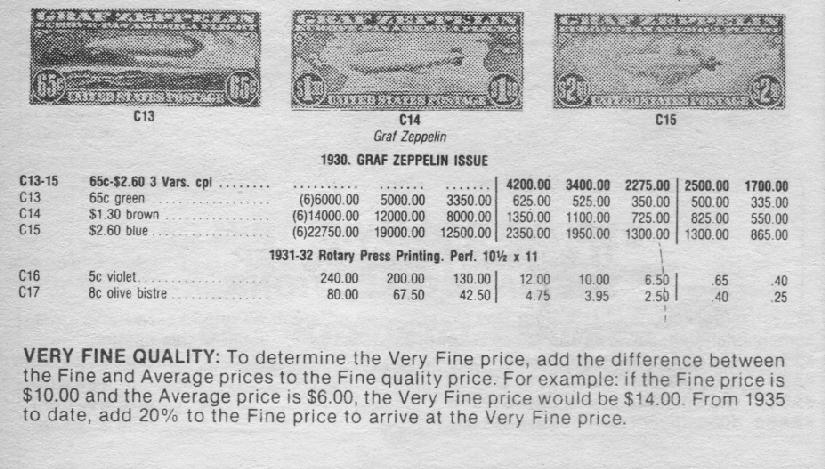
Here's just one (albeit extreme) example: Image:  Harris8586.jpg Harris8586.jpg87.9 KB The prices for fine and not hinged are in the fifth column from the right ($4,200.00 for the set). If you follow Harris's rules for the pricing for very fine, you end up with $900.00 for C13. That's just going to be a reasonably centered, not hinged stamp. Compare this to the prices for a graded C13 at one would think to be the approximate same condition: http://www.stampwants.com/C13-Mint-...ctiondetailsThere doesn't appear to be as much of a difference for more common, lower priced stamps, just the higher priced "A" list stuff. It would just be interesting to know when the bottom fell out, and why... |
|
Send note to Staff
|
| Edited by stahlhart - 04/16/2009 8:14 pm |
|
|
Pillar Of The Community
United States
6756 Posts |
|
|
There was a speculative bubble for US stamps that began in the late 1970s and popped in the early 1980s. Even some common stamps were affected (like the 2c Cape Hatteras setenant block of 4).
Like all bubbles, it was bound to pop. It had a good run of about 4 years. The recession of the 1980s made sure that the market didn't rebound for the rest of the decade and then some. Many US collectors at that time were like me, and stopped collecting for 5 years or more (but I didn't stop because the bubble burst; for me it was just a coincidence).
I'll see if I can find a chart of US stamp price trends so you can "see" the bubble. |
|
Send note to Staff
|
| Edited by khj - 04/16/2009 9:56 pm |
|
|
Pillar Of The Community
United States
6756 Posts |
|
|
OK, below is Linn's tracking of the US stamp market. You can see the bubble beginning around 1978 and then popping at the end of 1982. 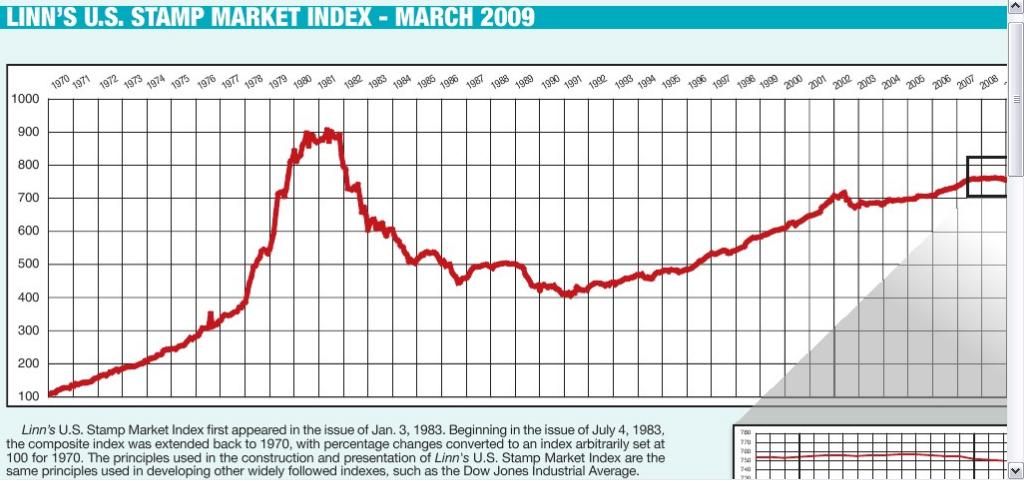 |
|
Send note to Staff
|
|
|
Pillar Of The Community
United States
6756 Posts |
|
|
The default picture size on this board makes the chart rather small. However, if you click on the chart, the chart should be larger and more readable. |
|
Send note to Staff
|
|
|
Pillar Of The Community
United States
6756 Posts |
|
|
Quote:
I think that was when MNH and grading certificates really became popular Yes, the MNH craze was running full speed at that time. Numerical grading of stamps did not begin until 2001. That's another bubble that is waiting to burst. I give it another year or two. I'm not a big fan of numerical grading of stamps. I support expertizing of stamps, but have no care for numerical grading. You are basically paying 10x or more for the number, not the stamp. The stamp hasn't changed any. I can understand paying a premium for an expertized stamp for issues in which there are known forgeries or alterations (i.e., regumming, reperforation...). Numerical grading is nothing more than a commercial racket, that's why the bubble will burst eventually. That's just my opinion. I know some collectors (not investors) who really enjoy collecting numerically graded stamps. To each, his/her own, as long as you enjoy the stamps! That's also just my opinion.  k |
|
Send note to Staff
|
|
|
Pillar Of The Community
USA
2877 Posts |
|
|
Inflation was rampant in the late 1970s and early eighties. Investors were looking for hard assets as a hedge against inflation. Gold and silver peaked at this time too. I was told that you could put stamps into a retirement account at the time, but I don't know if this was true. Many expensive stamps were bid up by investors pooling their resources, and the rest of the market was pulled up along with the high ticket items. Then supposedly the law was changed and stamps could no longer be included in retirement accounts. The bubble burst and there was a mass exodus of investors out of the market. |
|
Send note to Staff
|
|
|
Valued Member
24 Posts |
|
|
Thanks everyone for the reponses and historical data. I had not taken into account the inflation at the time, for one thing.
I'm also inclined to agree with you that this "grading" business is going to end up the same way -- every greater fool scenario does eventually. There appears to be quite a disconnect between non-graded and graded now. I like a decently centered stamp just as much as the next guy, but I'm not touching any of that.
Quite a few brick-and-mortar stamp and coin shops went under after that bubble, too, didn't they? I only know of two within driving distance now, and I live in a major metropolitan area.
Thanks again...
|
|
Send note to Staff
|
|
|
Moderator
United States
4788 Posts |
|
|
Valued Member
24 Posts |
|
|
Still kind of strange, though, that the Harris catalog cited is from 1985, a few years after this bubble burst. Guess it took a few years for everyone to get the message.
|
|
Send note to Staff
|
|
|
Pillar Of The Community
USA
2877 Posts |
|
|
Harris catalog values were always much higher than Scott. Harris sold stamps at a premium over Scott.
In the seventies you could buy a Harris catalog and Harris stamp packets at places like Woolworths or Thrifty Drug stores.
This is how many stamp collectors got their start.
So beginners often ordered stamps at inflated prices from Harris until they discovered the Scott catalogs (usually at the public library).
And when they finally bought a copy of Stamps Magazine or Linn's Stamp News, they discovered that small time dealers sold stamps at a discount to Scott. |
|
Send note to Staff
|
|
|
Valued Member
24 Posts |
|
|
Interesting. I never noticed that as a kid -- probably because I was a beginner on a limited budget and mainly bottom-feeding on common 20th Century commemoratives. The stamp dealers I went to might have been discounting the pricier stuff, but they seemed to more or less follow the catalog price for just about everything in my range. I remember the drug store Harris departments, the mixture packets and the evenings of soaking stamps off of paper that followed. Good times.  |
|
Send note to Staff
|
|
|
Pillar Of The Community
USA
3315 Posts |
|
|
Like the rest of you, I don't think the PSE grading "craze" of common stamps will last. Paying a 500-1000% premium for a common stamp just doesn't make sense. I do think the top 1% or so of desirable, relatively scarce material will continue to be a good investment over time though. |
|
Send note to Staff
|
|
|
Pillar Of The Community
United States
6756 Posts |
|
|
Excerpt from t360 Quote:
Harris catalog values were always much higher than Scott. Harris sold stamps at a premium over Scott.
...
So beginners often ordered stamps at inflated prices from Harris until they discovered the Scott catalogs (usually at the public library).
And when they finally bought a copy of Stamps Magazine or Linn's Stamp News, they discovered that small time dealers sold stamps at a discount to Scott. HEHarris is no longer around as an independent company. But today, you could replace "Harris" in the above partial quotation with "Mystic". Granted, however, that I've met many collectors who got their start because of Mystic. Also, Mystic has done more than their fare share to promote and support the hobby. On the British side, the same applies to Stanley Gibbons. Unlike Scott -- Harris, SG, and Mystic all sold/sell stamps. So their catalog is essentially like their pricelist. So you will basically see a conflict of interest reflected in their catalog prices. Other than Stanley Gibbons themselves, how many dealers can you name that consistently sells a wide range of stamps at 100% of Stanley Gibbons prices? |
|
Send note to Staff
|
|
| |
Replies: 15 / Views: 2,619 |
|



 Posted 04/16/2009 4:45 pm


 Harris8586.jpg


