Quote:
...they put me through an interrogation,what I was sending,how much it was worth ect. ect. ect.Then I filled out this form had to sign it...
Customs documents. You likely had a bulky or heavier than typical envelope, which shows that you're not sending just correspondence. Therefore, it must have been some kind of an item, they figured, and you must declare it to the Customs department of the country you're sending it to in case either the item is prohibited from that country, or there is payable duty on it. Duty is basically a tax charged to import something into a country, and if there is duty charged, it will be charged to the person receiving the item. Most countries allow the duty-free passage of unsolicited items, so long as "Gift" is marked on the customs form which "declares" what the item is, and the value is lower than $50 or the foreign equivalent.
The good news is that in most cases, stamps are allowed into most countries duty-free, because stamp collecting is seen as an "educational" pursuit.
Postage on a regular (letter-sized or manila) envelope is always charged by weight, so long as the envelope is not thick enough to qualify as a parcel. Check with the Post Office to see what their guidelines are.
If you are using a manila envelope, before you even mail it, mark in capital letters about an inch to an inch and a half above the address it's going to, the words "PHILATELIC MAIL, PLEASE HAND CANCEL".
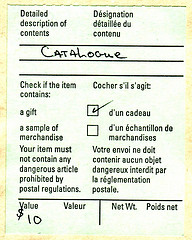
How heavy the item is will determine whether you will be filling out the small customs form or the large one. For example, here in Canada, if the item weighs less than 1 kilogram (2.2 lbs.) the small (C-1) Customs form is used (check to see what the USPS weight is to be able to use this). On that form, I usually mark in "Stamps For Collector", and underneath that, "Gift". In the lower right corner will be a small section for weight, and the clerk will fill that in after they weigh it. In the lower left is a small section for "Value", and in this, I usually just put in "$10.00".
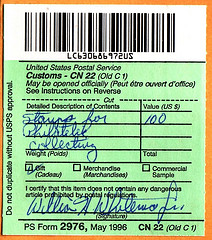
Here are some examples of the Small C-1 Form.
First, an American one:
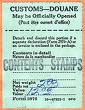
The newer type, with a barcode:
A Canadian one:
It's probably a good idea to weigh the item unsealed to make sure it's not too heavy to use this short form. If you have too much in the envelope, it's a simple matter to take something out, because this is the form you want to fill out instead of this sucker for heavier packages, which, as you can see, is a lot more involved:
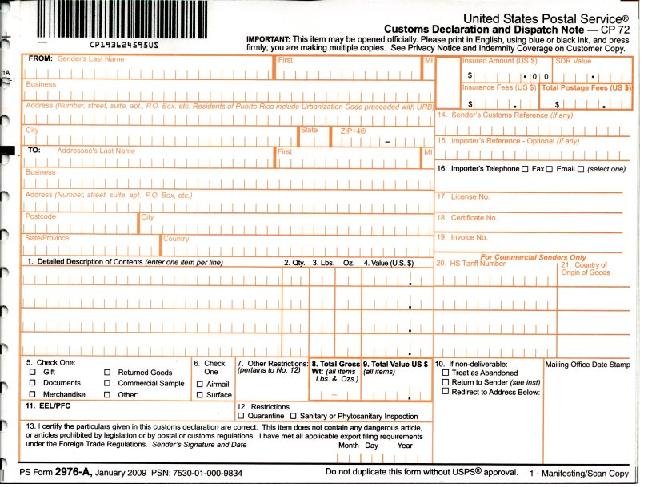
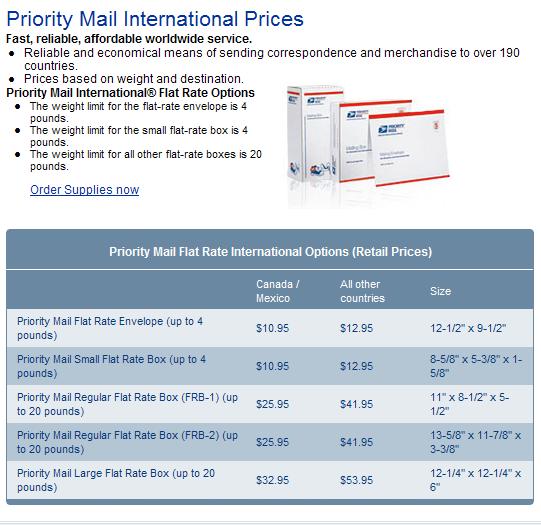
You can usually pick up Customs forms at the Post Office and take them home to fill them out at your leisure, and this will ensure less time spent in front of the counter clerk. You can also pick up a rate sheet, or maybe one is available at the USPS website online, which comes in handy for guesstimating the probable postage rate you will have to pay. It will also answer your questions regarding sizes an item has to be before it is considered a parcel, which would go at a higher rate than a letter. I can't say how things work at the USPS exactly at the moment, but here, if an envelope is thicker than an inch, it is automatically considered a parcel.
Hopefully, that answers most of your questions.





 Posted 06/10/2009 11:25 pm