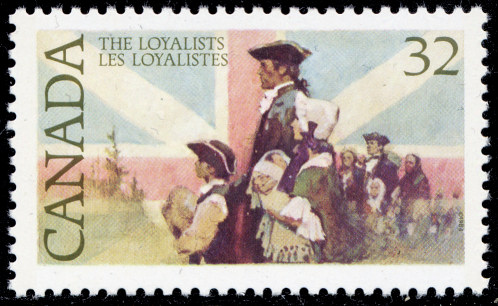
Seek a good quality high res scan of this stamp please,
for my virtual album.
MUCH has been written in tribute to the heroism of those Americans who fought on the
side of the British during the American War of Independence (1775-83). Loyal to their
King and Empire, they could not stand by and see their country divided. Even though they
be called traitors and their lands and goods confiscated, and their very lives endangered,
they remained, faithful to their Sovereign.
At the close of the War, thousands and thousands of these loyal subjects were forced to
seek assistance at New York, the headquarters of the British forces under Sir Guy
Carleton. There they were cared for until arrangements could be made to have them
transported to British territory.
Canada, particularly Upper Canada (now Ontario) and the Province of Nova Scotia (then
including what is now the Province of New Brunswick), was selected as a fitting place for
these exiles to seek a happier home. On April 16th, 1783, the first fleet o( twenty
transports, many small and uncomfortable, sailed from New York for Nova Scotia under
command of Admiral Robert Digby.
Others spent two or three months on the journey, tramping through hundreds of miles of
wilderness where no white man had set foot before, bringing with them what little they
could in the line of cattle and household goods. Men and women, once rich, were now
penniless and half-starved, many of them too old to start anew, Every week saw more and
more of these loyalists pouring into small towns already crowded with refugees. Every
building in these small towns was used as a shelter, and many had to live in tents until
houses could be built. Many of these men and women could not stand the hard life they
were forced to endure on the trek to Canada and so paid for their loyalty with their lives.
The British Government, in order to compensate these loyal subjects for a part of their
losses, gave them thousands of acres of land and about fifteen million dollars in money.
These United Empire Loyalists are responsible for the building of many Canadian cities
and towns, cities and towns which will for ever remain as monuments to the courage and
strength of these men and women who faced great hardships rather than betray their
birthrights as subjects of the British Empire.
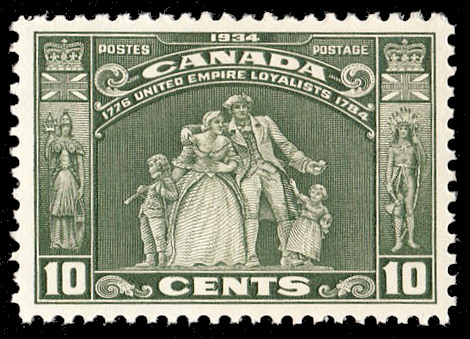
On Dominion Day, July I st, 1934, the Post Office Department of the Dominion
Government issued a 10 cent, olive-green stamp to commemorate the sesquicentennial of
the settlement in Canada of the United Empire Loyalists. The stamp depicts the famous
statue to the United Empire Loyalists in Princess Square, Hamilton, Ontario. This stamp
was awarded fourth place among the postage stamp designs of 1934 by a world consensus
of philatelists.
NORMAN J. GERAGHTY May 1939





 Posted 06/12/2010 02:10 am