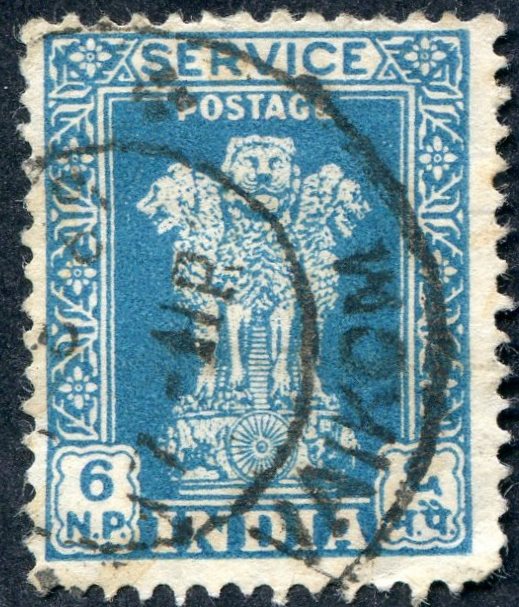
India : Official 6 Naye Paise.
Part CDS "VAIKOM"
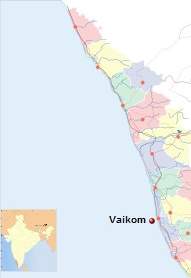
Vaikom is a small temple town in Central Travancore
Vaikom is situated in the North-West of Kottayam in Kerala, India. It lies between Ernakulam and Kottayam.
Vaikom is the oldest township in Kottayam, and among the oldest in South India.
Vaikom is populated by people from all communities, including Ambalavasis, Arayans, Christians, Dheevaras,
Ezhavas, Iyers, Muslims, Nairs, Namboodiris, Goud Saraswat Brahmins and Varmas.
Vaikom is administered by a Municipality and is the seat of a Munsiff's court (among the oldest to be established in
the Kingdom of Travancore).
The traditional economy has been based on coconut and rice crops, and fishing; more recently, crops like nutmeg,
black pepper, and latex have also been introduced.
The Vaikom Mahadeva Temple, known as Thekkan Kashi [Southern Kashi], is the heart of the town, and is
remarkable for the Vaikom Ashtami celebrations during November. It is notable as the venue of the Vaikom
Agitation for achieving for the lower castes the right to walk on the roads surrounding the temple.
Vaikom Satyagraha (1924 - 25) was a movement against oppression in society. The Satyagraha aimed at
securing freedom of movement for all sections of society through the public roads leading to the Sri Mahadevar
Temple at Vaikom
The
Vaikom Satyagraha was the first systematically organized agitation in Kerala against orthodoxy to secure the
rights of the depressed classes. For the first time in history, the agitation brought forward the question of civil rights
of the low caste people into the forefront of Indian politics. The town is famous for its Shiva temple, which in the
early twentieth century was the citadel of orthodoxy and casteism. As was the custom prevalent in those days, the
Avarnas were not allowed to enter the temples. But at Vaikom, they were not permitted even to use the public roads
around the temple. Notice boards were put up at different spots prohibiting the entry of Avarnas reminding them of
their social inferiority. All the more unbearable to them were the fact that a Christian or a Muslim was freely
allowed on these roads. An Avarna had to walk through a circuitous route, two to three miles longer to avoid the
road beside the temple. It seems that when Ayyankali, a Dalit leader and member of Pulaya caste, had to travel
through this road, he was asked to get down from his bullock cart, and walk through the circuitous route and his
bullock cart without him was allowed to pass through the road.
Satyagraha is a philosophy and practice of nonviolent resistance developed by "Mahatma" Gandhi. Gandhi deployed satyagraha
in the Indian independence movement and also during his earlier struggles in South Africa. Satyagraha theory
influenced
Nelson Mandela's struggle in South Africa under apartheid,
Martin Luther King, Jr.'s campaigns during
the civil rights movement in the United States, and many other social justice and similar movements.
(all edited text from Wiki)





 Posted 08/01/2010 07:01 am


