Stamp Community Family of Web Sites
Thousands of stamps, consistently graded, competitively priced and hundreds of in-depth blog posts to read


Stamp Community Forum
 
Username:
Password:
Save Password
Forgot your Password?

This page may contain links that result in small commissions to keep this free site up and running.

Welcome Guest! Registering and/or logging in will remove the anchor (bottom) ads. It's Free!

How Did Engravers At Babn In 1980 Make Changes To An Engraved Cylinder?

 
To participate in the forum you must log in or register.
Author Replies: 6 / Views: 82Next Topic  
Valued Member

Canada
117 Posts
Posted Yesterday   7:29 pm  Show Profile Bookmark this topic Add bk80 to your friends list Get a Link to this Message
Working on a project and in need of expert help. In 1979 to 1981 small vending booklets were printed by BABN in Canada. There seems to be a series of changes made to the engraving cylinder. There were 72 booklet panes on the cylinder and the cutting guide on the tab (selvedge/selvage) was originally made of horizontal lines then changed to diagonal lines then changed again to horizontal lines. The rest of the cylinder was untouched. The flaws on the rest of that cylinder did not change so it was not a wholesale change. Any thoughts from those in the know?
Send note to Staff

Pillar Of The Community
United States
1855 Posts
Posted Yesterday   8:44 pm  Show Profile Bookmark this reply Add cjpalermo1964 to your friends list  Get a Link to this Reply
Because the micro-flaws on the remaining 72-subject panes remained identical, the cylinder was not completely remade or re-entered and you are looking at localized modifications made to the cutting guide indicators on the cylinder.The likely chronological explanations for this sequence of changes are these.

1. The original horizontal lines on the tab (selvedge) were etched or engraved onto the cylinder to serve as an alignment target for the automated mechanical guillotine or slitting wheels. In booklet production, these sheets are slit and sliced into strips before being bound and cut into individual booklets. Horizontal lines provided a reference point for the operators to verify that the vertical or horizontal spacing was advancing correctly through the finishing equipment.

2. The change to diagonal lines was almost certainly a remediation step to fix a doctor blade or paper-shredding issue. In web-fed cylinder printing, a long steel doctor blade scrapes excess ink off the surface of the cylinder, leaving ink only inside the recessed cells. Deep, perfectly horizontal lines run parallel to the edge of the doctor blade. As the blade passes over a sharp, continuous horizontal groove, it can drop into the groove ("blade dip"), causing ink to smear, causing uneven blade wear, or creating a continuous stress point that could nick the blade.The structural solution: Re-engraving or burnishing out the horizontal lines and replacing them with diagonal lines (or a hatched pattern) allows the doctor blade to glide smoothly over the groove at an angle. This maintains structural support for the blade and ensures clean wiping. It also prevents the high-speed paper web from catching on a hard horizontal line during processing.

3. The change back to horizontal lines indicates that while the diagonal lines may have solved a printing or tool-wear issue, they likely broke the finishing and cutting department's workflow. By 1979–1981, printing bureaus were increasingly relying on electric eyes and optical sensors to trigger automated cuts on high-speed booklet-finishing machinery. Diagonal lines alter the contrast profile and exact positioning needed for automated photoelectric sensors or manual cutting alignment. If a machine looks for a sharp contrast transition at a precise micro-second intervals, a diagonal line introduces a variable trigger point if the paper web shifts even slightly left or right.

To fix this without discarding an expensive cylinder, BABN engravers utilized localized re-entry or burnishing and tooling. They would burnish (smooth down) the diagonal lines on the tab area of the 72-subject layout and physically re-engrave or etch the horizontal lines back into the cylinder. Because this was done precisely on the outer selvage edges of the layout, the stamp designs and their existing micro-flaws on the rest of the cylinder were left untouched.
Send note to Staff  Go to Top of Page
Edited by cjpalermo1964 - Yesterday 8:45 pm
Valued Member
United States
46 Posts
Posted Yesterday   8:45 pm  Show Profile Bookmark this reply Add Junius_Morgan to your friends list  Get a Link to this Reply
An example of what you are talking about would help.

Assuming it really is an engraved stamp, the transfer cylinder would not be normally reworked, but the master die. The master die would not have cut marks or alignment marks, but those would be placed there during the making of the printing plate.

Typically, one stamp of a single color and integral design (meaning the whole design is engraved at once, rather than a frame, vignette, value markers, etc.) is a master die.

The transfer roller is made with a single image

The transfer roller is then used to place that single image on the printing plate, multiple times, in proper place to make up a plate.

Any additional marks can then be added to the plate (Like plate number, alignment marks)

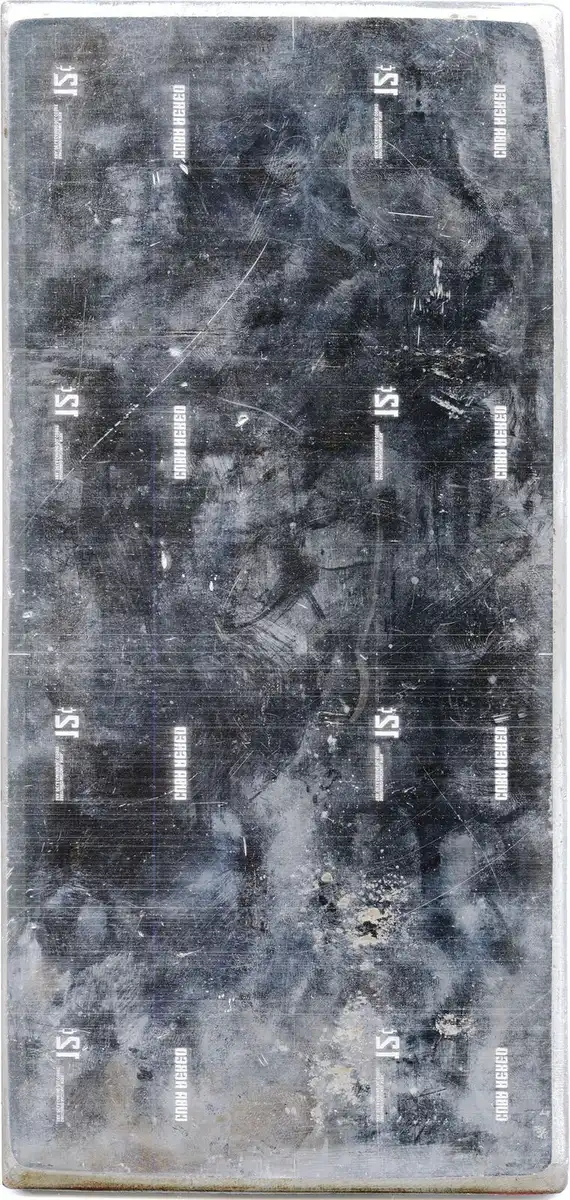
Here is a printing plate for a Cuban Airmail stamps, the color red element.

The master die would be a single engraving, transferred to the transfer cylinder, then rolled out 8 times to make a single plate.

You can repeat the process many times to create as many plates as you want. Any changes, either rework the plate, or, the master die.
Send note to Staff  Go to Top of Page
Valued Member
Canada
117 Posts
Posted Yesterday   11:16 pm  Show Profile Bookmark this reply Add bk80 to your friends list  Get a Link to this Reply
Wow, this is much more than I expected. Thank you both for the great information. I think I have to show the booklet pane in order to make this clearer.

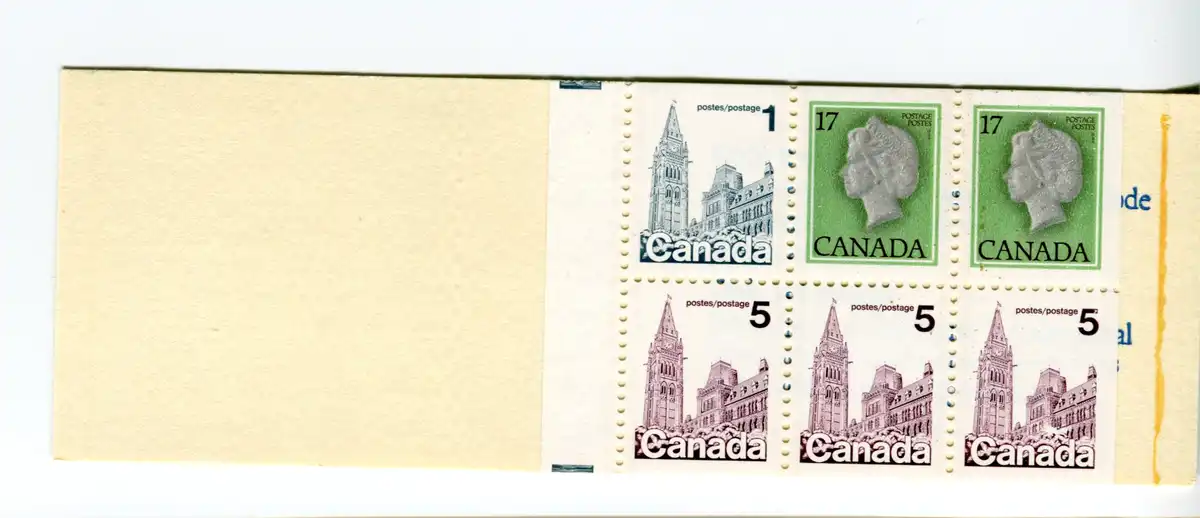
Here is one pane with the tab on the left. The cutting guides are top and bottom and yes this was the original design with horizontal lines. The new design has crossing diagonal lines then later it was changed again back to horizontal lines.
Exactly as CJPALERMO64 described.
But here is the problem. There were 72 panes laid out on this cylinder. Four columns of 18. So 72 cutting guides 2mm by 5mm. Was it possible to change all these without changing the cylinder. As I said previously, this is the engraved portion of the cylinder. On one tab half way between the two portions of the cutting guide there is a 2mm slash that appeared with the 1st change from horizontal to diagonal. It disappeared for the last change back to horizontal.
Then there are the series of dots in the shape of a G also between the two tabs on another pane that appeared with the first change and stayed till the end.
Your comment are truly appreciated. Thank you so much.
Send note to Staff  Go to Top of Page
Valued Member
United States
46 Posts
Posted Yesterday   11:37 pm  Show Profile Bookmark this reply Add Junius_Morgan to your friends list  Get a Link to this Reply
Thanks for the picture

Probably the first thing is that this is multiple colors. So multiple plates. Hard to tell if the colors overlap on the alignment lines.
Assuming they do, each plate (or it sounds like this is a cylinder) has the lines. They all drop on the same spot, showing each element is aligned, as well as providing the input for the cutting or booklet making machinery. So four plates to make each sheet.

On plates, what they can do is rub out the existing element, then pound the back of the plate to raise the metal to to correct height, and engrave (or more likely etch), the new element.

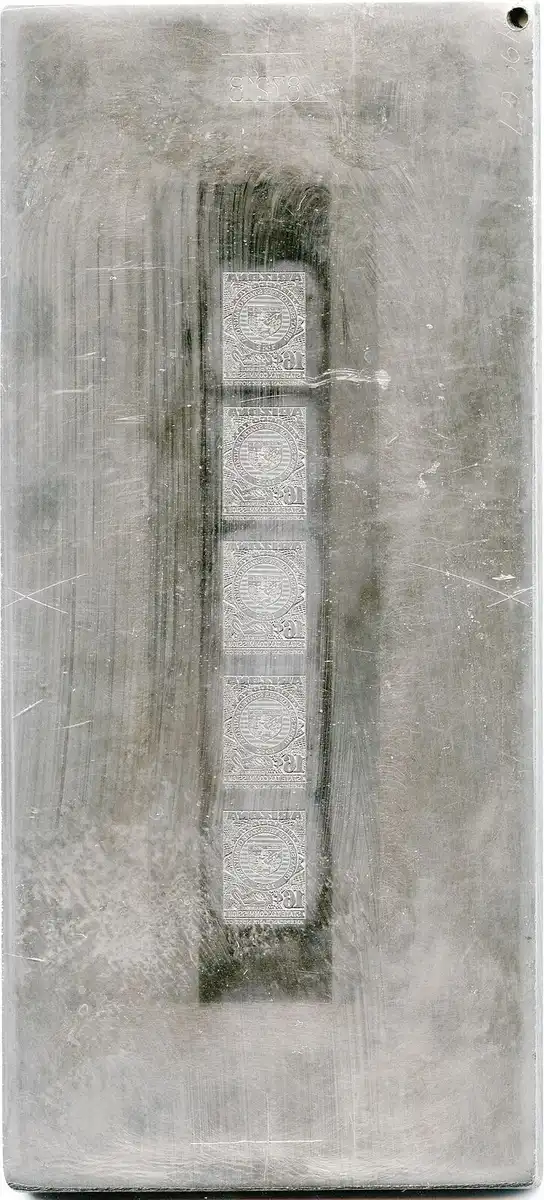
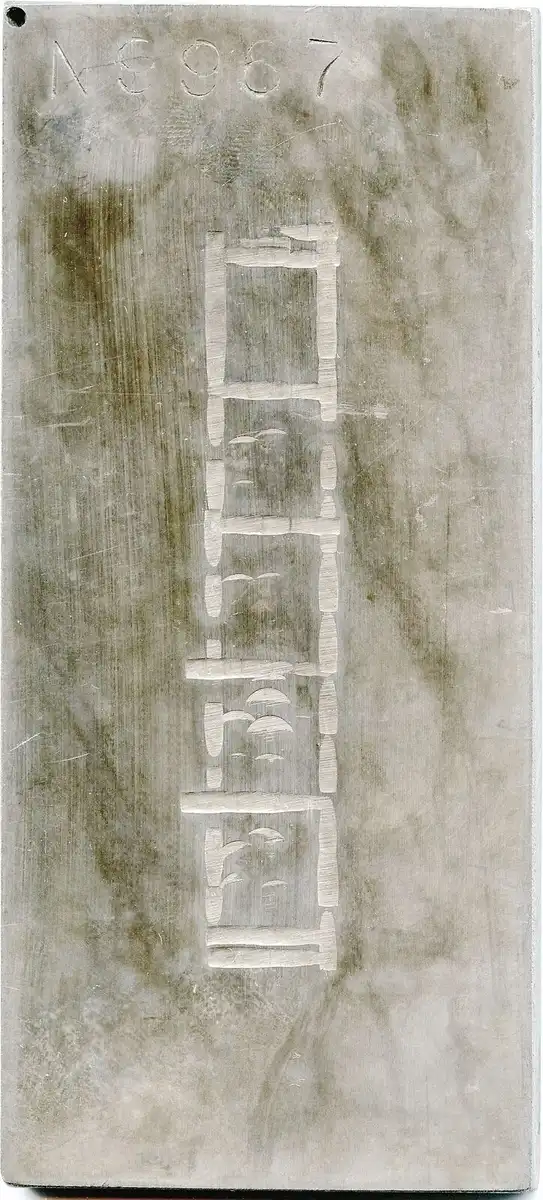
Here is a plate where you can see the the back pounded to raise the front to receive new impression.


On a different note. It really is odd to have two 17c stamps, a 1c and three 5's.

It is also possible they make new plates. The master dies do not change, so any unique elements remain, but a new plate can be created.
Do any of these have a visible plate block (number) Each color would have a unique plate number

Assuming also there were millions printed, there should be multiple plates. A plate can contain its own irregularities as well.
Send note to Staff  Go to Top of Page
Edited by Junius_Morgan - Yesterday 11:42 pm
Valued Member
Canada
117 Posts
Posted Yesterday   11:41 pm  Show Profile Bookmark this reply Add bk80 to your friends list  Get a Link to this Reply
I also understand what JUNIUS_MORGAN is explaining. Yes this is an engraved cylinder on a Goebel BRNST-500 that also had four stations for the Gravure. When looking at the pane above you will see that the one cent stamp, the three 5 cent stamps are fully engraved and of a different color. The engraved portion on the 17 cent stamps is all the lettering. The cutting guides mostly used with an electric eye were used for cutting the open booklets once they were attached to the card stock in the Booklet Machine. The folding then happens and it spits out these booklets in series of ten different covers.

The booklet machine was separate from the printing that was done on the web and the thing with this particular printing is that it was in rolls of 56,000 booklets (4 columns of 14,000) The stamps were printed and stored for a time until they could be put into booklets one column at a time. Quite an interesting situation that had the first and last printing sent to post offices first on older covers. Then the booklet machine printer got a cleaning and the newer looking covers received the stamps that had been put against the wall (First in last out)

I would like to know how much work it would have been to change 72 (2mm by 5mm) of those guide marks twice during their experimentation. I think it was experimentation because most of the future booklets that were printed for the new postage changes had diagonal guides but not all. Quite confusing when records are not available and one has to work with lots of booklets and a bunch of repeating flaws.
Send note to Staff  Go to Top of Page
Valued Member
Canada
117 Posts
Posted Yesterday   11:53 pm  Show Profile Bookmark this reply Add bk80 to your friends list  Get a Link to this Reply
OMG JUNIUS_MORGAN answered while I was writing.
This is a cylinder and different from the fascinating example you are showing. If I was dealing with plates I would be salivating. But this is a cylinder that printed so much faster than plates especially for booklets.
The Goebel at BABN first put down grey Queen's head and background on the first gravure cylinder. The second cylinder (gravure) put the green down, the third gravure put the invisible tagging where the perforations will eventually fall and the engraved cylinder put the rest down in one swoop. It all comes out the other end printed and perforated. Multicolor. But not in booklets yet.

You see... gravure prints 12 rows down and engraved prints 18. All in one motion.

I'm sure it is difficult to make changes to the engraved CYLINDER. That is why I am asking. Sorry for not seeing your quick response.

corrected a spelling mistake
Send note to Staff  Go to Top of Page
Edited by bk80 - Yesterday 11:57 pm
  Replies: 6 / Views: 82Next Topic  
 
To participate in the forum you must log in or register.

  Question Regarding My Grandfather's Stamp Collection
  How Did Engravers At Babn In 1980 Make Changes To An Engraved Cylinder?
  Louisville & Nashville Rail Road CO Postcards And Mail Related Items
  Unusual World War 1 Patriotic War Effort Fundraising Postcards
  Almost There, One More Stamp To Go.share Your Pages Missing One Stamp
  Do You Collect Hungarian Philately With A Judaic Focus?
  Vertical Line Across 2 Stamps Of Bk291
  Difference Between 6096A And 6096B ?
  Need To Know If These Stamps Are Real Errors And Worth Certifying
  Sweden 1.40kr Fluorescent Paper - Interesting Letter
  Patriotic Covers During The Civil War
  Tracking Standard Envelopes? (Imb / Informed Visibility). Intelligent Mail Barcodes.
  Caught In The Mail: Using A "muster" (Specimen) As Postage A Month Early!
  Looking For Ken Pugh Fakes & Forgeries Books / Manuals
  Sending Invoices For Ebay International Orders
  Collecting Aerograms/Air Letters
  #u536 Pre-First Day Cover
  "it's Just Me" Quarterly Stamp Show On August 7th, 8th, & 9th 2026 In Nashville, TN
  Any Info On A Scotts US 65 Imperf On Left
  Any Tips On Identifying Scott 6107 - 6112
  Scott US 406c The Search Continues
  Nashville Philatelic Society-Your Invitation To Our Auction Night Meeting Monday, July 27, 2026
  Help Identifying Pair Of Vertically Perforated 1 Cent Franklins
  Help Identify French Local And Colonial Revenues
  Plating Help Requested: KGV 1½d Brown - Potential Crown Flaw And Watermark Check

Go to Top of Page

Disclaimer: While a tremendous amount of effort goes into ensuring the accuracy of the information contained in this site, Stamp Community assumes no liability for errors. Copyright 2005 - 2026 Stamp Community Family - All rights reserved worldwide. Use of any images or content on this website without prior written permission of Stamp Community or the original lender is strictly prohibited.
Privacy Policy / Terms of Use    Advertise Here
Stamp Community Forum © 2007 - 2026 Stamp Community Forums
It took 0.12 seconds to lick this stamp. Powered By: Snitz Forums 2000 Version 3.4.05