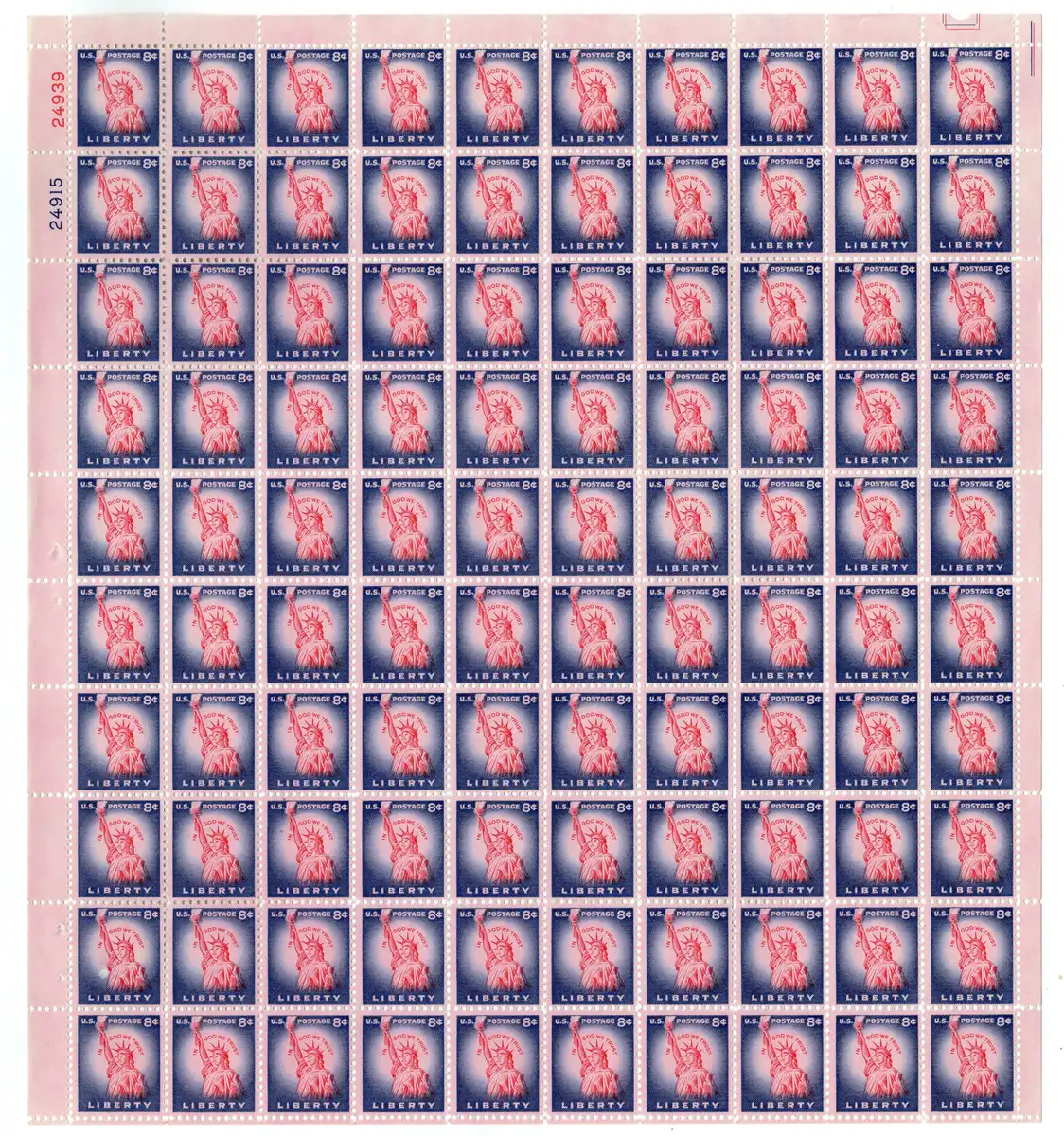
Scott 1041 was printed on a flat-plate press in two passes: blue first and carmine separately. My best guess is that the complete hole originally fitted over some kind of locating pin when the sheet went through for the second color. That would help put the sheet back in the same position so the red Statue of Liberty lined up with the blue background. The blue and red U-shaped outlines may have marked the location of that hole and also made it easier to check the alignment. When the sheet was later cut mechanically, part of the hole may have been cut away, leaving the semicircular notch we see now.
The longer blue and red lines are easier to explain. The Smithsonian has an uncut 400-stamp blue plate proof here:
https://postalmuseum.si.edu/object/...242263.16199You can see blue guide lines at the center of the sheet margins. I also found carmine plate proofs with the same type of lines in red. Since the finished stamps went through both color printings, both lines appeared on the final press sheet. When the 400-stamp sheet was cut into four panes of 100, parts of those lines remained in the selvage. That seems to explain the parallel blue and red lines on this pane.
I also wondered whether the hole was used when the stamps were perforated. After reading about the BEP's equipment, I'm less convinced of that. By 1954, the perforating machine normally used an electric eye to read printed marks in the sheet margins and automatically adjust the sheet's position. It apparently didn't need a locating pin through a hole.
So, at this point, I think the notch is more likely connected with registering the two color printings, handling the sheet, or cutting it into panes. I still haven't found any BEP source that identifies this exact U-shaped mark and notch, though, so this is only my theory so far.



 Replies: 3 / Views: 121

 Posted Yesterday 6:31 pm