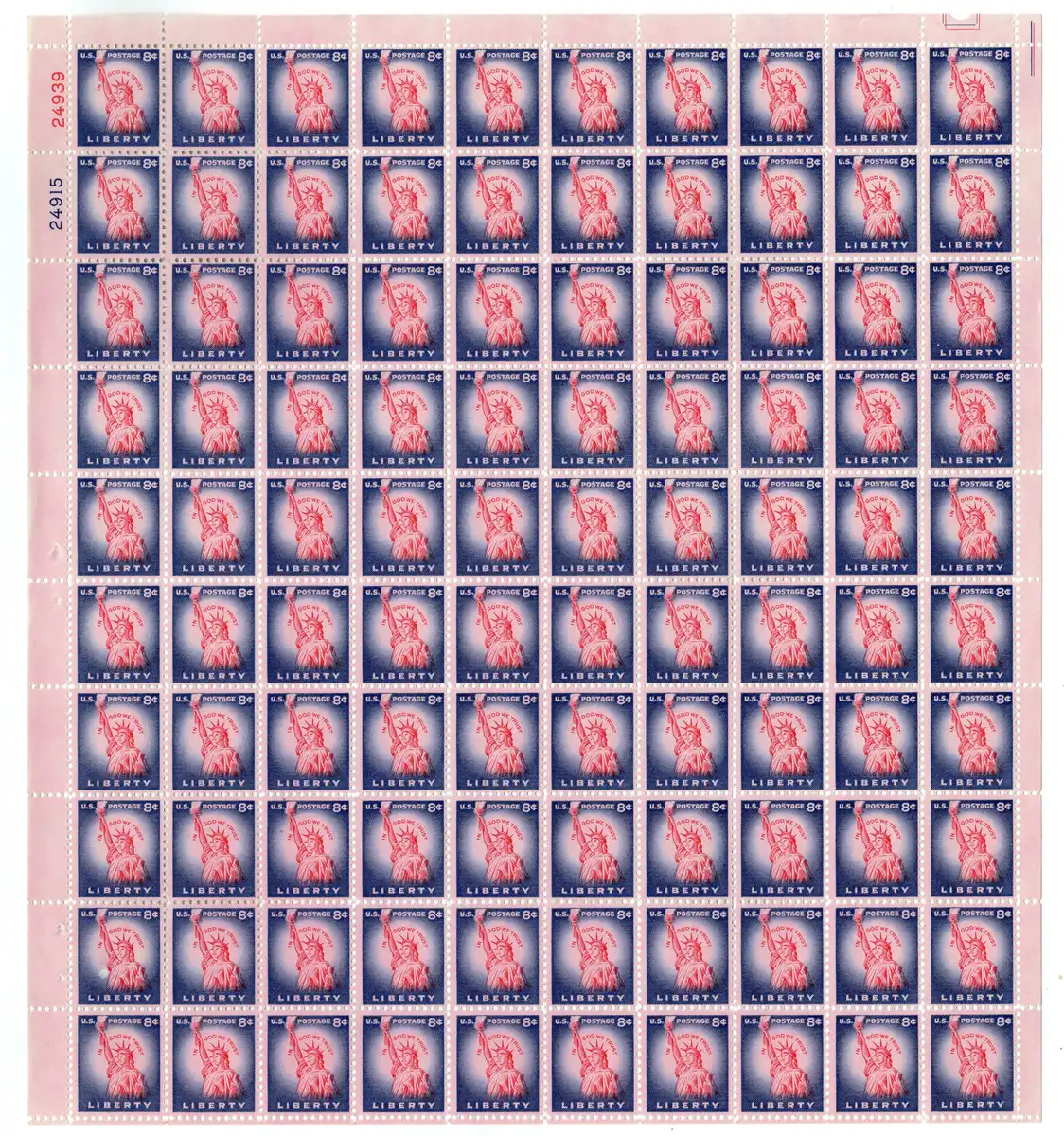
I kept looking and found another example that seems to explain what physically happened here.
This Smithsonian certified proof of the one-color 1956 $5 Hamilton has a complete small square in the same position, but no hole:
https://postalmuseum.si.edu/object/...0.283370.668Now compare it with this finished upper-right Hamilton pane. It has a round punch centered in that square, and the top-edge trimming passed through both the hole and the square:
https://kelleherstampassets.s3.us-e.../1010661.jpgThat leaves exactly what we see on the 1041 pane: a semicircular notch with the lower three sides of the box forming a U. It appears to be an intentional printed target for a production punch, which was normally supposed to be trimmed away.
The same complete square also appears on this Smithsonian proof of the one-color $1 Wilson:
https://postalmuseum.si.edu/object/....242263.2878Since the Hamilton and Wilson stamps were printed in only one color, the punch could not have been intended only to register the second color or prevent it from being inverted. On the 1041, however, the separate blue and carmine outlines could still provide a quick visual check that the two impressions were aligned at that point.
My best guess is that the hole was an indexing or orientation point used during some later production operation. A hole in one particular location could keep a sheet, or a pile of sheets, facing the correct direction and perhaps fit over a pin or against a fixture during handling, perforating, or trimming. I researched the electric-eye perforator, and it registered the perforations by reading printed marginal dashes, not by reading a physical hole, so I cannot say that this hole was specifically for perforating. What I still have not found is a BEP document naming the mark or identifying the exact machine or production step that used the hole.



 Replies: 8 / Views: 230

 Posted 08/23/2026 6:31 pm