Stamp Community Family of Web Sites
Thousands of stamps, consistently graded, competitively priced and hundreds of in-depth blog posts to read


Stamp Community Forum
 
Username:
Password:
Save Password
Forgot your Password?

This page may contain links that result in small commissions to keep this free site up and running.

Welcome Guest! Registering and/or logging in will remove the anchor (bottom) ads. It's Free!

1041 Sheet - Markings At Top

 
To participate in the forum you must log in or register.
Author Replies: 12 / Views: 327Next Topic  
Valued Member
United States
123 Posts
Posted 08/23/2026   6:31 pm  Show Profile Bookmark this topic Add serf_tide to your friends list Get a Link to this Message
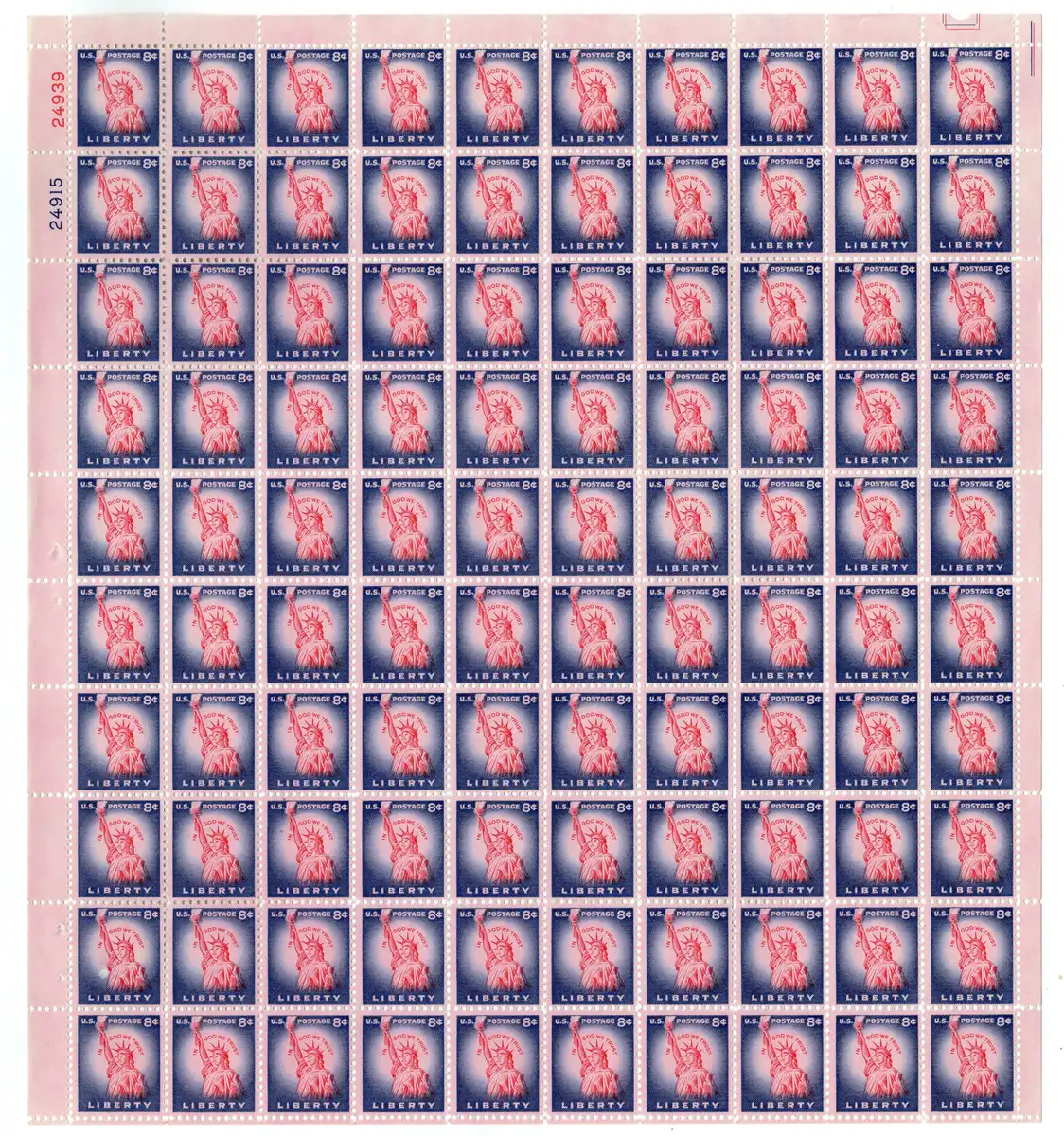
I have this full sheet of 1041 Liberty Flat Plate. It has these little boxes and a notch in the UR corner. It does not look like the notch is accidental/damage. Does anyone know what these are for? Thank you.
Send note to Staff

Bedrock Of The Community
12665 Posts
Posted 08/23/2026   6:46 pm  Show Profile Bookmark this reply Add rogdcam to your friends list  Get a Link to this Reply
Look forward to a complete answer from someone who knows but it looks to me like a color registration feature.
Send note to Staff  Go to Top of Page
Valued Member
48 Posts
Posted Yesterday   3:56 pm  Show Profile Bookmark this reply Add sochummy to your friends list  Get a Link to this Reply
Scott 1041 was printed on a flat-plate press in two passes: blue first and carmine separately. My best guess is that the complete hole originally fitted over some kind of locating pin when the sheet went through for the second color. That would help put the sheet back in the same position so the red Statue of Liberty lined up with the blue background. The blue and red U-shaped outlines may have marked the location of that hole and also made it easier to check the alignment. When the sheet was later cut mechanically, part of the hole may have been cut away, leaving the semicircular notch we see now.

The longer blue and red lines are easier to explain. The Smithsonian has an uncut 400-stamp blue plate proof here:

https://postalmuseum.si.edu/object/...242263.16199

You can see blue guide lines at the center of the sheet margins. I also found carmine plate proofs with the same type of lines in red. Since the finished stamps went through both color printings, both lines appeared on the final press sheet. When the 400-stamp sheet was cut into four panes of 100, parts of those lines remained in the selvage. That seems to explain the parallel blue and red lines on this pane.

I also wondered whether the hole was used when the stamps were perforated. After reading about the BEP's equipment, I'm less convinced of that. By 1954, the perforating machine normally used an electric eye to read printed marks in the sheet margins and automatically adjust the sheet's position. It apparently didn't need a locating pin through a hole.

So, at this point, I think the notch is more likely connected with registering the two color printings, handling the sheet, or cutting it into panes. I still haven't found any BEP source that identifies this exact U-shaped mark and notch, though, so this is only my theory so far.
Send note to Staff  Go to Top of Page
Bedrock Of The Community
12665 Posts
Posted Yesterday   4:01 pm  Show Profile Bookmark this reply Add rogdcam to your friends list  Get a Link to this Reply
Sounds good to me!
Send note to Staff  Go to Top of Page
Bedrock Of The Community
United States
10775 Posts
Posted Yesterday   4:36 pm  Show Profile Bookmark this reply Add revcollector to your friends list  Get a Link to this Reply
The lines are clearly color registration marks. I do not recall ever seeing a notch on any panes; screw heads printed, but not notches or holes such as this one.
Send note to Staff  Go to Top of Page
Pillar Of The Community
United States
4158 Posts
Posted Yesterday   7:17 pm  Show Profile Check eyeonwall's eBay Listings Bookmark this reply Add eyeonwall to your friends list  Get a Link to this Reply
Might have also insured the 2nd color wasn't inverted.
Send note to Staff  Go to Top of Page
Bedrock Of The Community
United States
10775 Posts
Posted Yesterday   7:47 pm  Show Profile Bookmark this reply Add revcollector to your friends list  Get a Link to this Reply
It's possible that it was there for that reason. This is the top left pane of the sheet, so there was nothing above it.
Send note to Staff  Go to Top of Page
Pillar Of The Community
United States
4394 Posts
Posted Yesterday   8:18 pm  Show Profile Bookmark this reply Add Parcelpostguy to your friends list  Get a Link to this Reply
The one show is three plate numbers after the reference proof. The three sided rectangle lines were not part of blue plate #24912. The vertical lines and the horizontal lines were used for color registration. The fact the boxes appeared later and contain, at least here, a notch does not seem related to later printing related efforts. I like the inversion prevention idea.

The OP's pane is miscut upward a bit. The notch and perhaps the boxes would have been removed if the cutting was properly registered.

The Marginal Markings Committee of The United States Stamp Society may have an answer.
https://www.usstamps.org/committees/
Send note to Staff  Go to Top of Page
Valued Member
48 Posts
Posted Today  9 Hrs 23 Min ago  Show Profile Bookmark this reply Add sochummy to your friends list  Get a Link to this Reply
I kept looking and found another example that seems to explain what physically happened here.

This Smithsonian certified proof of the one-color 1956 $5 Hamilton has a complete small square in the same position, but no hole:

https://postalmuseum.si.edu/object/...0.283370.668

Now compare it with this finished upper-right Hamilton pane. It has a round punch centered in that square, and the top-edge trimming passed through both the hole and the square:

https://kelleherstampassets.s3.us-e.../1010661.jpg

That leaves exactly what we see on the 1041 pane: a semicircular notch with the lower three sides of the box forming a U. It appears to be an intentional printed target for a production punch, which was normally supposed to be trimmed away.

The same complete square also appears on this Smithsonian proof of the one-color $1 Wilson:

https://postalmuseum.si.edu/object/....242263.2878

Since the Hamilton and Wilson stamps were printed in only one color, the punch could not have been intended only to register the second color or prevent it from being inverted. On the 1041, however, the separate blue and carmine outlines could still provide a quick visual check that the two impressions were aligned at that point.

My best guess is that the hole was an indexing or orientation point used during some later production operation. A hole in one particular location could keep a sheet, or a pile of sheets, facing the correct direction and perhaps fit over a pin or against a fixture during handling, perforating, or trimming. I researched the electric-eye perforator, and it registered the perforations by reading printed marginal dashes, not by reading a physical hole, so I cannot say that this hole was specifically for perforating. What I still have not found is a BEP document naming the mark or identifying the exact machine or production step that used the hole.
Send note to Staff  Go to Top of Page
Bedrock Of The Community
United States
10775 Posts
Posted Today  4 Hrs 34 Min ago  Show Profile Bookmark this reply Add revcollector to your friends list  Get a Link to this Reply
The Wilson proof is just a vignette proof for a bicolor stamp. So the idea of preventing inverted centers still holds. Once it was created for that purpose, it would have applied to all printings regardless of color. Every sheet of paper would have to conform to the plate pattern.
Send note to Staff  Go to Top of Page
Bedrock Of The Community
United States
10775 Posts
Posted Today  4 Hrs 31 Min ago  Show Profile Bookmark this reply Add revcollector to your friends list  Get a Link to this Reply
The upper right corner of many flat plate sheets was cut at an angle for the same reason. The plate was designed that way so that the paper could only fit in one direction.
Send note to Staff  Go to Top of Page
Valued Member
United States
123 Posts
Posted Today  1 Hr 32 Min ago  Show Profile Bookmark this reply Add serf_tide to your friends list  Get a Link to this Reply
Nice research.
Send note to Staff  Go to Top of Page
Valued Member
48 Posts
Posted Today  12 Min ago  Show Profile Bookmark this reply Add sochummy to your friends list  Get a Link to this Reply
Good catch on the Wilson proof; you are right that it is bicolor, so I should not have used it as a one-color example. The single-color $5 Hamilton still has the same boxed-hole arrangement:

https://postalmuseum.si.edu/object/...0.283370.668

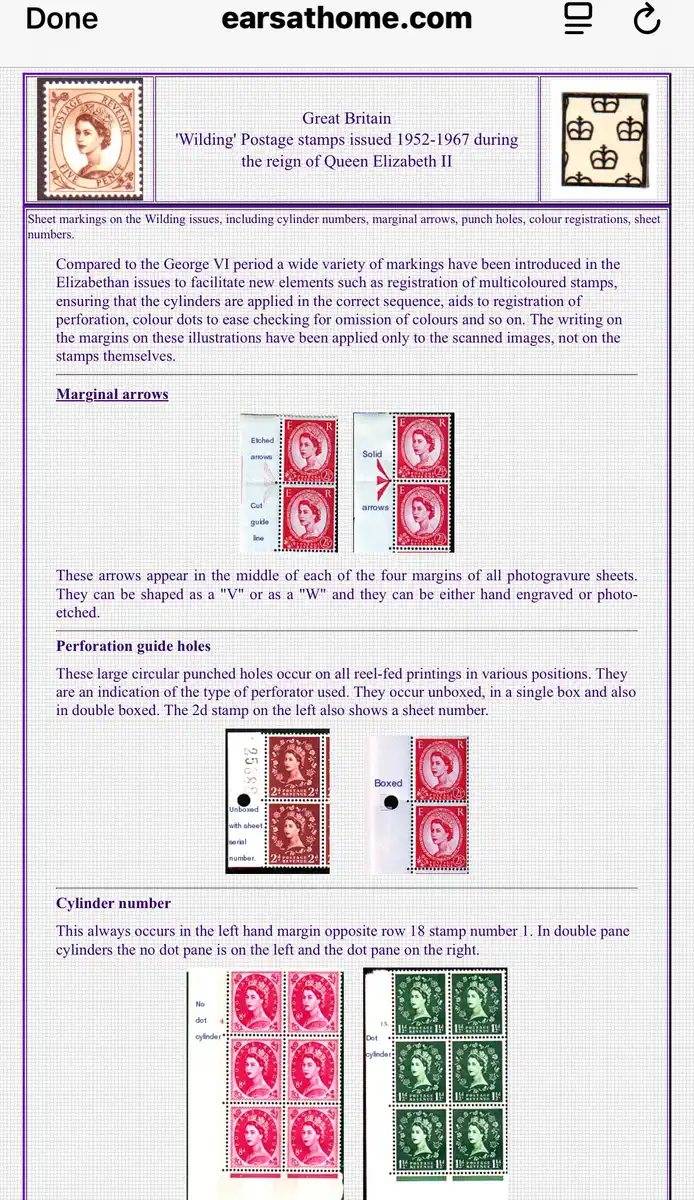
I also found similar boxed holes on contemporary British sheets, where they are specifically called "perforation guide holes":


(uploaded the screenshot since I wasn't allowed to insert the link to this website for some reason)

This article describes sheets being pierced and then placed over matching register pins on perforating equipment:

https://www.les-wilkinson.co.uk/article12.shtml

That fits the indexing/orientation idea well. My best guess remains that it was a keyed production point for keeping the sheet properly oriented during handling or finishing.
Send note to Staff  Go to Top of Page
  Replies: 12 / Views: 327Next Topic  
 
To participate in the forum you must log in or register.

Go to Top of Page

Disclaimer: While a tremendous amount of effort goes into ensuring the accuracy of the information contained in this site, Stamp Community assumes no liability for errors. Copyright 2005 - 2026 Stamp Community Family - All rights reserved worldwide. Use of any images or content on this website without prior written permission of Stamp Community or the original lender is strictly prohibited.
Privacy Policy / Terms of Use    Advertise Here
Stamp Community Forum © 2007 - 2026 Stamp Community Forums
It took 0.2 seconds to lick this stamp. Powered By: Snitz Forums 2000 Version 3.4.05