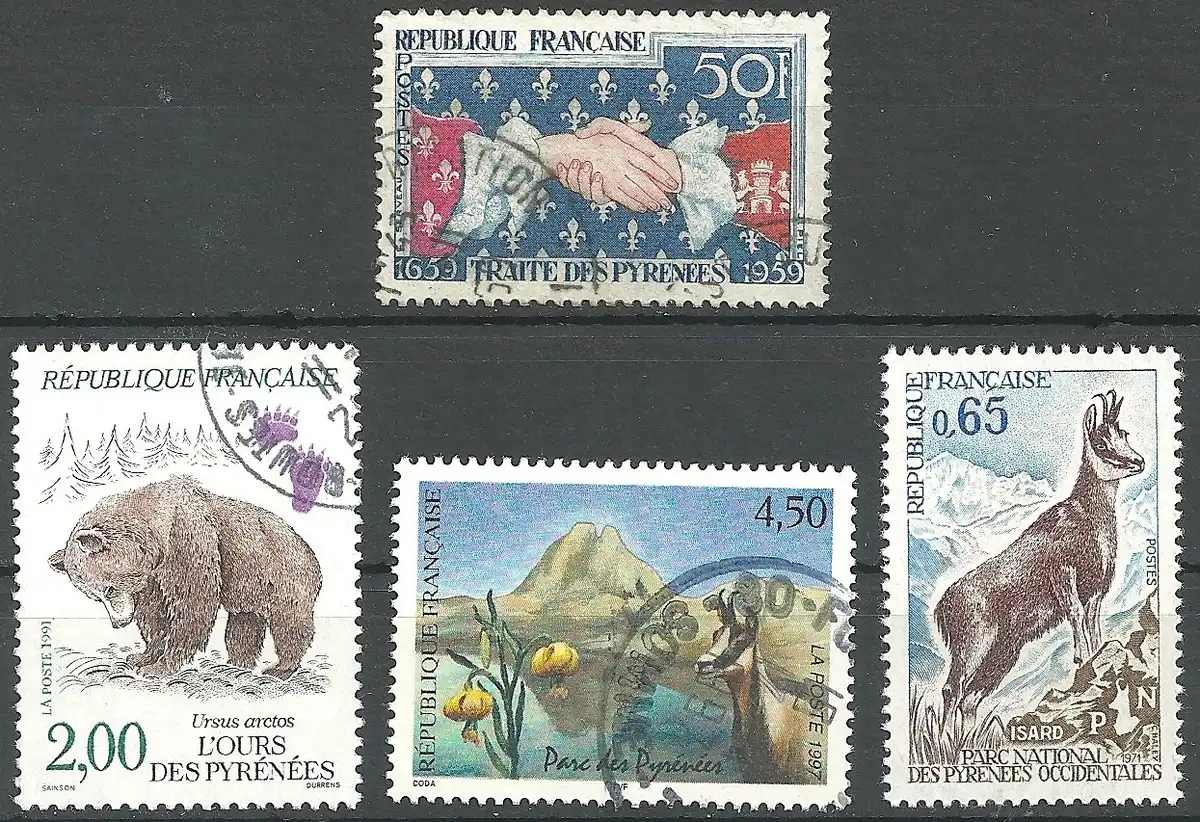
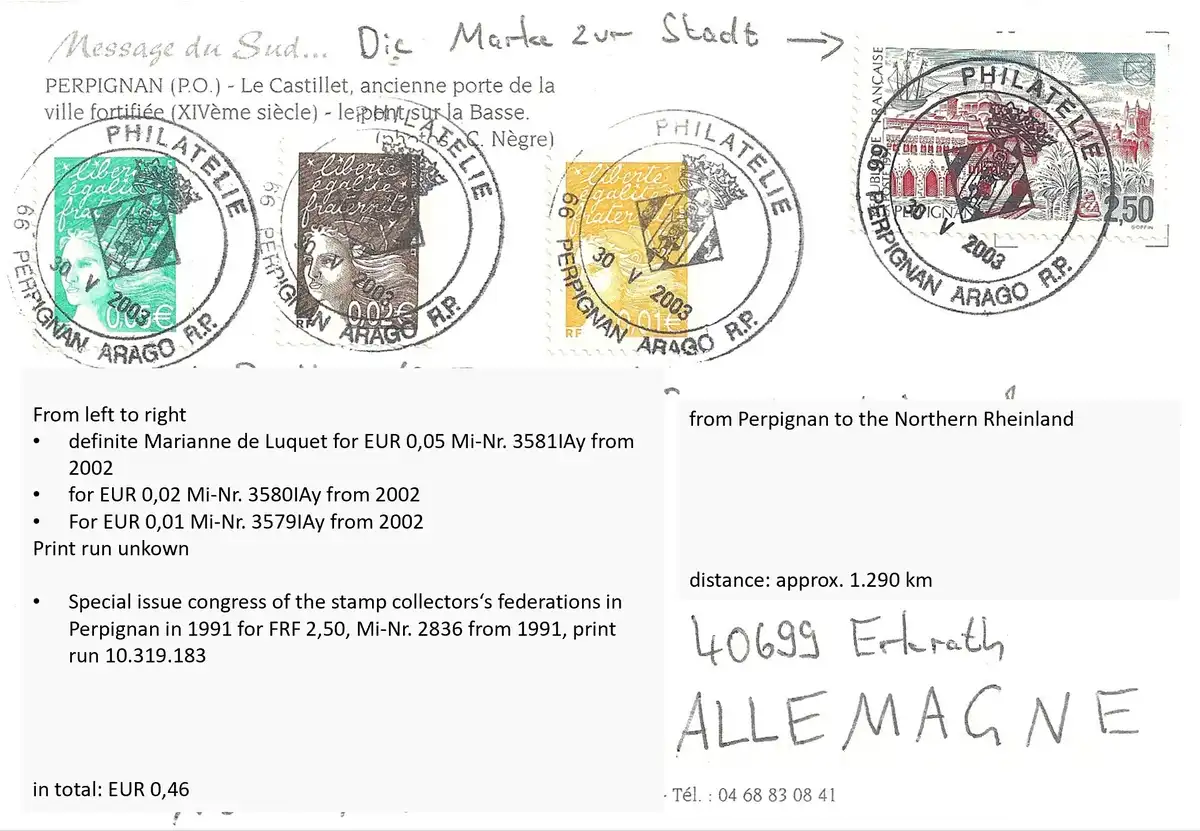
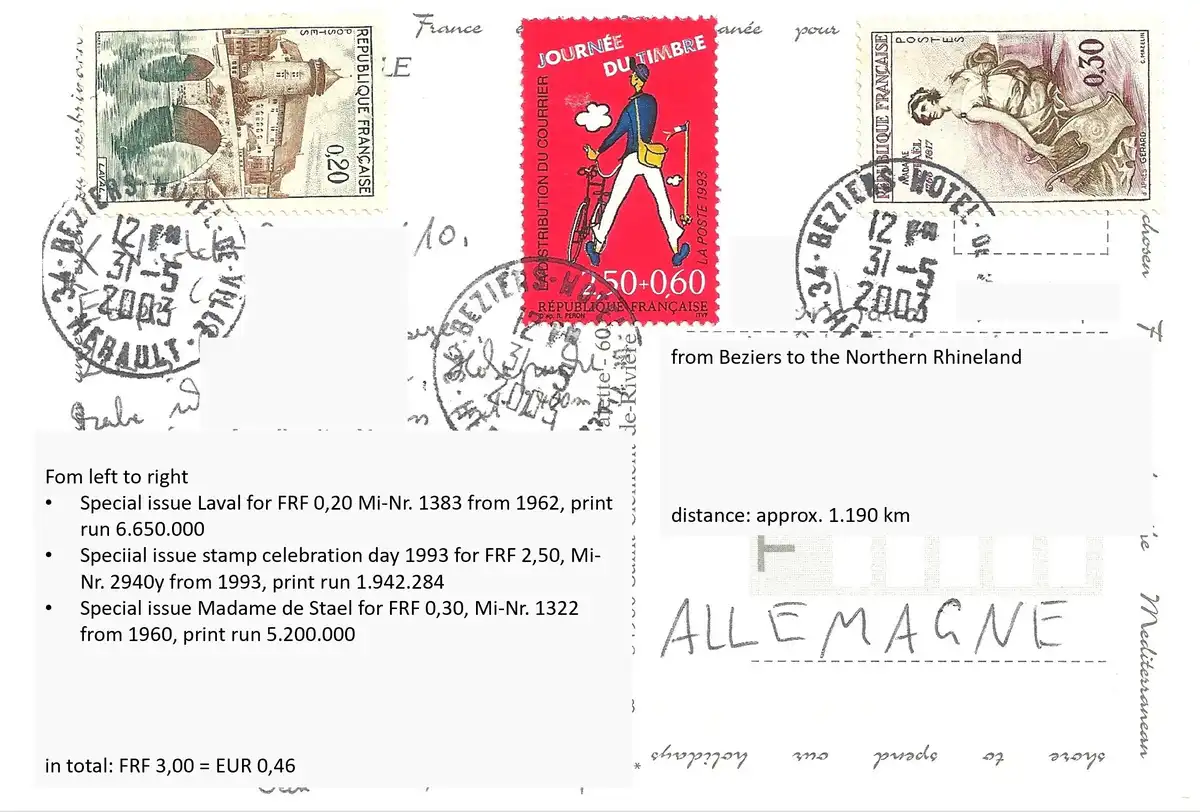
It was still time to the end of my holidays, thus I could shorten the distance to my dwelling cave in no hurry. Why not take some time to explore the mediterranean coast at a leisurely pace.
And that is a contrast, as after summits in high-altitude mountains one finds oneself in an all in all preponderantly plane region, predominated by salt marshes. For once, it was neither warm or cold at times, but only warm all the time. But travelling is looking for such contrasts and triggers for the traveller the necessity to adapt. If done successfully, this is proof of an ability to cope with life, flexibility and vigour.
It is about 100 km until we arrive in the town Béziers, which I had the opportunity to visit during childhood days with the family years ago.
I arrived on a Friday evening and the town was quite humming. The evening commenced for the folk with a round promenade (in anticlockwise direction) through the Parque de Évèques. To see and be seen. What fun to look what's going on and who is presenting himself. I remember quite well the impression of a young woman with her predecessor's roots in the Congo, I'd say—tall, athletic, self-assured, and graceful. That's how it is in France: there are many people with roots in France's former colonial empire, and that was so different from what Germany was like at that time.
But there were more important things to do the next morning, that is to visit the nearby post office (in the vicinity of the town hall). I expected the local special handstamp there. As it was, it was rather busy there, as apparently a lot of pensioneers were present to withdraw their pension which must have become due that very day. However, I had to wait quite a long time. Alas, when it was my turn, I got informed that the local special handstamp was not to be found there, as I was in the wrong post office, mine was not the main one. To get to the right venue would have meant to make my way through the town with the danger to end up in another long queue, which I didn't fancy (though it was a pity, and the level of my regret, you may derive from the fact that I can remember the event to the present day).
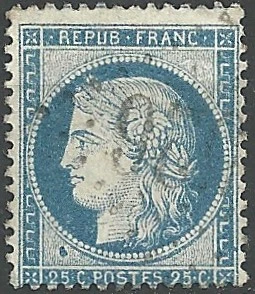
And hadn't I had promised lassies? Well, I have – and so I show you today for the quote of historic material the issue "Peace and Trade", also known as type Sage (which is the name of the Stamps's designer). Here we see on the left a woman holding an olive branch representing the peace and on the right to me as man of commerce an important god, namely Hermes. All this in front of a globe.
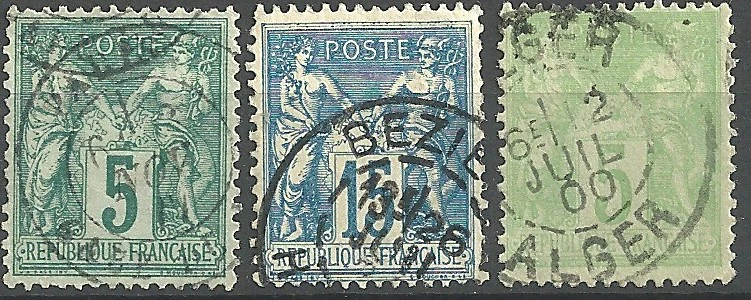
This definite issue was in use from 1876 to 1900. So, it seems that with the nudity of Madam Peace the French apparently hadn't had any problem.
When it comes to this issue I find it beautiful that the stamps have been printed on matching coloured paper. As to the obliterations I chose in respect of my sojourn a postmark on the 15 centimes-stamp being one of the town Beziers. On the issue shown on the right I find the town name of Algiers worth to point to (as until 1920 Algerians used French stamps. Algeria was reckoned to be a part of France itself for decades, not to be a colony).
As I myself being a merchant, I always love when money and goods circulate, and this around the world. At the time one could mail one's business letters with this divine protection on it. Marvelous! I would love to see my mail expedited with such stamps put on the items. But wait, mint stamps of that issue would still be valid for postage until this very day, but inflation makes any reasonable use of these stamps impossible, though it not prohibits it
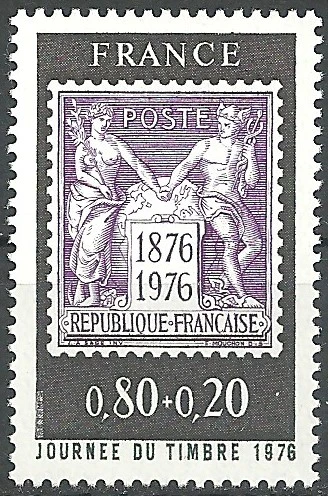
But philatelists of the present are still able to claw back on the special issue to commemorate the 100. Anniversary of the release of the original issue.
And now to the voyage
 above:
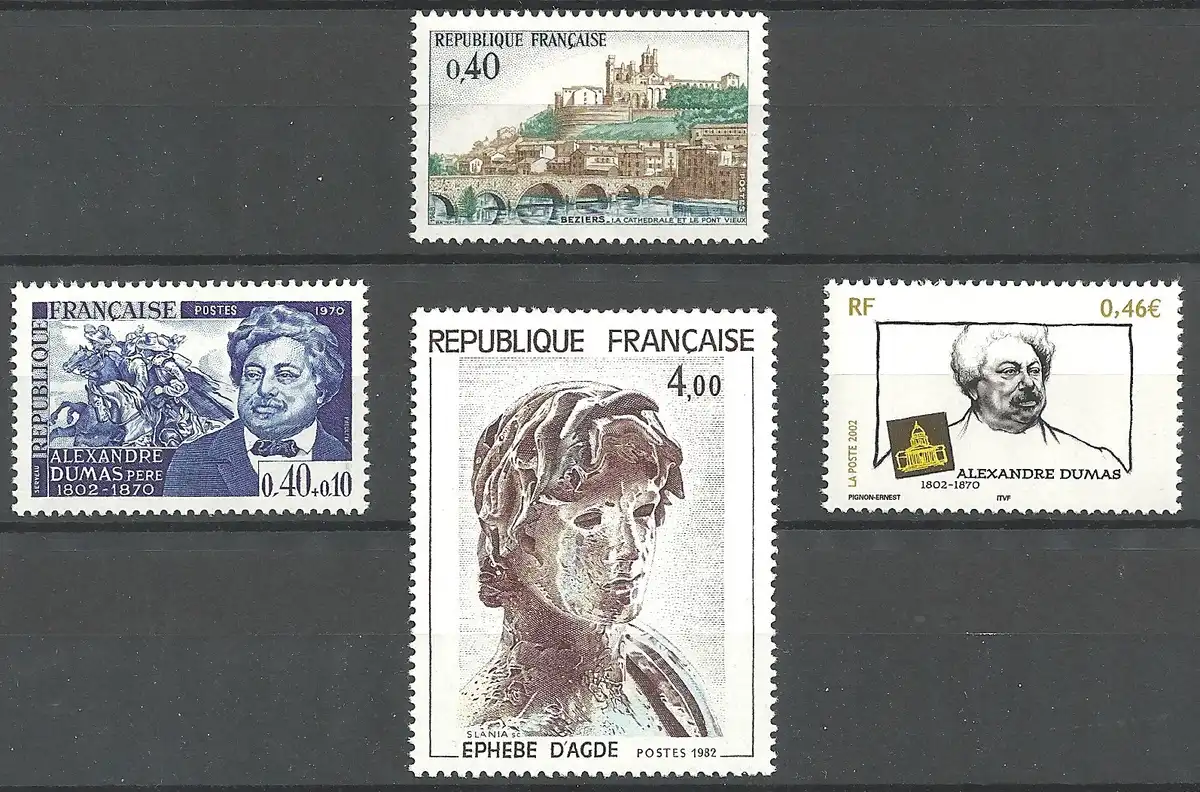
 astoundingly beautifully itched stamp displaying the cathedral of Béziers (where the people chose to promenade as described)
middle: accompanied me in French: Alexandre Dumas' Count of Monte Christo. Everyone knows the plot, thus excellently qualifying for training in vocabular. Again and again good to read. Men do love stories of vengeance. I prefer the stamp from 1970 to the design of the 2002 issue.
below: We say goodbye to Béziers and drive further on to the east, along the coast. There lies the city of Agde. When after the trip, I now and then reported of the stations of my travel, I named the village and remarked that the mood of one listener peculiarly lifted. Well, the reason for that is– and I had to read that fact up – that Agde is famous for his nude beaches and a certain Sex-Club-Scene throughout the country. Now, I knew the town from the map and from a stamp issue. And that issue shows the young man from Agde, one in the 1960ies in the bed of the Herault river found Hellenic figure of brass (which doesn't show a swinger, but it is said to display Alexander the Great). The statue is likely to be used as a light holder in a roman nobleman's house).
The stamp itself I acquired myself in 1983 from my personal allowance at the counters of a post office during a holiday in France, for FRF 4,00 – a by the time enormous amount of money for me. So, for 43 years in my possession, and that is why the stamp alone could be regarded to be an antiquity. And who itched this beautiful work of art? No one less than the famous Czeslaw Slania. Since 1961 until this day the French postal administration issues in this specific format stamps displaying pieces of art, always in the top price bracket of postage.
Remarkable in design and effectuation, and it is my pleasure to be able to point that out today to the interested public.



 Replies: 77 / Views: 12,214

 Posted 08/16/2026 01:15 am