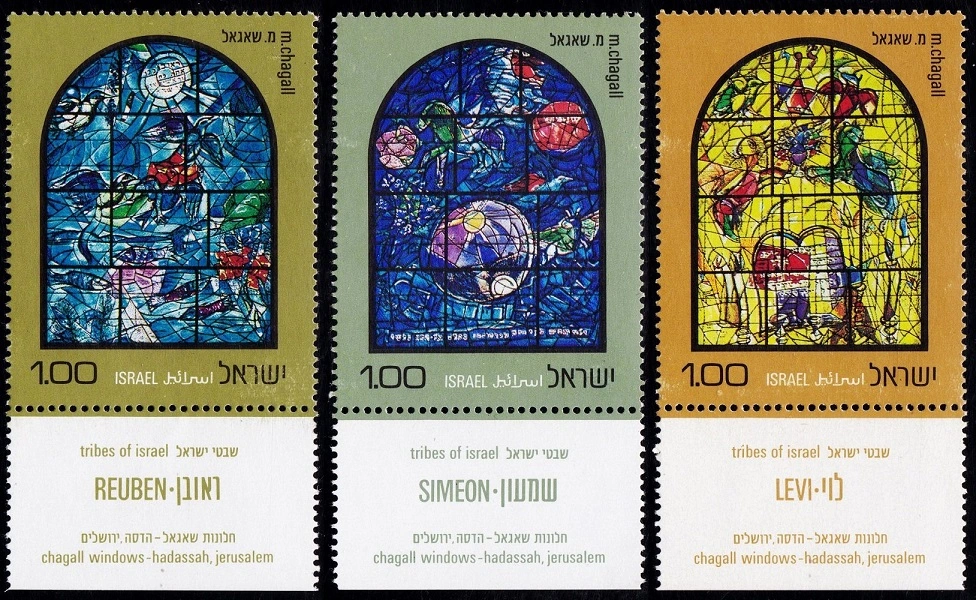
The Chagall Windows are a celebrated series of twelve stained-glass windows created by the Russian-French Jewish artist Marc Chagall for the synagogue of the Hadassah Hospital in Jerusalem. Unveiled in 1962, the windows represent the Twelve Tribes of Israel, with each window devoted to one of the sons of Jacob and inspired by the biblical blessings of Jacob and Moses. Rather than portraying human figures, Chagall filled the windows with symbolic animals, plants, ritual objects, and other biblical imagery, using intense blues, reds, yellows, and greens to create a luminous spiritual atmosphere. The windows were produced in collaboration with the master glassmaker Charles Marq at the Atelier Simon-Marq in Reims, France, and are regarded as one of Chagall's most important monumental works.
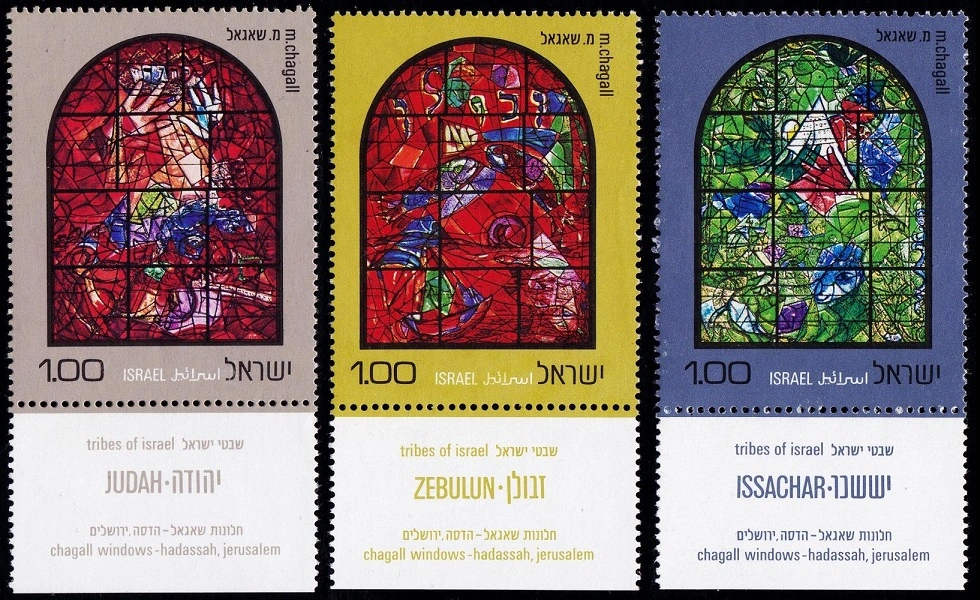
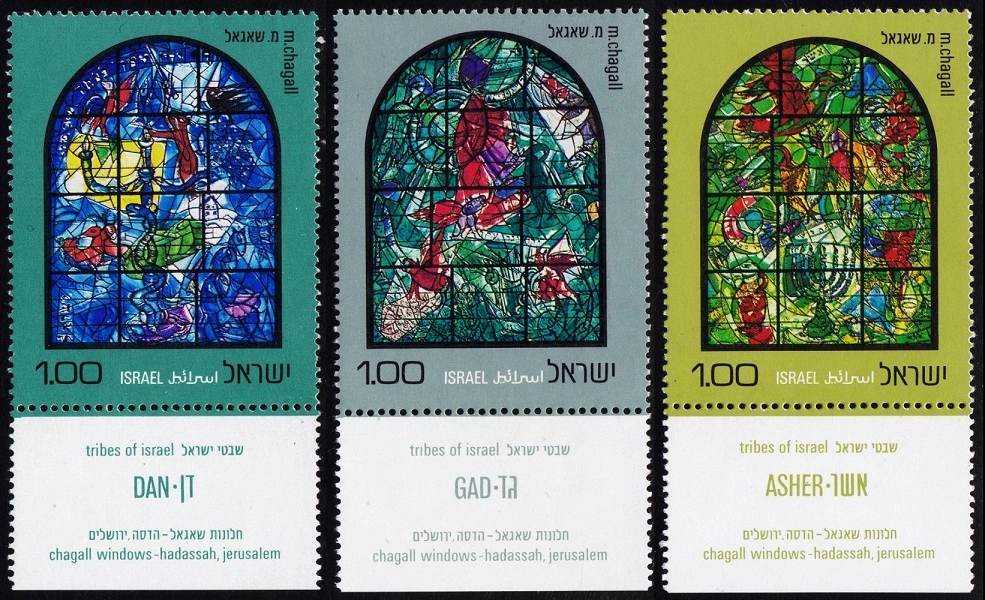
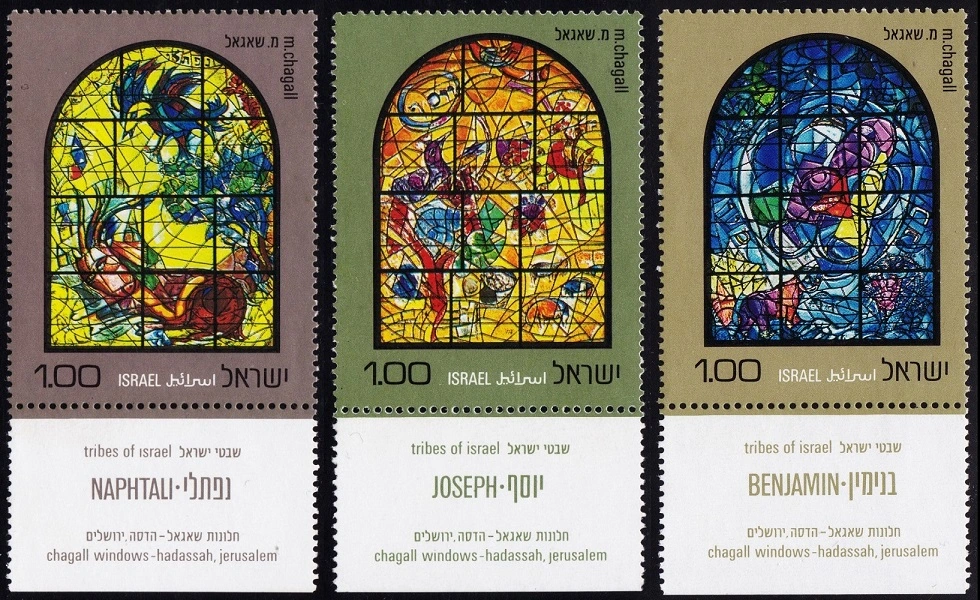
Israel issued during 1973 a set of the 12 windows. Here they are with description of the symbolism of each one.
Reuben – The turbulent waters, fish, and mandrake-like forms evoke Reuben's unstable character and Jacob's description of him as "unstable as water."
Simeon – Weapons, animals, and agitated forms suggest the violence associated with Simeon and Levi in Jacob's blessing.
Levi – The menorah, tablets, and priestly imagery symbolize the tribe of Levi's sacred role in worship and service in the Temple.
Judah – The lion and royal imagery symbolize Judah as the tribe of kingship, strength, and leadership from which the Davidic dynasty emerged.
Zebulun – Ships, fish, and maritime motifs reflect Jacob's blessing that Zebulun would dwell by the seashore and be associated with trade.
Issachar – Agricultural imagery and the strong donkey symbolize Issachar as a hardworking tribe connected with fertile land and labor.
Dan – The serpent and scales of justice refer to Jacob's words that Dan would "judge his people" and be "a serpent by the way."
Gad – Martial and animal imagery recalls Jacob's blessing that Gad would be attacked by raiders but would ultimately overcome them.
Asher – Olive branches, fruit, and abundant vegetation symbolize fertility, richness, and the "royal delicacies" promised to Asher.
Naphtali – The leaping deer and flowing forms reflect Jacob's image of Naphtali as "a hind let loose," symbolizing freedom, speed, and grace.
Joseph – Fruitful branches, animals, and abundant natural imagery symbolize Joseph as a "fruitful bough" blessed with prosperity and fertility.
Benjamin – The wolf and dynamic forms refer to Jacob's description of Benjamin as "a ravenous wolf," symbolizing courage and warrior strength.



 Replies: 109 / Views: 14,405

 Posted 07/04/2026 3:28 pm