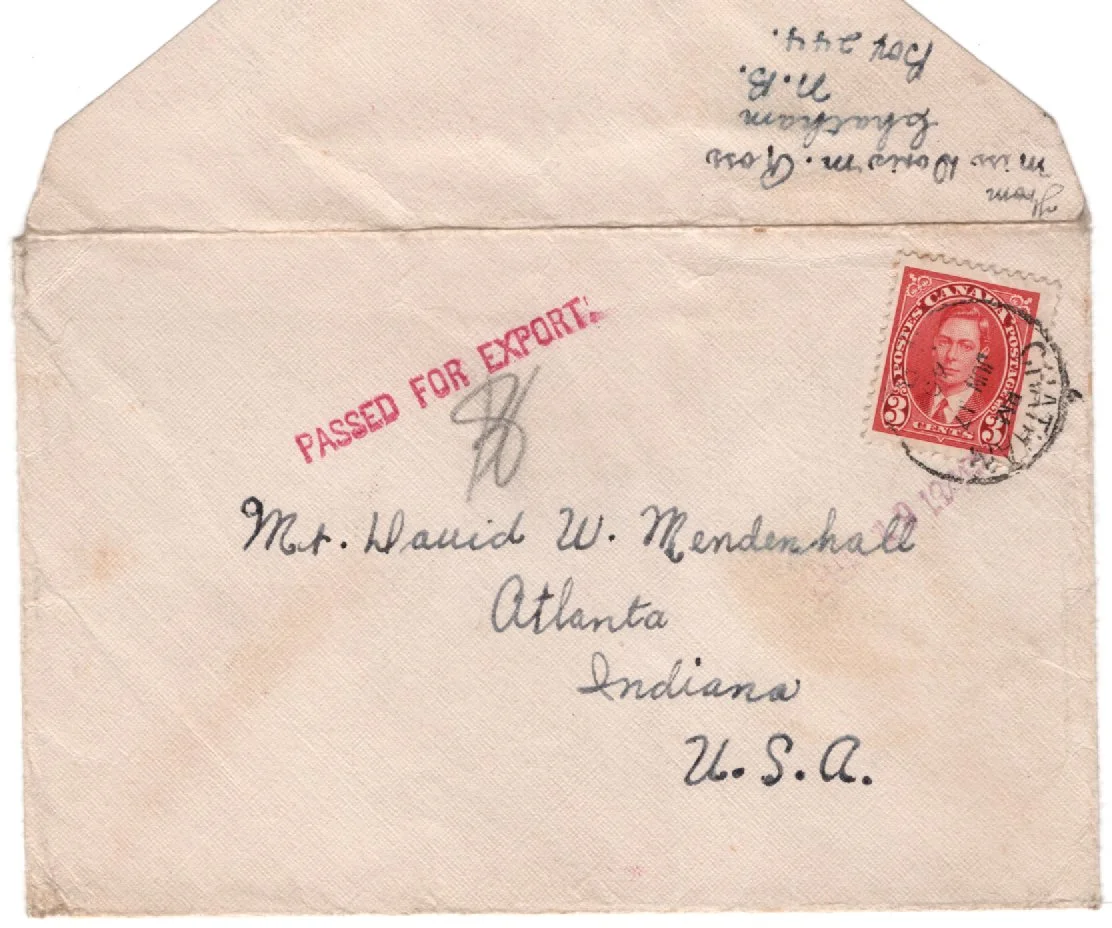
All of the documents I saw only mentioned postcards. Apologies if it appears otherwise in my response.
Value to the censors were not what we consider items of value. What the censor was required to do was review the text written on the post card. They would be looking info such as shipping, weather, sentiment, and other info that the government would see as potentially valuable to the enemy.
The documented procedures made no mention of other valuables they only were concerning postcards.
I have been collecting Canada WW2 for some time now. The PASSED FOR EXPORT and CENSOR markings are two different aspects of war time Canadian philately.
Censorship was control the dissemination of sensitive information. . In very general terms it was applied to all items to and from Canada not to domestic mail inside Canada. It is interesting that in the 1945 Newfoundland had not joined the Confederation and for censorship considerations was treated as a foreign country.
Again in very general the PASSED FOR EXPORT handstamps arose from the Foreign Exchange Currency Control regulations which were a completely separate set of rules designed, as the name suggests, to control the flow of currency out of Canada. These complex regulations were controlled by the Foreign Exchange Control Board.
In simple terms this meant the local postmasters had to check mail going out of Canada to ensure that it complied with the FECB regulations. It was the postmasters that applied the PASSED FOR EXPORT handstamps. They are not connected with censorship. In my original post I had assumed that LC was the postmasters initials as some did have their own handstamps. I had not thought about Letters of Credit. This was the first handstamp I have ever seen which included the LC and the only reference book I have for the FECB does not show any examples I can find.
Both are complex subjects with many facets to collecting them.
If I may offer an alternate explanation, the postmaster (by order of the Foreign Exchange Control Board) was required to ensure mailed items met the criteria for export, and initial same, from 1939 to 1951.
Setting aside the AI debate for the moment in favour of old fashioned detective work and surmise:
I think the strike of the handstamp is incomplete. D. L. C.(ameron) was the postmaster at Fredericton NB at this time (from Archives Canada). I expect that, Fredericton being a much larger post office, the PM had a handstamp made and that this is where the letter was cleared. A smaller post office would just handwrite "Passed for Export" and initial it. Note that Frederiction appears to be the origin P.O. anyway, regardless who the sender was or where she/he resided.
Mr. Becker's contribution is helpful to demonstrate the requirement of initials signifying personal responsibility for inspection. Obviously I doubt the Letter of Credit theory. P.S. Please post a full scan of the cover in the future, also backside if there are useful postmarks.
Disclaimer: While a tremendous amount of effort goes into ensuring the accuracy of the information contained in this site, Stamp Community assumes no liability for errors. Copyright 2005 - 2026 Stamp Community Family - All rights reserved worldwide. Use of any images or content on this website without prior written permission of Stamp Community or the original lender is strictly prohibited. Privacy Policy / Terms of UseAdvertise Here



 Replies: 23 / Views: 765
 Posted Yesterday 12:44 am


 And I add that there is no need to ask for a PM's name as that assumption was also off base.